Tess Lawrence is a professional journalist who, in our experience, is of unimpeachable integrity, high character and great goodness of heart.
And so we are saddened to report that Independent Australia’s contributing editor-at-large has recently been declared bankrupt for debts she claims she does not owe — after having being forced, due to financial hardship, to represent herself in court. In a sworn Affidavit, which the Victorian Supreme Court appears to have entirely ignored, and that we include in the following piece, Lawrence alleges that she was subjected to death threats in an interval in an earlier proceeding in the Melbourne Magistrates’ Court by an opposing solicitor in an effort to procure her to change her sworn testimony.
Medical diagnoses show that the trauma associated with these threats triggered a breakdown that, despite her having worked as a journalist in war-zones, and having been physically assaulted on several occasions in the course of professional duties, caused Lawrence to lose the mental and physical ability to represent herself. Despite this, the court decided to not take any of these matters into account and carried through with judgement against her even in her absence while she received treatment.
This case has gravely significant implications about the state of justice in Victoria. We urge you to read the story and express your support in the comments after the piece for the doughty and fearless Tess Lawrence as she continues to fight against her persecutors. Without our diligent efforts to redress the root causes of such injustice, what has happened to Tess Lawrence can, of course, at any time, happen to any one of us.
Victorian Justice: what happens outside Court stays outside Court
Journalist advocate Tess Lawrence has made a comprehensive statement to Victoria Police alleging death threats by a lawyer from influential legal firm McKean Park. Copies of the Police Statement have also been sent to the Attorney General of Victoria, Robert Clark and the Ombudsman.
Lawrence has worked intimately with the Bourke St legal firm on a number of high profile assignments, providing hundreds of hours of pro bono media services for her well-publicised 2009 campaign ‘The Choir of Hard Knockbacks ‘, when McKean Park represented a group of disaffected choir members of the award winning ABC TV documentary series ‘The Choir of Hard Knocks’.
McKean Park has bankrupted Tess Lawrence over an alleged debt that Lawrence denies owing them. The National Australia Bank later joined McKean Park as the sole creditor on the Bankruptcy Creditors Petition. Lawrence says she will be fighting the Bankruptcy Order.
Because of financial hardship, for three years the investigative journalist and specialist in ethical media services has been forced to represent herself in the Supreme Court in a multi-million dollar counterclaim against the National Australia Bank — who is suing her for alleged Default.
Lawrence’s counterclaim accuses the National Australia Bank of predatory, false and misleading representation and behaving in a fraudulent and unconscionable manner; using duplicitous and corrupt conduct, including the withholding of evidence and original documents from the Defendant’s own bank file; and using fabricated evidence — amongst other matters.
Pitted against a phalanx of NAB lawyers, Lawrence managed to get the matter to trial in the Supreme Court of Victoria, scheduled for September 26, 2011 — which she understands to be the first time in Victoria that a self-representing non-lawyer litigant has been successful in such an action.
However, before the trial, on May 9, 2011, in the Melbourne Magistrates’ Court, during an application for a re-hearing in the McKean Park Bankruptcy matter Lawrence alleges that she was accosted by a McKean Park lawyer, who screamed at her, harangued her and even made death threats in an effort to induce her to change her evidence and perjure herself.
In a sworn Affidavit prepared for an ill Lawrence by Phil Grano, from the Office of the Public Advocate, and presented to the Supreme Court in the National Australia Bank matter on 26 September 2011 (pg. 3), in an endeavour to seek an adjournment, Lawrence states the following:
‘….The Magistrate, Mr Braun, hearing the matter asked the solicitor appearing for McKean and Park, Richard Ashley, to request Tony Rogers (the senior partner) to attend the Court. The matter was then adjourned to seek Mr Rogers’ attendance. Outside the Court Richard Ashley verbally attacked me and abused me for causing the attendance of Mr Rogers. His language was intemperate and threatening with words to the effect “You’re dead” and “you fucking bitch”. “The NAB and I will take you down”. “You will have nothing, you will be destroyed”. He pointed at me when saying these things and I thought he was going to strike me. I felt incredibly intimidated and I did not leave the court premises during the adjournment. I vomited in the ladies’ toilet.
‘7. I was helped by the Court Network person. She gave me access to a telephone and I called a lawyer, Mr Ross Delahunty, to seek advice. He advised me to raise the matter immediately with the Magistrate after the Court resumed. I subsequently did this, but the Magistrate said he did not want to hear what happened outside the Court.’
[Open the full 49 page affidavit by clicking here.]
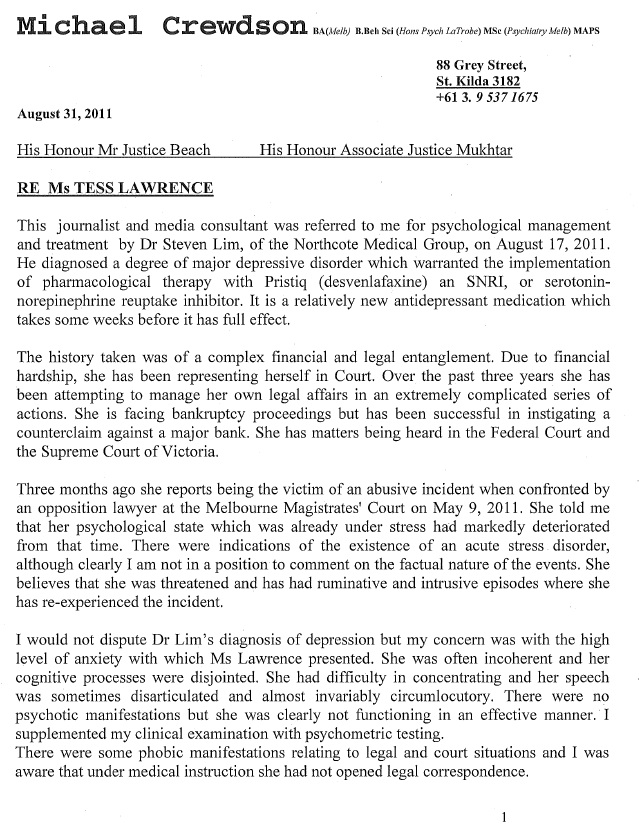
Lawrence says the attack sent her into a spiral of depression and despair, such that she became physically and mentally unable to represent herself. Her assertion is supported by numerous medical certificates provided in her affidavit, which state that the alleged threats and verbal abuse did indeed trigger in Lawrence severe “psychological distress” (note image below).
And according to a diagnosis tendered by eminent clinical psychologist and psychotherapist Michael Crewdson, senior lecturer and senior fellow of the School of Medicine at the University of Melbourne, Lawrence suffered severe Post Traumatic Stress Disorder (PTSD), immobilising the self-representing litigant who was certified incapable of handling her own legal affairs and was incapable of instructing lawyers.
In his written statement to the Court, Mr Crewdson makes the following diagnosis (note image below extract):
‘Three months ago she [Lawrence] reports being the victim of an abusive incident when confronted by an opposition lawyer at the Melbourne Magistrates’ Court on May 9, 2011. She told me that her psychological state which was already under stress had markedly deteriorated from that time. There were indications of the existence of an acute stress disorder, although clearly I am not in a position to comment on the factual nature of the events. She believes that she was threatened and has had ruminative and intrusive episodes where she has re-experienced the incident.
‘I would not dispute Dr Lim’s diagnosis of depression but my concern was with the high level of anxiety with which Ms Lawrence presented. She was often incoherent and her cognitive processes were disjointed. She had difficulty in concentrating and her speech was sometimes disarticulated and almost invariably circumlocutory. There were no psychotic manifestations but she was clearly not functioning in an effective manner. I supplemented my clinical examination with psychometric testing.’
A similar diagnosis to Crewdson’s was also submitted by another psychologist, Dr David List.
Despite this medical evidence being presented to the Court, the magistrate refused to grant an adjournment to allow her to seek treatment – or justice – insisting that the court action proceed even in Lawrence’s absence or distressed state — severely compromising her defence.
After the verbal assault in the Melbourne Magistrates Court on May 9, 2011, Lawrence says she was forced to stand, petrified with fear, next to her alleged assailant in Court as she tried to tell the Magistrate about what had happened just outside his Courtroom.
“Magistrate Braun dismissed my pleadings,” recalls Lawrence, “saying words to the effect that he was not concerned with what went on outside the Court and only interested in what went on inside his Court.”
Lawrence argues that if such threats to kill and trash property and attempts to coerce people to alter evidence and commit perjury, had been made to say, a magistrate or gangland figure, then an adjournment would have been granted, or imposed by the magistrate.
“The magistrate and the Judicial System has a duty of care to oversee the safety of self-representing litigants, women and all other people within the court, including employees,” she says.
“What has happened to me has happened to many others and highlights the inadequacies of the court system to assist protect the weak against the powerful.”
In an ironic twist, last year, Lawrence wrote to the Chief Magistrate Ian Gray after she witnessed an ugly punch-up take place on the ground-floor of the Supreme Courts. Lawrence, a specialist in crisis management communications, noticed that the fight played out with friends and family members eventually managing to restrain the warring parties — and that security staff did not intervene or even attend. After making enquiries, she discovered that the Supreme Court’s communications systems – for Judges, staff and citizens, including security staff – were totally inadequate and had major flaws. Lawrence says she wrote then to the Chief Magistrate out of concern for public safety in both the Supreme and Magistrates Court — and the courts system in general.
In her dealings in the Supreme and other Courts, Lawrence says that, at times, the hostility towards her as a self-representing litigant was palpable — with Magistrate Braun making statements to the effect that to grant her an application for a rehearing of the Bankruptcy matter would be tantamount to opening the floodgates to self-representing litigants.
Lawrence says she was ridiculed in Court by the NAB for her pre-existing stammer — and that her dyslexia was given emphasis by Magistrate Braun when he read out her Affidavit in Court, admonishing her for not having a lawyer. Lawrence recalls she told the magistrate that the last thing she wanted to do was to represent herself, but since the NAB would not release any funds from her property portfolio to allow her to pay for a legal team, Lawrence had none available to pay for lawyers.
Unfortunately, cases of judges treating self-representing litigants with such callous disrespect and neglect is far from rare— indeed, in a story published earlier this year, IA detailed an example of two Queensland judge showing a self-represented litigant – Jennifer Nash – with outright contempt. And in 2007, former judge Geoff Davies had a story in The Australian, where he said instances of litigant disrespect was rapidly increasing.
Indeed, towards the end of piece (‘National disciplinary power is needed to rule on overbearing judges’, 14/9/2007) Mr Davies said:
“… there has been a gradual decline in respect by the public for persons solely on the basis of their position or authority. Rightly, the litigating public will no longer tolerate ill-tempered, overbearing rudeness from judges. They are entitled to be treated fairly in court.”
Lawyers don’t want to take on ‘the top end of town’
Lawrence says she spoke to several lawyers who, although sympathetic, were not prepared to assist her defence against the NAB or McKean Park.
“A number of lawyers confided to me that they did not wish to take on ‘the top end of town’,” says Lawrence.
She says Legal Aid also were not interested in even meeting Lawrence because she “held property”.
And when she rang PILCH, (the Public Interest Law Clearing House), to whom the NAB is a generous donor, Lawrence says the PILCH representative was forthright — not even wishing to know any details about the merits of her case.
“He told me categorically: ‘we don’t take on anything to do with the NAB’,” says Lawrence.
David Krasnostein, the Group Corporate Counsel of the National Australia Bank Ltd, was chairman of the PILCH Board at that time.
Disturbing connections
There are a number of disturbing connections in the National Australia Bank versus Tess Lawrence case that, she asserts, have an interesting backdrop to the Melbourne legal and political establishment.
In the sworn Affidavit prepared by Phil Grano, Lawrence says the Law Institute of Victoria seized six boxes of her Trial documents from the office of Murumbeena solicitor Mr Ross Delahunty, the lawyer she phoned in distress after she was threatened.
From the affidavit (pg7):
19. Significant files of mine in relation to this proceeding were in the possession for safekeeping of the lawyer I contacted after the incident on the 9th of May 2011, Mr Ross Delahunty. Mr Delahunty has advised me that the Law Institute of Victoria seized these documents from a private filing cabinet. Mr Delahunty has complained against the Law Institute. The Law Institute has not returned the documents to me. In fact, it has engaged the firm of McKean and Park, a coincidence that I find disturbing. Now shown to me and marked TPL-8 is a copy of a letter from McKean and Park to Mr Delahunty.
Apart from information relating to the court action, among these documents, says Lawrence, is potentially explosive information, including some about certain figures from the Melbourne underworld and their connections to the Melbourne establishment.
Lawrence claims she contacted the Law Institute of Victoria, who she says admitted they had taken the documents. Lawrence says she instructed the Law Institute to immediately return her documents to the office of Ross Delahunty. Until now, this has not been done, though she was informed earlier today that some documents have been returned, though Mr Delahunty is uncertain which documents have been returned or whether they are intact.
She says the seizing of these documents has prejudiced her chances of a fair trial, something she also asserts in her Affidavit.
“Surely no Trial can fairly proceed with one of the Parties being deprived of their Trial documents,” says Lawrence.
“I cannot imagine, say, a trial involving Paul Dale or Tony Mokbel proceeding with either the Prosecution or Defence being deprived of their trial documents through no fault of their own, but instead, having been seized by a regulatory bastion such as the Law Institute of Victoria.
“I cannot understand why the Court did not call them to account for their actions. I thought we were all equal before the Law, but it seems those belonging to the legal profession are treated more equally than we of the great unwashed.”
Lawrence said she was absolutely stunned to discover that McKean Park Lawyers were acting for the Law Institute in the “theft” of her documents. And the National Australia Bank is also listed on the Creditors Petition of the McKean Park Bankruptcy Order for an alleged Visa Card debt, that Lawrence claims was on-sold at least twice.
Victorian justice doesn’t keep its promises
The Bankruptcy Order was made on November 11, although His Honour Associate Justice Gardiner did not deliver his Judgement until November 15.
Lawrence says she is still awaiting the transcript of the September 26 Trial, in order to put in a competent appeals process.
Given that Lawrence was sick and unable to attend, and despite an adjournment plea by eminent
Senior Counsel Dr Ian Freckelton (acting pro bono) — and, despite the psychological evidence from forensic psychologist Michael Crewdson and the in court testimony of Dr David List, the former head of the Psychologists Registration Board of Victoria, His Honour did not see fit to grant any adjournment.
Lawrence says that, until the attack, she had not missed a single appearance in the Supreme Court in three years. Indeed, on one occasion, when the NAB and its lawyers Turks Legal were a no show, she was asked by His Honour Associate Justice Mukhtar to call up them up to ask them to attend.
“I was horrified when Justice Mukhtar asked me to telephone my opponents and persecutors and invite them to attend Court,” says Lawrence.
“I was sick in the stomach and shaking at this, but I did it so as to not incur the displeasure of the Court.”
According to her Affidavit, Lawrence says His Honour AJ Mukhtar promised that she would be able to call in the favour she did to the Court and to the NAB/Turks Legal that day.
That day Lawrence wanted to call in that favour and mercy came on August 4, 2011, in the Supreme Court before His Honour Mukhtar — the penultimate hearing day before the September 26th Trial.
Lawrence was desperately ill — something she had kept all Courts and Parties appraised about with up-to-date medical certificates. But when it came to judgement in her case, she was not only unaware of the Hearing, she was certainly not in a fit state to attend had she even known about it — something her medicos had made abundantly clear to the Court.
Associate Justice Mukhtar did not keep his promise to Lawrence. At her non-appearance, no-one was despatched to call her to see where she was— which, if the medical reports stand, was probably lying in a catatonic foetal position on her sofa.
Orders were simply made in her absence — and that was that.
The current crisis
Lawrence has not received any Sherriff’s Warrant and has received no related phone calls, however she has had unconfirmed reports that some of her property located outside Melbourne has been trashed and that people have been reported taking things from inside the property — including boxes. Lawrence says most of the furnishings do not belong to her, having been sold to raise funds several years ago. Other things are private family mementos, the Lawrence family having been entirely burnt out twice — once in bushfires, and once in riots in the Persian Gulf.
Whilst she has not recovered entirely from her illness, Lawrence says the medication and therapy has helped rebuild her confidence and restore impart her courage. Her PTSD is stabilising and its management becoming easier.
She says that she is trying to retrieve the situation and has decided that, regardless of what happens, she is back in the ring.
Tess Lawrence says what has happened to her can happen to others, and that we should all be aware of the compromised nature of the justice system:
“I am so distressed that a woman, a self-representing litigant, can receive a death threat within the portals of the Court and – despite reporting it to the regulatory bodies, despite magistrates knowing, despite Supreme Court Judges knowing, despite the Federal Court knowing, despite the Federal Magistrates Court knowing, despite the Ombudsman knowing, despite the Attorney General knowing – nothing is done, the code of silence on violence continues.
“It makes a mockery of the White Ribbon Campaign and those good men who have made the Pledge not to tolerate or perpetrate violence towards women. What happened to me, most likely happens to other women and other self-representing litigants.
“To have one’s day in Court is a cornerstone of our judicial system.
“The tragedy here is that those who are supposed to be meting out Justice are themselves contributing to depriving others of it.”


152 Comments
Dear Tess, this is horrible! I feel for you my dear. What can we do to help?
Dear Tess,
I am very sorry that you have had to endure your own terrible injustice, with the consequential impact on your own health.
In spite of that you continue to fight for others, which shows true courage and compassion.
Tess, you may not have served in the military, but I’m sure I speak for all of us, when I call you a “hero”.
They have tried to break you but they have failed. Take strength from all of us who would gladly walk beside you and protect you. You are as brave as any soldier who goes into battle for his or her country. You care for others and put their needs ahead of your own.
Hold your head high Tess. It is your detractors and those who would hurt you, that are cowards and dregs of the earth. Any of you out there that bank with the National Bank should put yout money with someone else and tell them it’s because of what they did to Tess Lawrence. And as for the lawyer, let him try to accost a male. No, he is only capable of picking on women.
Tess, we will always be walking at your side
John Griffiths
Dear BARNEY WARD, you are already helping. It has always been a privilege for me – and an honour, to be able to campaign for Justice for you and your Brethren. You are after all, our fathers, our brothers, our sons and uncles and nephews and partners and Cobbers, to say nothing of the magnificent women in past and current Defence Forces who so often get ignored by Governments and bureaucrats.
I am getting my courage back – and whenever I reflect on what so many of you have been through – and are going through, even as I write this – it makes me pull my socks up. What you all
endured for your country – and for us – makes my problems so utterly trivial.
And what’s more, you’re still enduring pain – as do many of your family members.
And yet, you are so feisty and resiliant and clever and warm and funny – and daily your intellects displayed in your comments far outstrips those of the politicians who continue to treat you with contempt in our name.
Hello Tess
Keep Strong !
Lena
Dear Tess,
I am staggered by what I have just read.
Please tell us what we can do to help and I will move heaven and earth to achieve your wishes.
I realise it is of little comfort to you at this time but the old saying “never let the bastards get you down” still rings true.
When you are ready, get back into the ring – there are thousands of us in your corner. God bless.
Dear JOHN GRIFFITHS, thank you for what you say here and I am stockpiling your remarks in a secret pocket in my heart, to sustain me.
John, in order to help the campaign and your Brethren, you and your Darling opened your home to the media and TV cameras in that wonderful 7.30 Victoria segment on ABC TV.
Your honesty and openness greatly contributed to my decision to post my medical and psych reports.
Crikey, what happens to me, happens to lots of us and I spend a great deal of my professional
life in journalism trying to encourage others to let me write their stories and give me
documents, and so it would have been totally hypocritical of me not to do what I ask of others.
I have never set myself above readers and have resisted all attempts in my professional life to make me ‘ write down ‘ to readers.
Your words, warmth, compassion and your support are great and generous gifts.
I feel totally safe with you walking at my side.
I am no hero John, that is a sacred term reserved for the likes of you, and for the daily acts of heroism of so called ‘ ordinary ‘ people as they struggle with difficult challenges and triumph over them, in utter anonymity and without any public fanfare or publicity.
Thank you Sir.
Dear LENAS, thank you so much. I wil!!!!
Dear KBHUSSELL, far from being of little comfort, your rallying words are a BIG inspiration Ken.
That wonderful saying does ring true. Too right. And they won’t get me down – not with you about.
What a magnificent thing to say Ken. I am definitely getting back into the ring.
How could I not with you in my corner !
Dear KBHUSSELL, far from being of little comfort, you rallying words are a BIG inspiration Ken.
That wonderful saying does ring true. Too right. And they won’t – not with you about.
What a magnificent thing to say Ken. I am definitely getting back into the ring. How could
I not with you in my corner !
Well said, every one! I wish I could find words like yours, people, when they’re needed.
Dear Tess, be strong, and remember we’re with you.
The villain here is the NAB, an unrepentantly corrupt company.
McKean Park is a dirty little sideshow, representative of myriad bottom feeding law firms, thankful for the drip from banks’ bottomless legal expenditure.
Irony or ironies then that we should confront, at the end of TL’s horror story, an ad for the NAB!
The NAB’s pr machine is omnipresent; its purpose is precisely to cover up its ongoing predation.
All independent media outlets operate on a shoestring.
But the NAB’s money is blood money, on a par with tobacco and asbestos.
Out damned spot.
Hi Tess, after reading the above. I am not surprised at the uncaring NAB bank, i got rid of them years ago now as i didn’t feel as though i had to fight them all the time to withdraw funds.as for the lawyer who threatned you well i can say one thing that comes to mind and he is nothing but a coward. hang in there Tess it is not your fault that our legal system is a shambles. the system here in WA is not much better. it is a sad day for all when our country is run by lawyers who think that they know all and we know nothing. by the way i think the judge is an idiot. everything happens outside his court before it comes before him. hang in there Tess you are more a human being than most of the lawyers and judges that i have met.
Hi Evan, Thanks for your message. Just a quick note about IA’s advertising. You’re right, independent media is run on a shoestring and, as an effort to defray some of our costs, we unashamedly run advertising. Our advertising comes through 2 separate ad networks, as well as from a small number of direct customers we negotiate privately. But we have virtually no control over the adnetwork ads, which I understand often are selected through keywords found in particular articles. I guess, if NAB think this article about Tess Lawrence is a good ad for them, such that they are going to advertise on our site – more fool them.
Dave Donovan
IA Managing editor
Dear EVAN JONES, thank you for your comment. Of course I am aware of your forensic research as a political economist and academic, that you have completed in relation to the National Australia Bank and other banks.
In fact, you may not be aware of this, but as evidence in my Counterclaim against the National Australia Bank, I have included several of your papers and submissions and your article in
CounterPunch.
I want to thank you for your information, research and vigilance on behalf of the Australian
people.
In relation to the NAB, and its constant advertising ( that I understand is tax deductable, so I was told ) yes, I’ve noticed, with not a touch of irony, how frequently they advertise on
Independent Australia.
They also monitor us. In Court as ‘ evidence ‘ they lodged several of my articles on
Independent Australia in a despicable effort to trash the psych reports and testimony of
eminent senior psychologists.
The NAB panicked when the matter was set for trial, knowing full well that the extent
of their despicable activities would finally be publicly exposed.
KNOW YOUR ENEMY ? Yes, I do. MORE TAKE LESS GIVE.
Dear JOHN LAWRENCE, thank you for your courage-building words and support.
Of course, during this continuing horrendous experience, wonderful people and eminent lawyers among them have helped me; as indeed have wonderful people within NAB,who have provided me with documents and information because they have been distressed at the conduct of their masters.
The NAB has to buy its reputation because it cannot earn it. Look around at the millions of dollars spent in their sponsorships – including the National Press Club.
And there are some wonderful Judges too of course. And I don’t mean I call them wonderful if they find in my favour. I’m talking about the likes of Supreme Court Justice Paul Coghlan, who I wrote about some months ago here, in relation to the tragic story of little Darcey Freeman, who was thrown off the WestGate Bridge by her father, Arthur Freeman.
Independent Australia also published the audio of his judgement, it was so wise and compassionate and took into consideration the psychological impact upon the community of the horror and sadness many of us felt at how this little child met her death and by whose hands she did.
Ashley’s assault is not merely a matter for criminal investigation.
Ashley is transparently in contempt of court.
He attempted to get TL to change her statement, i.e. to lie (and that against her own interests), but he blamed TL for the ‘inconvenience’ of having Rogers of McKean Park attend the hearing when it was the magistrate who so ordered it.
Contempt of court.
Yet Magistrate Barry Braun treated TL with contempt, de factor siding with Ashley.
Braun himself is in contempt of his own court.
There is some evidence (albeit fragmentary) that the NAB in the past has strategically sought to establish bank-customer relationships with people in the legal profession, including judges.
It is relevant as to who the Magistrate in this instance banks with (or if there is a share portfolio including banks).
There is no registry of financial interests required of the judiciary or the magistrature. High time that that significant omission (justice should be seen to be done) was rectified.
Tess is not alone by any means, our legal system is run for the “top end of town” and discriminates heavily against those on low incomes, those without the benefit of a decent education, sexual assault victims, and in particular those living with psychiatric conditions and those who cannot communicate in a manner acceptable to our courts – an example being the recent case where charges against a paedophile bus driver in Adelaide are likely to be dropped because the children he abused are considered unfit to give evidence or be cross-examined.
I have put a petition online calling for our lawyer-run adversarial legal system to be replaced by an improved version of the investigative system as is used in France and Germany, see:
http://www.gopetition.com/petitions/truth-in-justice-reform-adversarial-legal-system-to-i.html
And I have just yesterday put two more petitions online re the current unaccountability of lawyers:
http://www.change.org/petitions/attorney-general-for-australia-remove-advocates-immunity
http://www.change.org/petitions/parliament-of-australia-senate-provide-australians-with-unbiased-and-effective-legal-disciplinary-bodies
Dear EVAN JONES, I understand – and you would know better – that the NAB has the largest
contingent of in-house lawyers of any corporation in Australia – is that so ?
And that it also ranks highly amngst those companies who do the largest legal out-sourcing.
Is that so Evan ?
Dear SUNSTROKE, I know the case you’ve written about. It is outrageous to put a ‘ legal size fits all ‘ application on any kind of disability.
The notion that charges are dropped because victims are considered unable to give evidence or be cross examined is an insult and dehumanising.
This is not Law. This is expediency.
Every case should be conducted on its merits. And each one of us is entitled to expect to be treated in a humane way. Children above all.
Hi all
This stinks.
I would hope that ALL people involved with the Fair Go campaign support Tess to the hilt. After all, Tess is one of a very, very few jounalists who have taken up the fight on behalf of of serving and ex member of the Australian Defence Force in exposing the injustices perperated over the yeas.
It just shows that no one is immune to persecution.
Keep up the fight.
Re Tess’ query about NAB lawyer numbers.
When I wrote the Counterpunch piece in late 2007
http://counterpunch.org/jones12122007.html
I cited a contemporary AFR article that claimed that the NAB and CBA apiece had 100 in-house lawyers each. The scale of this excess was highlighted by the fact that BHP Billiton then had 30 in-house lawyers.
As for legal out-sourcing, only the NAB’s legal department heavies would know. But the tentacles are substantial.
Here’s a table of selective cases of NAB pursuit/litigation against small business customers & guarantors.
Mallesons Stephen Jaques Multiple
Cannon & Peterson Nobile NSW 1987
Thynne & Macartney Somerset/Kabwand Qld 1988
Finlaysons Zollo SA 1997
Russell Kennedy Petit-Breuilh Vic 1999
Freehills Idoport NSW 1999-2007
Mallesons Freeman Qld 2000
Dibbs Crowther & Osborne Blacker NSW 2000
Thynne & Macartney Bernstrom Qld 2001
Russell Kennedy Walter Vic 2004
Minter Ellison Cornell WA 2009
Dibbs Abbott Stillman Satchithanantham NSW 2009
Henry Davis York Kay et al NSW 2010
Allens Arthur Robinson McCall Qld 2010
Dibbs Barker Thirup NSW 2011
Turks Lawrence Vic 2011
Thomsons Anonymous Vic 2011
above post continued.
Mallesons is the top tier numero uno law firm.
Mallesons was involved in two of the NAB’s most heinous take-downs, Brendan Communications (Vic 1988) and Troiani/Wide Bay Bricks (Qld 2001).
Lesser cases are farmed out to lesser firms, but often to firms with a strong State presence (e.g. Thynne Macartney in Qld; Dibbs in its many manifestations in NSW).
As an example of NAB/law firm linkages and practices, one particular litigation against the NAB had the NAB warning off/buying off the plaintiff’s would-be law firm; subsequently the plaintiff’s chosen lawyers (a big firm) were blackballed by the NAB for years for having had the temerity to act for the other side.
Dear JOHN SAINSBURY, you are so thoughtful to post your wonderful comment on both ‘your’ page
and here.
And I’m enjoying the two-way conversation between the two!!!! I learn from you all every day.
Tess, I can only support all those comments from the Vets you have fought so hard for. You are a champion.
We have a legal system, not a justice system. The two are not synonomous. There must be thousands of little people who cannot afford to take on the system because they do not have deep enough pockets.
All animals are equal before the law – but some are more equal than others.
You are very brave to reveal so much of yourself for public scrutiny. A lot would just go to ground.
As to your case in particular, I thought it would be a matter of natural justice that you would have your chance to defend yourself in court and that if you were medically unable to do so properly that would be considered. Obviously not.
I don’t know your taste in music – but this is for you – and all the other little people who refuse to be cowered by the rich and powerful.
http://www.youtube.com/watch?v=ZBR2G-iI3-I
Dear KEN MARSH, thank you for this happy fix – and I’ve just had a blast of Gloria belting out that fab anthem ‘ I will Survive. ‘ It’s an oldie but a goodie! So thanks for putting in the link.
Ken, so often I ask people to reveal personal details so that I can include them in stories and investigations and expose them to public scrutiny. I’m not referring to public figures here – I’m referring to what you call the ‘ little people ‘ you and me, our families and friends.
Whenever I sat in Court, reporting on various cases, I never put myself in a different catagory. I always thought, ‘ there but for the grace of……………go I. ‘ I still do.
I believe in a common humanity and the politics of Love.
Every time I went into the Supreme Court or the Magistrates’ Court, I did not walk in there alone. I took with me all those hundreds of ‘ little people’ like me, to whom similar things
have happened.
I think of the Courts as the temple of the people. Before which we all stand equal, regardless of the size of our purse, our religion or no, our social standing, ethnic origin, et cetera.
Why should this be a lofty or fanciful notion ?
Given my experience ( the first ) with personal mental trauma, and being subjected to the
utter diffidence of the Courts, gives me an understanding of what permanently mentally incapacited people endure in the legal system – and elsewhere.
I was beginning to think that perhaps I should put a bloodstained bandage around my head – because my illness was invisible; although it wasn’t entirely, but you know what I mean.
Thanks Ken, for taking the trouble to write your inspirational comment. I am no champion and I am not brave, but I do take heart and inspiration from what you and your Brethren say and do.
And I am certainly not alone in that.
Hi Tess,
It is difficult to understand exactly what you are going through but suffice to say that I was gobsmacked in the extreme to read of your ordeal.
You ARE a champion and you ARE brave – believe it and be strong.
Dear DOUG CONN, thanks Brother, I cannot tell you how much your support and reaction sustains me. Your fight has lasted for decades and I could never pretend to understand what you have all gone through – and what your families have gone through. And what some serving Defence Force personnel are going through right now, even as I write this in the early hours.
Thank you Doug.
Tess, please get in contact with me. I have read your entire case and nothing about it surprises me. I am going through it now where a summary judgement was made in Supreme Court even though I supplied a 54 page counter claim and found that if I am making allegations of fraud (which I did) then they could not get summary judgement. But of course the associate judge allowed it.
I am the director and producer of SALUTE (www.salutethemovie.com) about my uncle Peter Norman’s stance for civil and human rights at the Mexico City Olympics. Now known as the “Black Power Salute”. I am now so overwhelmed with how much fraud is going on in our courts by the banks and especially the National Australia Bank that I am making a film JUST on my case and that of others like you. Don’t worry I’m a pro film maker so this will expect a proper release.
Can you please get in contact with me. A mutual friend sent me here when he saw what i’ve been doing. Check out http://www.thehumanracefilm.com and you can see what i’m doing.
Stay brave Tess, I’m in the ring with you from this point on.!!!!
Matt Norman
Director | Producer
Wingman Pictures Pty Ltd
http://www.wingmanpictures.com
http://www.thehumanracefilm.com
Dear Tess
I just want to add my support to you in this disgraceful situation.
You are by no means the first or the only (see Matt’s reply above).
I have a very strong feeling the NAB and McKean Park will be held to account, hopefully resulting in some redress, even reparation for you and others. Robert Hollingworth
Dear MATT NORMAN,thank you for doing what you do; few of us have your courage. And thank you for your poignant and moving SALUTE.
Your Uncle’s stance for civil and human rights has been a touchstone for me since
salad days. The image of he and his brother black athletes Tommie Smith and John Carlos, standing on the podiums, arms raised in the Black Power salute in the ’64 Olympics has ringbarked not only sporting history – but the history of human rights and surely ranks among
the more courageous and nobler of passive but powerful activism. True warriors for Justice, all.
It was a disgrace when Australia didn’t invite him to participate in the Sydney Olympics celebrations, but thank goodness that America was more gracious. I think there’s a statue to the three Darling Men at a university somewhere – and the podium where your Uncle would have stood, is vacant, to encourage the rest of us to make a stand.
I will get in touch with you as soon as I post this comment Matt, and please thank your wonderful vigilant friend for directing you here.
I too am sickened at the level of fraud that is promulgated through our Courts by Banks.
So many people, lawyers included, have told me that this happens all the time. I cannot contribute to this corruption by remaining compliant and silent.
I have been campaigning alongside Diggers on this site, in another story, to try and get Veterans and serving Defence Force personnel, a few paltry dollars more. I am disgusted by
what our own Government(s) and institutions do in our name.
The Diggers have been a wonderful support since they found out about this, and there is a great sustaining power for me in their support.
I know that like me, they will be so excited and cheered to read your comment Matt; it’s like a happy bolt from the blue. Thank you.
The NATIONAL AUSTRALIA BANK’s motto KNOW YOUR ENEMY is a salient and ominous warning.
I will stay brave Matt, because you and others are in the ring with me. And what a lovely thing to say to a fellow human in distress.
I have strapped myself to the ropes on this one.
Dear ROBERT HOLLINGWORTH, thank you so much for your wonderful words that I have taken to heart.
Your support give me strength. And you are so right when you say that I am not the only one.
Are you, by any chance the famous writer Robert Hollingworth ?
Hi Tess, re Robert Hollingworth…. yes he is the famous writer. And for the sake of showing you who cares, it was HE who directed me to read your story. He’s someone I can honestly say is a friend that has another of those true strength’s that are needed in this country. He’s a great guy and a stunning writer.
The Film “The Bank Vs Me and the Magna Carta” is currently in production. I really want you to tell your story along with others like you and I. It’s good to know that Parliament are watching my webpage http://www.thehumanracefilm.com as all hits are recorded. So is NAB and the scum sucking so called lawyers who love to read about themselves.
I’ve been dealing with Gadens Lawyers. The funny part about this whole thing is that they still think that winning a case is about who can tell the biggest lie. The fact is that truth always comes to the front of the line. Gadens is a company that has many in it’s ranks that pretend to be lawyers but are just thugs. I like that though as they are also very easy to beat. Hi Kevin, I know you’re reading this
The biggest problem with lawyers is that they forget the lies they’ve told. I just BEAT a top legal firm in Melbourne in a County Court case by representing myself. It was easy… turn their lie against them and they run. Gadens stupidly used a barrister that you’ve also been humiliated by who loves to smirk all the way through his cases. I’ll wipe the smirk of his face by putting it on camera for the world to see who the fraud lawyers are.
I believe that I have the same rights as anyone out there. So if Lawyers and Courts think it wise to continue letting National Australia Bank free reign to get away with ongoing campaigns to kill Australians then we let them enjoy feeding time.
thehumanracefilm.com has had over 25,000 hits in just three days. My other sites have had over 13,000,000 (thirteen million). I am a passionate speaker who has met with World leaders, I am a filmmaker that hates people that spit on the less fortunate and can not stand ego lawyers and banks that are the very reason why the World is in so much trouble.
Mark my words, I work very hard to investigate injustice and to bring to society a truthful look at what we have become. All the information in my possession is guaranteed to bring down the NAB as the frauds they are. It’s called Securitisation (Securitization) which is fraudulent.
The simple answer is this – When you get a mortgage the bank sell it on the stock market to thousands of investors. Fraud number 1. The bank don’t use any money of their own and in fact the money that comes in under the “THIN AIR” money we hear about through notes. So if the bank hasn’t put any money in but the borrower puts a deposit etc then the bank have no claim on your asset which has been securitized. Thus they are also not allowed to foreclose as they literally have no claim on your home. This is the basic version. I will write the full version for Independent Australia shortly so that I can share my case with everyone.
For more info go check out thehumanracefilm.com where your story tess can be found in the blog area. To the National Australia Bank who is watching, “It’s ok that in your last stunt to Australia you said you were breaking up with the other banks. I have a gift that will help your customers break up with you too”.
So my appeal goes in on Monday for my own case against the Supreme Court stupidity and the NAB corrupt practice and I’ll add more then. For now though, anyone interested in supporting the film we are currently trying to raise $25,000 which in comparison to “SALUTE” is cheap. Salute cost me $2,000,000. Any advocates out there wanting to support the film just get in contact. You’ll get great incentives.
I could always ask the bank for a LOAN to pay for the film… how ironic.
The BUCK STOPS HERE tess. Keep yourself firmly buckled up. This is real and these people need a good hard shake up. Ps- the prick that abused you will have a very hard time standing up to the likes of me.
ps – For all those that don’t know… I have BiPolar and am proud. Nothing at all wrong with a good mental disease to get you focused on your goal. I’m also not ashamed of it and make no excuse for it. It is controlled and has given me far more pleasures than heartache. So Tess, mental illness is not an excuse for thugs to take a shot at you. Remember that it doesn’t make you weak to speak out about such a horrible issue but makes you Human.
Let’s call it “first round to the NAB, corruption and fraud”.
ROUND TWO – DING DING
Congratulations Tess and Dave on pulling all the threads together in such a cohesive, well-written account of Tess’s harrowing tale.
It should, of course, have been on the front page of The Age.
I hope we see more people who’ve had their rights goose-stepped over in the same way as Tess also come forward with their stories.
No doubt this chilling account of fraud, corruption, collusion and thuggery by Melbourne’s so-called “establishment” will have reached those named by now. They need to know their behaviour has now been laid bare for public scrutiny. Good on you, Tess, for declaring “I am back in the ring”. Game on NAB and McKean Parke! IA will be tracking your every move with regular updates as the tale continues to unfold. Talking to Tess the day this was posted, there was no doubt that the sharing of this story has given her renewed strength and confidence.
Dear MATT NORMAN, and so it is THE one an only Robert Hollingworth! As a matter of fact I have his newly launched novel’ SMYTHE’S THEORY OF EVERYTHING ‘by Hybrid Publishers, by my side right now. In fact, watch this space and Indy Oz, because we will soon publish a review.
Matt, I am astounded, but not surprised, at all that you have endured. And yet you reach out a helping hand to me.
When I read your story, so much of it mirrored my own experience. I admire your strength and determination and the fact that you are not going to capitulate to the fate that others have ordained for you.
You do not have to be a lawyer to be an advocate for Justice or a warrior for humanity.
Onya Matt, I will help in any way I can.
Please keep us posted. And thank you for caring for others.
Dear SANDI KEANE, brave colleague, friend and environment warrior woman.
Thank you for your wonderful support and confidence building – especially these past days when I have been told that my home and family possessions ( and other things that do not belong to me ) have been trashed by people unknown and that more files and family possessions have been stolen and that my home and possessions have preposterously been marked as ‘ abandoned ‘ without my knowledge or notification, whilst I have been ill in Melbourne, and having medical treatment and therapy.
Very sorry to read about your trouble Tess. Hope everything turns out fine in the end. Walk tall, keep your spirits high.
Dear EVAN JONES, I note that in your above list of favoured law firms that handle the NATIONAL AUSTRALIA BANK’s outsourced legal work, that you have referred to my own case NAB V LAWRENCE, and the fact that the legal firm TURKS (LEGAL) is representing NAB against me.
I understand that ANDREW FOX now of TURKS LEGAL defected from RUSSELL KENNEDY and took the
NAB account with him to TURKS – or a sizeable chunk of it and that RUSSELL KENNEDY are still
smarting that they have lost such a big cash cow.
There are even more wheels within wheels that will be revealed in due course, thanks to good people with a conscience.
Is anyone in Australia studying the number of legal cases involving banks – which bank has the
highest number of court cases a year ? Do you know Evan ?
Tess, what can I say. Horrified and appalled don’t seem to cut it sufficiently. Don’t know what I can do to help. Have tweeted. About to blog at The Network. Anything I can put up – or for any one else supporting Tess – please write to misseaglesnetwork(at)gmail(com)
Dear LEN LIDDELOW, thank you Sir. Actually, I still have faith that Justice will prevail and without doubt there are many dear and wonderful people who are lawyers and judges and legal bureaucrats. Of course there are, and I am privileged to know some.
I will try and walk talk ( given that I’m a little over 5ft! ) and for sure your words will keep my spirits high Len – and if they slump a bit – I will re-read the wonderful messages
many of you have left for me.
You are all my inspiration for not giving up.
Dear MISS EAGLE, thank you Sister, you are such a Darling. The fact that you even care enough to leave a comment is so courage-building for me. Thank you so much for your tweet networking – and thank you for the blog at The Network. Everything, absolutely everything helps.
In three years of representing myself in the Supreme Court of Victoria against the NATIONAL AUSTRALIA BANK, I never missed a single day in Court. It was only after the alleged death threats and trashing of my property threats, and threats to destry me, that I buckled and went under,to a place I’ve never been to before – and never again wish to visit.
I know from your website and your reputation that you are concerned with issues of social justice and human rights, and that like our SANDI KEANE, you are a warrior for the environment.
Thank you for doing what you do. And thank you for your support.
PHIL GRANO,lawyer from the Office of the Public Advocate in Victoria, thank you for preparing my Affidavit seeking an adjournment of the Trial in the Supreme Court of Victoria before His Honour Associate Justice Gardiner.
The competency of that Affidavit, I understand,( I was ill and not in Court )was actually used against me, in an argument that, if I could have written or even instructed you on such a lucid Affidavit, it would disprove my claims that I had a mental illness. And the claims of eminenent
senior forensic psychologists MICHAEL CREWDSON and DR LIST and my GP, DR STEVEN LIM.
I know that eminent Senior Counsel DR IAN FRECKELTON who appeared pro bono for me on the morning of September 26, 2011, pleading for an adjournment of the trial because I was mentally ill, pointed out to the Courts ( in my words and understanding ) that the well-drafted and lucid Affidavit was due to your professional legal expertise and not any coherency on my part.
Indeed Dr Freckelton told the Court that I was so garbled and incoherent that he would NOT
take instruction from me.
So you see what happens in Court. How things are allowed to one party but denied to another.
If the Court saw fit to call in person DR DAVID LIST ( MICHAEL CREWDSON was overseas, lecturing ) to give evidence and be cross-examined, then why didn’t the Court see fit to call in PHIL GRANO and cross examine him ?
Of relevance:
http://www.canberratimes.com.au/news/opinion/editorial/general/banks-still-the-untouchables/2390634.aspx
MEDIA ALTERT:THE VICTORIAN INJUSTICE SYSTEM.
Here’s a link to a fab article by the renowned political economist and commentator EVAN JONES, in today’s THE CANBERRA TIMES, headlined:BANKS STILL THE UNTOUCHABLES:
http://www.canberratimes.com.au/news/opinion/editorial/general/banks-still-the-untouchables/2390634.aspx?storypage=1
MEDIA ALERT:THE VICTORIAN INJUSTICE SYSTEM.
Here’s a link to a fab article by the renowned political economist and commentator EVAN JONES, in today’s THE CANBERRA TIMES, headlined:BANKS STILL THE UNTOUCHABLES:
http://www.canberratimes.com.au/news/opinion/editorial/general/banks-still-the-untouchables/2390634.aspx?storypage=1
Dear EVAN JONES, congratulations on your fine article in THE CANBERRA TIMES; a major breakthrough. I’ve put your link in as well, in another comment.
re TL’s question above – ‘Is anyone in Australia studying the number of legal cases involving banks?’
The answer is no. Life is too short.
Go to Austlii to test the waters.
http://www.austlii.edu.au/
type in the national australia bank (in inverted commas) and you get 7,500 entries. (some of these judgements referred to would name a NAB case as a legal precedent.)
Apart from the Big Four, there are other nasty litigants against victims, especially Perpetual Trustees.
The real numbers of cases are larger than what’s listed here,
firstly because many cases never get to court (the victim is screwed out of the public gaze, or, in rare cases, an out of court confidential settlement is made where the victim has smoking gun documents on the bank).
secondly because some very sensitive judgments are kept from public listing by judges involved so that nobody knows what happened. classic exhibits here is the lower court judgement against Somersets/Kabwand, 1988, the summary judgement against Troiani/Wide Bay Bricks, March 1991, and the summary judgement against Bernstrom, late 1991. The first two of these judgements were criminal, and the third corrupt. Not by accident that the three judgements were in the deep north that is the Queensland court system. (as far I can determine, not a single bank litigation judgement went against a bank in Queensland between 1991 (foreign currency loan cases) and 2011 (and that single judgement I suspect was produced to get people off the chase).
Banking law academics tend to skirt around this hard stuff.
SOme of them find it impossible to believe that the regulatory system is not in perfect working order. This is truly ‘ivory tower’ stuff.
Check out any banking law text that they tend to use in university courses, and the pages devoted to malpractice are miniscule.
The related dimension not mentioned in the previous post is the immense cost to the public exchequer of bank litigation.
Banks deduct their legal expenses from taxable income; banks write off bad debts (often contrived) against taxable income.
And the publically funded court system is clogged to death with this malefactor class.
THE VICTORIAN INJUSTICE SYSTEM.
Dear EVAN JONES, this is staggering info. Thanks for the
heads up. Surely it’s time for a Royal Commission into the
Banks.
I still can’t understand why the magnificent
investigation work of Nick Mckenzie and Richard Baker of
The Age, into the shannanigans of the RBA, isn’t on the nation’s front pages.
We are so petrified of The Establishment. With good reason.
At least Nick and Richard won a Walkley Award for their work!
THE VICTORIAN INJUSTICE SYSTEM:
Dear EVAN JONES, thank you for all your sleuthing.
Please don’t stop. Be the eyes and ears of the people.
What about ethical notions like transparency and public
accountability ?
And I wonder what NAB shareholders make of all of this ?
Tess, thanks for posting the link to the Evan Jones article. I do hope all my Facebook friends enjoy it as much as I did
Dear KEN MARSH, you are a champion for sharing this fine and brave article by EVAN JONES and it
is great that THE CANBERRA TIMES ran his story in the first place. I hope that it encourages
Big Media to shine a light where it hasn’t shone in years.
Since Independent Australia broke this story – and it is only the tip of the inceberg in terms of the whole story – and we will be publishing more – dozens of people have contacted us with shocking and heartbreaking stories of their own.
Evan has done much academic research into the banks – and the National Australia Bank in particular. In fact, I included his work as supporting evidence in document Discovery in my Amended Defence and Amended Counterclaim.
The original Defence and Counter Claim prepared by solicitors had at least 7 errors of fact, that were not discovered until I took over my case because of financial hardship – but thank goodness things happened that way – otherwise these errors of fact would have led to me losing the case outright in the first five minutes. Moreover, the same solicitors failed to return all my original documents. I had not intended leaving those particular original documents with them, but they asked if they could photocopy them. The upshot is, I never got them back and no names or pack drill, but someone who works there said they were most likely shredded, possibly accidentally.
Evan has put a link to his article on CounterPunch in one of his comments. It’s well worth a read. So he is a longtime researcher on this subject. The difficulty for an academic like Evan is this – his subject NAB, is all-powerful and buys its reputation since it is incapable of earning it otherwise.
But that is not to say that the majority of EMPLOYEES of THE NATIONAL AUSTRALIA BANK are not marvellous people. They are. And many are involved in fine community projects, for sure. And I have received wonderful support from some NAB people who are disgusted at what has happened to me – and to others.
The NAB invariably tries to portray cases as simple default cases. At times, they are neither simple nor default cases. In my case, the NAB engaged in predatory, fraudulent and unconscionable conduct; as cited in my Amended Defence and Amended Counter Claim, and in which
the horrendous errors of fact installed by a solicitor, were thankfully corrected, much to the chagrin of the NAB lawyers, who were most displeased that the errors were picked up and furious at the amendments and corrections I made to the Defence and Counter Claim – but they did not object to it, which is curious, given that as the case shaped up as going to Trial, at the last minute, the NAB panicked and outrageously tried for Summary Judgement. They lost that. They appealed that. They lost the appeal. The matter was set for Trial by HIS HONOUR
JUSTICE BEACH for September 26, 2011. I was overjoyed.
But then I was attacked within the portals of the Melbourne Magistrates’ Court on May 9, 2011
and that subsequently led to my PTSD and inability to represent myself at that time – and despite pleadings to HIS HONOUR ASSOCIATE JUSTICE GARDINER, by the eminent SC, DR IAN FRECKELTON and eminent senior forensic psychologists MICHAEL CREWDSON and DR DAVID LIST for an adjournment,it was denied.
Hi Tess,
This would have to be a classic “Travesty of justice”.
I would like to put on public record that your tenacity in getting this situation to the Victorian Supreme Court is an inspiration to all mainstream Australians, and a substantial black mark against the NAB and McKean Park Lawyers.
McKean Park Lawyer’s website boasts “2003: Celebration of our 140-year anniversary. The firm committed to contributing 140 Acts of Kindness for the year”. Obviously they don’t list Acts of Agression, if their Senior Lawyer sets the company standard in the treatment of woman and is a role model for junior staff, god help the legal “profession” of the future.
Tess, if you get time download a copy of the 2007 movie We’re Here to Help,
a true story, albiet NZ, about the little man taking on bureaucrats, eventually winning, and the twist at the end is just icing on the cake. It will brighten you day.
If need be I am sure there are enough of us in southern states to march on the Supreme Court if that would help.
Keep up the good fight, our thoughts and best wishes are with you.
Dear COLIN COYNE, I’ve just read this and teared up. It is wonderful that you’ve bothered to check out the McKean Park website for yourself. Thanks Colin. I hadn’t expected this and will put your comments in my secret pocket in my heart. I draw from it in troubling moments, and
when I think I might misplace my courage.
Your comment is inspiration writ large.
Thank you for your support, and your best wishes. You are Darlings. Like Brothers.
Hi Tess,
Evan Jones said on 8 December that “There is no registry of financial interests required of the judiciary or the magistrature.” Do you know if that is just Victoria or Australia-wide? I’m thinking that maybe a ton of letters to the new Attorney-General might cause her to stamp her authority and make a stance on something extremely useful?
Regards
DOUG CONN re THE VICTORIAN INJUSTICE SYSTEM.
Good point Doug,I’m sure EVAN JONES will know the answer to this. I reckon he’ll check into the site soon.
What are your thoughts Doug – do you support mandatory reporting of the financial interests of the Judiciary ?
re Doug Conn’s query re whether the absence of a registry of judicial financial interests is confined to Victoria or whether it is Australia-wide.
I don’t know, but I assume that there is no such beast anywhere, otherwise its selective existence would put significant pressure on ‘backward’ regions.
Such a registry would be of enormous public interest.
But one needs complementary restrictions.
Any financial relationship with a particular bank, past or present, should involve a judge recusing himself/herself from presiding over a case in which that bank is represented.
In Victoria, Dodds-Streeton J presided over NAB v Walter (VSC 36, 2004). The learned judge admitted to being the beneficiary of 8,000 NAB shares (then worth $250,000), and to having a banking relationship with the said NAB. Nevertheless, She opined in court: “a fair-minded observer with knowledge of the material facts would not reasonably apprehend that I might not bring an impartial mind to the resolution of the questions to be decided in the proceedings.” The learned judge gave the judgement to the NAB, and you couldn’t get anything more impartial than that.
In Queensland, Paul de Jersey acted for Westpac on his way to the bench. But in 1992, de Jersey presides over one of the most scurrilous judgements in recent history (Westpac v Potts, Qld SCA 657 of 1988), in which he (and his ex Brisbane Grammar contemporary) overturn a trial judgement on a foreign currency loan case, handing victory to Westpac. de Jersey, now Chief Justice, has presided over numerous cases involving the NAB (all handed to the NAB), having admitted to a banking relationship with the NAB.
Back in the pristine garden State of Victoria, the barrister acting for the NAB in the aforesaid litigation of NAB v Walter was one, Nemeer Mukhtar. (It was a rubbish judgement, in which none of the substantive issues of the relationship and the default were raised.) Mukhtar also appeared for the NAB in Kranz v NAB, VSCA 92, 2003.
Having been elevated to the bench, here is Mukhtar presiding over NAB v Lawrence.
Mukhtar AsJ did the right thing in denying the NAB summary judgement over Lawrence. But then the learned judge retreated into establishment verities by ignoring, indeed excusing, the NAB’s refusal to discover its documents pertinent to Tess Lawrence’s defense.
Without such documents, as the learned judge would no doubt have been well aware, TL’s fate was early sealed.
Dear EVAN JONES, thank you so much, not only for responding to DOUG CONN’s query, but for putting into the public domain for us all to share, such vital information that is now available for others involved in litigation with the NATIONAL AUSTRALIA BANK.And other banks.And institutions.And corporations.
You show great courage in your painstaking research and forensic scrutiny,and as a self-representing litigant, I am grateful that you have lent your academic prowess as a political economist, to investigating these matters, and as I have said before, your fine writings in these matters – and your submissions to Federal Parliament remain evidence in my case.
This information is also important for lawyers – and Judges. All of us. I think there is a strong case for judges recusing themselves if there is a perceived conflict of interest. It is not only a matter of Justice being done, but Justice being seen to be done.
You are right about the NAB’s refusal to discover documents. To this day they have refused to
produce the original contract. I handwrote some sentences on the contract, including that I was signing the contract without the benefit of legal advice, and that I had never seen the
contract before that moment. So I know catagorically that the document that the NATIONAL AUSTRALIA BANK has produced is a concocted and fraudulently compiled deceptive document.I have stated that a dozen times in Court and in Affidavits.
It beggars belief that AJ Mukhtar would deem in Court, as he did, that for the purposes of the
Court and to move the protracted matter along,if the NAB identified the document they produced to be the original contract, then it would thus be deemed to be their original contract.
Excuse me ?
What’s wrong with this picture ?
Is the Court endorsing the practice of fraudulently compiled documents ?
To this self-representing litigant, it would seem so.
The concocted document that the NATIONAL AUSTRALIA BANK has produced is NOT the original
contract I signed and annotated. Period.
The NAB should be compelled by the Court to produce the real and original Contract. And not given the Court’s imprimatur to doctor documents or to misrepresent the facts or to fabricate evidence.
And the NATIONAL AUSTRALIA BANK has produced more than one fraudulently concocted document in my case. And I say that without fear of contradiction. And have stated so in Court and in my
Affidavits.
Dear DOUG CONN, MATT NORMAN, EVAN JONES and All, you might be interested in the Oath that is taken by Judges in the Supreme Court of Victoria: From the website: –
‘At the time of appointment as a Judge, a Judge takes an Oath or Affirmation of Office. That Oath is, to ‘… at all times and in all things discharge the duties of my office according to law, and to the best of my knowledge and ability without fear, favour or affection.’
In accordance with the Oath or Affirmation, a very important part of the role of a Judge is to preside over the hearing of a case as an ‘impartial referee’ and ensure that the rules of evidence and proper procedures are followed. A Judge also directs a jury and answers any questions a jury may have during a trial or when deliberating.’
I hold that the rules of evidence were not followed or enforced in my case.
Hi Tess,
I was surprised, well shocked, to learn of the absence of a registry of judicial financial interests in Victoria and probably Australia. These people (the judiciary) are human and subject to the same sort of influences that others face and yet they are immune from actively taking interest in them? I don’t think so. Yes Tess, I believe that such a registry should exist and now that my interest is heightened I feel a letter to the new Attorney-General on this issue is a worthwhile effort.
Dear DOUG CONN, when you think about it, it’s bleeding obvious innit !!
When you write your letter to the Attorney-General,please post a copy in the comments here – are you thinking Federal or State – or both , Ken ?
It’s a Bonzer idea Champ!
Hi Tess,
I was thinking that a letter to the new Federal AG Nicola Roxon might be appropriate. If she was so inclined she could use her considerable influence, or not. We will never know if we don’t ask.
Start sharpening your pencil and have a Merry Christmas and a Happy New Year. Cheers!
Dear DOUG CONN, you Champ, I think it’s a brilliant idea and when you do, could you please post the letter here, so we can all read it.
I think the idea of a registry is sensible and goes towards transparency and public accountability.
THE VICTORIAN INJUSTICE SYSTEM expose has given so many people an insight into what can sometimes happen when vulnerable self-representing litigants make a stand against fraud and corruption.
Stand by for the amazing story of actor and award-winning Director/Producer Matt Norman, another
self-representing litigant also fighting the KNOW YOUR ENEMY bank, the NATIONAL AUSTRALIA BANK.
Matt left a wonderful and supportive comment on my story here – and, like me, he is living his horror story, right now. He will have my support in his quest for justice.
Tess Lawrence’s ordeal with the NAB is a story of variations on a constant theme.
One familiar dimension in the TL story is that of the mobile bank lending officer. When a lending officer stuffs up or acts corruptly (on his/her own accord or doing the bidding of upstairs), the going gets tough and the officer is shipped off somewhere away from the heat and light.
So the bank officer that created TL’s problems in the first place was shipped off to Hong Kong. Then the NAB has the temerity to huff and puff about the difficulty and expense of bringing him back for litigation purposes, but the bank sent him overseas in the first place to get him out of the way.
This practice has been going on since time immemorial. In Nobile v NAB (1987) the suburban Brisbane officer’s lies were so transparent that the judge decided for the Nobile family. The bank sent its officer out of sight, but simultaneously appealed the adverse judgement! What chutzpah. The NAB lost the appeal as well but learnt that it had to do better next time – not to clean up its act, but to win any post corruption litigation by even more corruption.
Next time arrived immediately in the form of the hapless Somersets. The Toowoomba NAB officer induced (by lies, both to the Somersets and to the bank hierarchy) the Somersets to buy a worthless property which was about to be foreclosed by the NAB (the officer was a friend of the owner). This time the NAB won in court by every dirty trick in the book. The officer was shipped off to Warwick out of sight. But the newly impoverished Somersets, coincidentally forced to Warwick, saw him in the street, and the officer was moved back to the scene of the crime.
In 1993, a NAB officer successfully induced Sante Troiani to bring his Bundaberg brickmaking business over to the NAB as a prelude to the NAB destroying his business over the long term. This officer was moved out of Bundaberg within several months of his successful soliciting of Troiani.
In a recent rural Victorian case, the NAB manager has been moved on out of reach after the usual fiasco. But there’s the perennial garden variety cases in which a branch officer will stuff up the initial contractual relationship; they are moved elsewhere and another officer (or a succession) is brought in to clean up the mess, always at the expense of the customer (c/f Walter, McMinn). Occasionally a branch manager may be ‘too sympathetic’ to a customer, so they are moved on; or sometimes, the manager stays put and the customer is forced to move to another branch where the customer’s status is suitably downgraded.
In May 2011, NAB Business Banking Manager Joseph Healy claimed that “… bankers must commit significant stretches of their career to working with the same customers in their local communities.” The reality is otherwise.
Dear EVAN JONES, you are so spot on and I salute your forensic research. Thank you for doing what you do. Thank you for looking over us. Please continue to do so.
In my case, the bank manager concerned was indeed shipped off to Honkers. From there I understand that after a while, he was despatched to India.
When I was trying to track him down, being a self-representing litigant, The NATIONAL AUSTRALIA BANK and its lawyers TURKS lied to me and told me that they didn’t know where TOM STANLEY was.
Pathetic. I gave them days to try and find out. I gave them weeks to try and find out. The nonsense continued. This is true. Can you believe that they would even try it on. But they did.
In exasperation, both myself and my dear McKenzie Friend, Robert Hutchinson rang the normal
13whatever number for the NAB, and the switchboard operator told us ( separately ) within seconds where TOM STANLEY was. In Honkers.
Several of his former workmates told me that he was as surprised as they were that he was considered O/S material. He was sent offshore so that he wouldn’t have to give evidence in Court. No question.
In fact, the NATIONAL AUSTRALIA BANK initially tried to con the Court into accepting a
written statement from him for the Trial !!!!!
I vigorously objected. I was/am so looking forward to questioning him myself. Can’t wait.
Strangely and mysteriously, he’s now back in Oz.
Dear EVAN JONES, you are so spot on and I salute your forensic research. Thank you for doing what you do. Thank you for looking over us. Please continue to do so.
In my case, the bank manager concerned was indeed shipped off to Honkers. From there I understand that after a while, he was despatched to India.
When I was trying to track him down, being a self-representing litigant, The NATIONAL AUSTRALIA BANK and its lawyers TURKS lied to me and told me that they didn’t know where TOM STANLEY was.
Pathetic. I gave them days to try and find out. I gave them weeks to try and find out. The nonsense continued. This is true. Can you believe that they would even try it on. But they did.
In exasperation, both myself and my dear McKenzie Friend, Robert Hutchinson rang the normal
13whatever number for the NAB, and the switchboard operator told us ( separately ) within seconds where TOM STANLEY was. In Honkers.
Several of his former workmates told me that he was as surprised as they were that he was considered O/S material. He was sent offshore so that he wouldn’t have to give evidence in Court. No question.
In fact, the NATIONAL AUSTRALIA BANK initially tried to con the Court into accepting a
written statement from him for the Trial !!!!!
I vigorously objected. I was/am so looking forward to questioning him myself. Can’t wait.
I understand he’s now back in Oz.
Given the longevity of incompetence, corruption and criminality in the NAB, of at least 25 years standing, one would have to ask – where is the centre of power and authority in this company?
CEOs (and Board chairmen) come and go (esp the fumbling eras of Cicutto and Stewart), but the NAB sails on on a predetermined course.
So the NAB’s real core must lie somewhere other than at the top of the formal hierarchy, including the entire Group Executive Committee.
The faceless legal division would have to be a prime suspect.
APRA produced its sterling report on the dysfunctional NAB culture in 2004 (following the trading desk scandal). But this report was uncharacteristic of APRA’s own culture, which thinks only in terms of statistics (capital ratios, bad debt ratios, etc.). APRA has since gone back to sleep regarding internal cultural issues, allowing the NAB to get on with business as usual.
Just a reminder. Here is the NAB’s own take on its culture:
“At the heart of our Group is a belief in the potential of our customers and communities, and in each other. We look for positive, value-creating and sustainable relationships and solutions. We are motivated:
To do the right thing.
To help our customers and communities.
To realise potential.
This belief also places a high standard for our behaviours and asks all employees to be authentic and respectful, work together and create value through excellence.”
I’d like to see that!
Dear EVAN JONES, your contribution to this comments section of THE VICTORIAN INJUSTICE SYSTEM is proving invaluable to those of us seeking shelter from the corporate and legal thuggery of the NATIONAL AUSTRALIA BANK and in my instance,its collaborators to bankrupt me,MCKEAN PARK, as I have stated in affidavits and other documents, including a statement made to Victoria police.
My continuing investigations have revealed even more conflicts of interest in my matter concerning judicial impartiality.I will reveal these soon. Remember, I provided much of this
evidence to the Supreme Court and to the Magistrates Court and to the Federal Court and to the
Federal Magistrates Court.
I’m talking about evidence,not hearsay, not rumour, not innuendo.
In affidavits,were documents and evidence that by any measure of justice went far beyond even ‘mere’ conflict of interest that I assert should have caused some of those sitting in judgement to at least have called into question what was before them. Even though I was unable to attend Court to defend myself, my affidavits are sworn documents and as such sworn
testimony.
How is it that AJ GARDINER of the Supreme Court saw fit to call in DR DAVID LIST, the Consultant Psychologist who examined me and diagnosed my PTSD and who was subjected to intensive questioning by the NAB’s lawyer and indeed his Honour – but why didn’t his Honour counterbalance this by summoning witnesses to be questioned on the claims in my sworn affidavit?
Why did he not summon MCKEAN PARK or THE LAW INSTITUTE OF VICTORIA ? And why didn’t His Honour call Murumbeena Solicitor ROSS DELAHUNTY, who was the lawyer I phoned after the death threats and other threats by MCKEAN PARK’s RICHARD ASHLEY.
And it was from DELAHUNTY’s office that the LAW INSTITUTE OF VICTORIA took six boxes of the NAB Trial and the MCKEAN PARK/NAB bankruptcy matter – and other documents; the ONLY documents taken from a private filing cabinet. This happened BEFORE the set Trial date of September 26!
And guess what, MCKEAN PARK, were acting for the LAW INSTITUTE OF VICTORIA in that matter.
Why was the evidence of Dr List, who was present in Court, simply turfed by his Honour and why wasn’t anyone questioned ‘ from the other side ‘ in relation to testing the contents of my affidavit. So was written evidence from forensic psychologist MICHAEL CREWDSON. So were the pleadings of eminent SC, DR IAN FRECKELTON, for an adjournment. Does not the evidence of these good and honest men count for anything on the scales of justice and who,out of compassion and humanity, stepped into the line of fire, on a pro-bono basis.
And let us not forget the kindness of compassion of PHIL GRANO of the PUBLIC ADVOCATE’s
OFFICE, who did the affidavit for me – and whose legal prowess was actually demeaned in
Court by asssertions by the NATIONAL AUSTRALIA BANK that it was basically so good, that I must have done it, and thus I couldn’t possibly be as ill as doctors Crewdson and List said.
What an insult not only to PHIL GRANO, but also all who work in the OFFICE OF THE PUBLIC ADVOCATE.
Why didn’t AJ GARDINER call PHIL GRANO to testify ? Why not ? We’re talking Justice here.
Not one-sided Justice. Equal Justice.
PHIL GRANO could have surely given evidence on my demanour and my incoherency.
His Honour didn’t seem to realise that in his role with the PUBLIC ADVOCATE, MR GRANO is
well used to working with people who are in mental or physical disarray or impairment and/or who maay be totally incapable fo acting for themselves.
Thank goodness for that, I say. And thank goodness for the OFFICE OF THE PUBLIC ADVOCATE.
I provided hard evidence that I was telling the truth. The NAB was not called upon by His Honour to be tested on the evidence provided in the affidavit MR GRANO prepared.
TL would like, naturally, to see some ‘judicial impartiality’, but it appears to be honoured more in the breach. The case of NAB v Walter highlights how insouciant is the legal profession’s approach to the concept. The NAB was given judgement over the Walter family in February 2004, with Dodds-Streeton J (beneficiary of 8,000 NAB shares) presiding and Nemeer Mukhtar as NAB counsel. I quote from a piece I wrote on the NAB/Walter relationship in April 2007.
« Carmen Walter then took Dodds-Streeton herself to court in April 2004 claiming that she “… acted oppressively … by wilfully and perversely exercising federal jurisdiction … in a matter in which she has a personal interest by virtue of her substantial shareholding and indebtedness to the National Australia Bank Ltd, which bank was party to the matter before Her Honour. Her Honour refused to stand down dispite (sic) objection.”
The transcript of the hearing [Melbourne Magistrates Court, 18 May 2004] is a masterpiece of comedy [albeit, contra Gilbert & Sullivan, without a happy ending]. The Defendant declined to appear. The magistrate [Fitzgerald] demonstrated incompetence regarding his brief. He asked to see a copy of the Crimes Act to check section 34 1B under which Ms Walter had brought charges (which refers to the administration of justice).
However, the hearing was henceforth taken over by a representative of the Commonwealth Director of Public Prosecutions [then Damian Bugg, QC]. The DPP’s factotum, a Mr. Sharp, instructed the magistrate that the Act under which the DPP operates allows the DPP to take over proceedings without needing to seek leave – ‘pursuant to Section 9 subsection 5 of the Commonwealth Director of Public Prosecutions Act 1983’ (p.3). The DPP thence appropriated the proceedings and closed the case. Mr Factotum also instructed the magistrate that ‘the legislation does not require the Director to give reasons for taking over and decline to further proceed with matters’ (p.8).
Ms Walter noted that the letter that she received from the DPP claimed that the case was being closed because of lack of evidence. Ms Walter points out to the magistrate that the DPP has not yet been privy to any evidence, so how would he know? The factotum then claimed that the jurisdiction at issue is a State not a federal one and that the case must be stuck out on that ground.
The Judge’s counsel demanded costs, demanded the eradication of the hearing and material from the public record, and noted that (p.14): “… the defendants (sic) status is a Justice of the Supreme Court of Victoria the allegations made are scandalous in as much as that they allege serious impropriety in the course of her judicial duties.”
Precisely the point. The Judge’s counsel has an a priori presumption that a Supreme Court Justice is above human foibles. The propriety of the 8,000 share ownership and personal banking relationship with a party under the Judge’s jurisdiction, not to mention sloppy reasoning through the Walter judgment, has disappeared from the ledger. »
The Factotum was right. Section 9 (5) gives the DPP absolute discretion over proceedings “in respect of an indictable offence against a law of the Commonwealth”. But who put the DPP’s office up to the abuse of this inordinate power? The legal establishment? The NAB’s political connections?
Note the DPP’s Mission Statement:
“The Office of the Commonwealth Director of Public Prosecutions (CDPP) is an independent prosecuting service established by the Parliament of Australia to prosecute alleged offences against Commonwealth law, and to deprive offenders of the proceeds and benefits of criminal activity. It aims to provide an effective national criminal prosecution service to the Australian community.
The CDPP’s vision is for a fair, safe and just society where the laws of the Commonwealth of Australia are respected and maintained and there is public confidence in the justice system. The CDPP’s purpose is to provide an ethical, high quality and independent prosecution service for Australia in accordance with the Prosecution Policy of the Commonwealth.”
This pernicious case highlights that the judiciary is above the law, or at least that law that is applicable to the rest of us. Corruption pure and simple.
Dear EVAN JONES, this is staggering information. Is there anyone who is overseeing the administration of Justice ? Of course, all this in no way implicates the many wonderful Judges
we have, and privately some of them will voice concerns about the parlous state of our Justice system.
Corporate psychopaths like the NAB run rampart in the Courts and everyone agrees they are too powerful, but mostly everyone is too scared to do something about it,including State and Federal Governments.
And I heard some regular commentator on the ABC the other day say we shouldn’t be bagging the banks – we should be building them up. What planet is he from ?
In Court, when a self-representing litigant criticises the bank, it provokes someone like Mukhtar to admonish me and say something like ‘ you seem to hate the bank. ‘ If I was a lawyer
exposing the NAB’s misconduct to his client, it would simply be regarded as normal.
On several occasions I’ve pointed out to Mukhtar that I do not hate the NAB per se and that there are wonderful people who work for it – including informants who give me information
because they can’t stand the scrotum-scratching culture.
Evan, each time you write something, we learn so much more of the methodologies of a bank that is so mired in unsavoury and unseemly conduct and corporate thuggery.
Thank you for putting an acadenic and scholarly firewall around those of us who have been so mercilessly bludgeoned by this bank.
The names in your latest comment are indeed familiar, and I will write more at a later date.
Dear Evan, would you look over my appeal. I’d really like your thoughts.
Dear MATT NORMAN, could you please put a link to your brilliant Appeal and Website in a comment.
NAB FRAUD USA CASE, a must read for all litigants, lawyers and shareholders of THE NATIONAL AUSTRALIA BANK.
LAWYERS LABATON SUCHAROW are heroes. The following is a direct copy from their legal website:More about specific lawyers who worked on this case later.
You might wish to contact them – or have information for them.
In re National Australia Bank Securities Litigation
Labaton Sucharow LLP served as Lead Counsel for a class of non-U.S. purchasers in In re National Australia Bank Securities Litigation, No. 03-CV-6537 (U.S. District Court for the Southern District of New York). In August 2003, the case was brought on behalf of a class of purchasers of the securities of National Australia Bank Ltd. (“NAB”) alleging that Defendants violated Sections 10(b) and 20(a) of the Securities Exchange Act of 1934 by disseminating materially false and misleading statements concealing fraud by NAB at its wholly-owned United States subsidiary, HomeSide Lending, Inc. (“HomeSide”).
The alleged accounting fraud occurred entirely in Florida where HomeSide was based, but the fraudulent financial information was published in NAB’s financial statements that were disseminated from Australia. On October 26, 2006, the District Court dismissed the Complaint, finding that it lacked subject matter jurisdiction over the claims of non-U.S. purchasers of NAB securities purchased on non-U.S. exchanges. Labaton Sucharow appealed the decision and argued the appeal on July 18, 2008.
On September 17, 2008, the Securities and Exchange Commission (“SEC”) submitted a significant brief in support of non-U.S. purchasers in the action against NAB. The SEC filed an amicus brief recommending that the Australian plaintiffs in this case should be able to utilize the U.S. court system for an effective means to redress their losses.
The SEC advanced the position that non-U.S. shareholders may avail themselves of the U.S. federal securities laws and federal courts to pursue defendants who engaged in securities fraud when the fraudulent conduct in the United States was material to the scheme’s success and a substantial part of the fraud.
On October 23, 2008, the U.S. Court of Appeals for the Second Circuit declined to adopt the SEC’s position and affirmed the District Court’s opinion.
On behalf of the Plaintiffs, Labaton Sucharow filed a petition for writ of certiorari with the United States Supreme Court. On November 30, 2009, the Supreme Court issued an order that it would review the questions presented by the case. The Supreme Court heard the appeal on March 29, 2010.
The Supreme Court issued its opinion on June 24, 2010. Justice Scalia delivered the opinion of the Court and held that the federal securities laws do not provide a cause of action to foreign investors suing foreign and American defendants for securities fraud if the foreign investors purchased or sold the securities on foreign exchanges.
Although the Court’s decision is disappointing, Labaton Sucharow prosecuted the Morrison action on behalf of Australian investors because it believes that the U.S. securities laws must protect foreign investors from fraud committed in large part on American soil, even when that fraud only affects securities purchased on foreign exchanges. When fraud is committed in the United States, its victims should have recourse under U.S. law and receive the same protection and restitution as American investors. We will continue to fight for the cause of shareholder rights to the full extent allowable by U.S. law and we will urge Congress to enact legislation that would reverse the effects of this decision.
* Comment on the from Tess Lawrence re Homeside: –
For the public record, I cite Homeside in my documents before the Supreme Court of Victoria.
I will write more about Homeside and of corrupt activities and a cover up by senior NAB executives in Australia.
Hi Tess, good find. I used some of this as well in my case. For those that want to have a look at my appeal thats coming up on 19 January 2012 10.30 Practice Court, Court 10, 210 William Street Melbourne (come along) then you can read it here…. http://thehumanracefilm.com/archives/1155
I would love to hear comments etc from everyone. It’s important that I get all the help I need so that this becomes a matter of MUST KNOW INFORMATION and not back page news. As you will see in my APPEAL, I am doing this for ALL AUSTRALIANS not just my own home. Please back my cause. The end result will make all mortgages from all banks that securitize non-payable. A film is also being made like Michael Moore’s approach.
Dear,MATT NORMAN thanks, your Appeal document will no doubt be being pored over by NAB
right now. I hope NAB shareholders read it as well. I feel that many shareholders will
be disgusted that as my sworn affidavits – and yours – attest, that the NATIONAL AUSTRALIA
BANK is a serial fraudster – both in Australia and internationally, where it is trashing
the reputation of all of our banks and our banking system.
This is the real reason for their multi-million dollar Ad campaign about ‘ breaking up with
other banks ‘ really a blessed distancing and relief for those banks who are continuously
and invevitably dragged into the NAB’s murky orbit.
For too long the NAB has been allowed to ride roughshod over ordinary people in the Courts and it has cut a swathe into the public consciousness by buying multi-million dollar sponsorships in all spheres of sporting and social life.
It galls me to see the NAB logo plastered all over the NATIONAL PRESS CLUB broadcasts on the
ABC.
The NAB buy its reputation. It is incapable of earning it.
NAB MEETS WITH US FEDERAL RESERVE BOARD STAFF. MAY 13.2011.
Former PILCH chairman, DAVID KRASNOSTEIN attends.
Meeting Between Federal Reserve Board Staff
and Representatives of National Australia
Bank May 13, 2011
Participants:
Mark Cahaney, David Krasnostein, and Jay Son Yoong (National Australia
Bank); H. Rodgin Cohen, Jiang Liu, Virgil Mattingly and Mark Menting
(Sullivan & Cromwell)
Betsey Howes-Bean, Brian Knestout, David Lynch, Jeremy Newell, Kathleen
O’Day and Christopher Paridon (Federal Reserve Board)
Summary:
Staff of the Federal Reserve Board met with representatives of National
Australia Bank (“NAB”) to discuss the restrictions on proprietary trading
and hedge fund and private equity fund activities under section 619 of the
Dodd-Frank Wall Street Reform and Consumer Protection Act (also known as the
“Volcker Rule”).
Among matters discussed in the meeting were NAB’s views regarding: the
potential impact of the Volcker Rule on NGAM’s investment advisory and asset
management business; scope of statutory exemptions related to insurance
company activities and activities of foreign-based banking entities “solely
outside of the United States”; potential scope of the statutory definition
of “hedge fund” and “private equity fund”, as well as “banking entity,”
under the Volcker Rule; and the potential impact of the Volcker Rule on
foreign-based banking entities and the U.S. financial system.
NAB FRAUD USA/OZ:BLOOMBERG NEWS:
NAB’s HOMESIDE fraudulent conduct in the United States and Australia has direct relevance to the pleadings of both MATT NORMAN’s case and mine. I will write more about this particular aspect later.
In my case,the NAB has constantly sought to cover up its fraudulent and corrupt activities by
dressing its case against me ( and others ) as a ‘simple ‘ case of Default.Bollocks. My Amended Defence and Amended Counterclaim (the original Defence and Counterclaim prepared by lawyers contained factual errors )asserts fraudulent and related sordid conduct.
The NAB’s fraudulent squalid activities has no geographical boundaries, as this article by GREG STOHR of BLOOMBERG NEWS, attest. Please all note – wasn’t 2009 the same year that NAB
begged the US FEDERAL RESERVE BANK to bail them out and stop them from crashing, with the staggering sum of $4.5BILLION ? And did the NAB tell its shareholders about this ?
National Australia Bank Fraud Case Gets U.S. High Court Query
By Greg Stohr – June 1, 2009 10:03 EDT
June 1 (Bloomberg) — The U.S. Supreme Court signaled it may consider how far the country’s securities fraud laws extend overseas, asking the Obama administration for advice on a shareholder lawsuit against National Australia Bank Ltd.
Australian shareholders of Melbourne-based NAB want the justices to review a federal appeals court’s decision that the suit was beyond the jurisdiction of U.S. courts. The investors’ appeal says HomeSide Lending Inc., formerly a Florida-based mortgage-service subsidiary of NAB, fraudulently overvalued its assets, eventually forcing $2.2 billion in writedowns.
Should the high court take up the case, it would become one of the top business disputes of the nine-month term that starts in October. The U.S. Chamber of Commerce, the Securities Industry and Financial Markets Association and the Securities and Exchange Commission all filed briefs when the dispute was before the 2nd U.S. Circuit Court of Appeals in New York.
The justices directed their request today to U.S. Solicitor General Elena Kagan, the administration’s top courtroom lawyer. She will receive input from the SEC, which supported the investors at the appeals court.
The case stems from NAB’s disclosure in 2001 that interest- rate assumptions used by HomeSide in a valuation model were incorrect and caused inflated estimates of mortgage-servicing fees. Writedowns in 2001 caused the bank’s American depositary receipts to fall more than 11 percent.
Fraud in the U.S.
The shareholders contend that the core of the alleged fraud occurred in the U.S., giving American courts jurisdiction to consider the case and apply U.S. securities laws.
“Every false statement made by NAB concerning HomeSide’s operations, results and value was a repetition of the false financial information that HomeSide concocted in Florida for the very purpose of misleading NAB’s shareholders,” the appeal argued.
The 2nd Circuit rejected that reasoning, noting in its 3-0 ruling that NAB compiled and issued its public statements in Australia.
“The actions taken and the actions not taken by NAB in Australia were, in our view, significantly more central to the fraud and more directly responsible for the harm to investors than the manipulation of the numbers in Florida,” the three- judge panel said.
NAB told the Supreme Court that “every single one” of the alleged misstatements and omissions were made in Australia by the parent company. NAB acquired HomeSide in 1998, then sold it to Washington Mutual Inc. in 2002.
Courts around the country have used different standards to determine whether judges can consider so-called “foreign cubed” lawsuits, those that involve non-U.S. plaintiffs, corporations and markets.
The case is Morrison v. National Australia Bank, 08-1191.
NAB AND STEVE BRACKS:
FYI. Former Premier Steve Bracks is on the National Australia Bank’s Commuunity Advisory Council.
Community forum welcomes Steve Bracks
* About Us/
* Corporate responsibility/
* Community/
* News & reports/
* Latest news/
* Community News Archive 2008/
* Community forum welcomes Steve Bracks
National Australia Bank has appointed former Victorian Premier, The Hon. Steve Bracks, to its Community Advisory Council.
The Council provides a forum with community organisations and is an avenue for NAB to keep in touch with community issues facing the bank in Australia. Council members provide input and feedback on NAB’s community activities and approach. Mr Bracks was welcomed to the Council this month by Council Chairman, Mr Tim Costello.
Mr Bracks has been working as an Executive Advisor to the bank on a number of corporate social responsibility issues.
NAB FRAUD:CORNELL UNIVERSITY LAW SCHOOL.
* Read this summary by the esteemed US Law
School and please note how the NATIONAL AUSTRALIA BANK thinks its fraudulent activities
are irrelevant: –
Morrison v. National Australia Bank (08-1191)
in
* comity
* FOREIGN TRANSACTIONS
* securities
* subject matter jurisdiction
Appealed from the United States Court of Appeals for the Second Circuit (Jan. 11, 2010)
Oral argument: Mar. 29, 2010
SUBJECT MATTER JURISDICTION, SECURITIES, COMITY, FOREIGN TRANSACTIONS
Respondent National Australia Bank (“NAB”) is an Australian corporation with significant U.S. operations. In 2001, NAB acknowledged flaws in the method that its Florida subsidiary, HomeSide Lending, had used in calculating the value of its mortgages and recording this value on its balance sheet. This recognition led to a drop both in NAB’s stock and ADR values. Petitioners, who represent a class of Australian and American shareholders, brought suit against NAB for alleged violations of Sections 10(b) and 20(a) of the Securities and Exchange Act of 1934. The Second Circuit dismissed the case for lack of subject matter jurisdiction. On appeal, Petitioners argue that the Securities and Exchange Act applies to foreign commerce, while NAB argues that there is a presumption against extraterritorial application of Congressional acts. The Supreme Court’s decision in this case will strike a balance between providing a U.S. forum for litigation between international parties and furnishing a recourse for international shareholders who fall victim to the fraudulent activity of international corporations with significant American operations.
* [Question(s) presented]
* [Issue(s)]
* [Facts]
* [Discussion]
* [Analysis]
Questions presented
1. Whether the antifraud provisions of the United States securities laws extend to transnational frauds where: (a) the foreign-based parent company conducted substantial business in the United States, its American Depository Receipts were traded on the New York Stock Exchange and its financial statements were filed with the Securities Exchange Commission (“SEC”); and (b) the claims arose from a massive accounting fraud perpetrated by American citizens at the parent company’s Florida-based subsidiary and were merely reported from overseas in the parent company’s financial statements.
2. Whether this Court, which has never addressed the issue of whether subject matter jurisdiction may extend to claims involving transnational securities fraud, should set forth a policy to resolve the three-way conflict among the circuits (i.e., District of Columbia Circuit versus the Second, Fifth and Seventh Circuits versus the Third, Eighth and Ninth Circuits).
3. Whether the Second Circuit should have adopted the SEC’s proposed standard for determining the proper exercise of subject matter jurisdiction in transnational securities fraud cases, as set forth in the SEC’s amicus brief submitted at the request of the Second Circuit, and whether the Second Circuit should have adopted the SEC’s finding that subject matter jurisdiction exists here due to the “material and substantial conduct in furtherance of” the securities fraud that occurred in the United States.
top
Issue
Whether federal subject matter jurisdiction exists for foreign shareholders in actions against a foreign-based company, where the claims arose from a massive accounting fraud perpetrated by American citizens at the foreign-based company’s Florida subsidiary.
top
Facts
Headquartered in Australia, Respondent National Australia Bank (“NAB”) derives approximately 55% of its assets and revenues from its Australian operations and its remaining revenues from operations abroad. See Morrison v. National Bank of Australia, 547 F.3d 167, 168 (2d Cir. 2008). Although none of NAB’s $1.5 billion worth of “ordinary shares” (functionally equivalent to American common stock) trade on exchanges in the United States, its American Depository Receipts (“ADRs”)—which represent shares of foreign stock and grant a right to obtain the foreign stock that they represent—trade on the New York Stock Exchange. See id.
In 1998, NAB acquired HomeSide Lending (“HomeSide”), a Florida mortgage service provider. See Morrison, 547 F.3d at 168–69. By 1999, HomeSide was the sixth largest mortgage service company in the United States and accounted for 5.4% of NAB’s profits. See id. To calculate its profits, HomeSide reflected the value of its mortgages by calculating the present value of their expected profits, recording that value on its balance sheet as an asset known as Mortgage Servicing Rights (“MSR”), and then amortizing the MSR’s value over its expected life. See id.
In 2001, NAB acknowledged flaws in HomeSide’s valuation model relating to the interest rate that HomeSide had used in valuing its MSRs. See Morrison, 547 F.3d at 169. Ultimately, HomeSide’s calculations effectively overstated the value of its servicing rights. See id. As a result, NAB disclosed in July 2001 that it would incur a $450 million write-down, and again in September 2001, it disclosed a second $1.75 billion write-down; in response, the value of both its ordinary shares and ADRs first dropped 5% in July, and then subsequently dropped by 13% and 11.5% respectively in September. See id.
Petitioner Robert Morrison, an American citizen, and two other citizens of Australia who purchased NAB ADR shares on the New York Stock Exchange (“Morrison”) brought suit against HomeSide, NAB, and various individual officers and directors, alleging violations of Sections 10(b) and 20(a) of the Securities and Exchange Act of 1934. See Morrison, 547 F.3d at 169. NAB moved to dismiss the complaint, alleging that the court lacked subject matter jurisdiction and that Morrison had failed to state a claim. See id. at 169–170. The district court granted the motion based on lack of subject matter jurisdiction. See id. at 170. In affirming the district court’s decision, the Second Circuit found that several key factors—including the fact that the fraudulent statements came out of NAB’s Australian headquarters, the absence of any effect of such fraud on America or Americans, and the long causal chain linking HomeSide’s actions to the information that investors received—indicated that it lacked subject matter jurisdiction. See id. at 176–177. The Second Circuit also found it material that it is NAB’s lawyers, accountants, and bankers who take primary responsibility for the corporation’s public filings, not those of HomeSide. See id. at 177. Morrison appealed, and the U.S. Supreme Court granted certiorari on November 30, 2009. See Question Presented.
top
Discussion
Petitioner Robert Morrison argues that the Securities Exchange Act of 1934 (“Exchange Act”) applies to foreign commerce and urges the Court to adopt the SEC’s “material or substantial” test to resolve the circuit split at issue. See Brief for Petitioners, Robert Morrison, et al. at 22, 31. According to Morrison, such application has international consequences consistent with respect for traditional standards of sovereignty, territoriality, and international comity. See id. at 32, 38. National Australia Bank (“NAB”) in turn argues that, in interpreting the statute, the Court should apply the presumption against extraterritoriality and the presumption that congressional action does not intend to violate another sovereign’s laws to deny extraterritorial application of the Exchange Act. See Brief for Respondents, National Australia Bank, et al. at 23–24, 26, 39–40, 41–44.
Amici curiae, MN Services Vermogensbeheer B.V. et al. (“MN Services”) argues that the fact that NAB listed itself on the New York Stock Exchange without any desire to raise capital illustrates a larger trend: by making securities voluntarily available in American markets, foreign issuers demonstrate a willingness to comply with stringent American standards for disclosure and liability. See Brief of Amicus Curiae MN Services Vermogensbeheer B.V., et al. (“MN Services”) in support of Petitioners at 9. Consequently, because U.S. regulations are viewed as the “gold standard for purposes of accurate and complete disclosure,” evidence shows that a foreign company’s stock “generally rises on news that it is listing in the U.S. and will be subject to U.S. securities laws,” because of the increased confidence this compliance spawns in investors. See id. at 11. Amici curiae, Alecta Pensionsförkäkring, et al. (“Alecta”), points out that failure to apply U.S. Securities regulations and rights for private causes of action to foreign investors would thus adversely impact the United States’ own interest in maintaining its reputation as a safe and reliable place to conduct business and to invest. See Brief of Amici Curiae Alecta Pensionsförkäkring, et al. in support of Petitioner at 34.
On the other hand, the Securities Industry and Financial Markets Association, et al. (“SIAFMA”), argue that the increased costs from compliance and private causes of action would discourage new international investment in the United States, particularly at a time where American markets are vulnerable. See Brief of Amici Curiae the Securities Industry and Financial Markets Association, et al. in support of Respondents at 11, 15–16. The United Kingdom also writes on as amicus curiae, and additionally questions whether it is even necessary for the United States to police international securities, given that most investors are fully aware of the regulatory regime that they buy into when they invest in securities internationally. See Brief of Amici Curiae the United Kingdom and Great Britain and Northern Ireland in support of Respondents at 25, 27. The European Aeronautic Defense & Space Co. further points out that because the U.S. procedures for discovery, fee arrangement, and class actions conflict with European policies, subjecting foreign corporations to onerous American standards may undermine the policy choices that the corporation’s home jurisdiction has made and undermine the role of the home jurisdiction’s judiciary. See Brief of Amici Curiae European Aeronautic Defense & Space Co., et al in support of Respondents at 22, 25, 31, 24.
On the other hand, MN Services argues that denying the protections of the Exchange Act to foreign investors who purchase securities outside the United States completely ignores the fact that modern securities markets transcend national boundaries. See Brief for MN Services at 5. However, the Yale Law School Capital Markets and Financial Instruments Clinic indicates that extraterritorial application of the American fraud-on-the-market doctrine would place American courts in an uncomfortable international position. See Brief of Amicus Curiae Yale Law School Capital Markets and Financial Instruments Clinic in support of Respondents at 11–13. Because the doctrine requires shareholders to prove that they were trading on an efficient market, applying the doctrine internationally would require courts to assess the effectiveness of foreign regulatory regimes, a determination that domestic courts are not in an appropriate position to make. See id.
Nonetheless, the Australian Shareholders’ Association and The Australian Council of Super Investors (“ASA”) argue that, because these regulatory schemes are expensive to develop and implement, the United States should set an example by using its funds to enforce conduct that adversely impacts foreign investors in order to demonstrate the value of such enforcement. See Brief of Amicus Curiae Australian Shareholders’ Association and the Australian Council of Super Investors in support of Petitioner at 8. ASA also argues that American failure to enforce such laws risks inviting reciprocal responses from foreign jurisdictions, ultimately prevents investors from seeking any redress against international fraudulent conduct, and effectively amounts to “exporting” the fraud that occurs within its borders. See id. at 8, 11–12. The United Kingdom points out, however, that failure to impose securities standards on foreign transactions would not necessarily “leave an enforcement void”; shareholders still retain a state right of action for common law fraud, the SEC can still choose to bring forth an enforcement action, and the shareholder could always use the legal system in place in the corporation’s home jurisdiction to press a claim. See Brief of the United Kingdom and Great Britain and Northern Ireland in support of Respondents at 37–39.
The Supreme Court’s decision in this case will balance the American interest in not serving as a forum for litigation between international parties and providing a private cause of action against fraudulent activity by companies who perform business domestically. Morrison’s victory would likely heighten investor confidence and subsequently increase willingness to invest in U.S. securities, at the expense of potential conflicts with regulatory frameworks of other sovereign nations. In contrast, a ruling in NAB’s favor would result in an increased willingness on the part of international businesses to carry out operations in the United States. It might, however, also mean that international investors of companies with American operations who assume U.S. securities laws protect them and provide a cause of action in American courts will not receive the benefits of such protection.
top
Analysis
Petitioners, Robert Morrison and other individuals who bought shares of National Australia Bank American Depository Receipts (“ADR”) on the New York Stock Exchange (“Morrison”), and Respondent, National Australia Bank (“NAB”), both agree that this case is about statutory interpretation and turns upon the language in Section 10(b) of the Securities Exchange Act of 1934 (“SEA”). See Brief for Petitioners, Robert Morrison, et al. at 13; Brief for Respondents, National Australia Bank, et al. at 19. Section 10(b) is an anti-fraud provision that gives a private right of action to purchasers and makes it unlawful for any person to engage in any act that would operate as a fraud or deceit upon any person, in connection with the purchase or sale of any security. 15 U.S.C. § 78j(b). The main issue here is whether a “foreign cubed” class action—foreign plaintiffs, suing a foreign issuer, based on transactions in a foreign country—does not properly belong in a US. Court. See Morrison v. National Bank of Australia, 547 F.3d 167, 172 (2d. Cir. 2008).
Does the language of Section 10(b) of the Securities Exchange Act of 1934 confer jurisdiction over “foreign cubed” claims?
Morrison argues that there is strong precedent establishing that courts cannot reject subject matter jurisdiction conferred upon them by Congress. See Brief for Petitioners at 14. In support of this argument, Morrison cites Supreme Court cases stating that the issue of subject matter jurisdiction is determined from statutory interpretation of the language in the statute’s jurisdictional provisions. See id. With these rulings in mind, Morrison argues that the language in § 10(b) of the SEA does not limit jurisdiction to conduct affecting only Americans or the American exchange. See id. at 18. Morrison reaches this conclusion by identifying key statutory language in the SEA that supports an expansive reach of § 10(b) to include all fraudulent activity undertaken within the United States. See id. at 13, 23. One of the conditions of a § 10(b) violation is the use of interstate commerce, or of the mails, and Morrison points out that the term “interstate commerce” is defined by the SEA to include “commerce . . . between any foreign country and any state.” See id. (emphasis in original). Morrison contends that the fraud in this case involved HomeSide’s accounting practices in the United States; fraud perpetrated through filings with the Securities Exchange Commission (“SEC”), and perpetration through press releases. See id. at 15–16. Morrison contends that this activity therein occurred in the United States, involved interstate commerce and communications through the U.S. mail, which sufficed to confer subject matter jurisdiction. See id. at 15-16.
NAB counters that §10(b) should not be interpreted to apply extraterritorially. See Brief for Respondents at 26. NAB finds support in a canon of construction that applies a presumption against extraterritoriality, indicating that unless there is a clear Congressional intent, courts must construe the force of the statute to apply only to the territorial limits of the United States. See id. at 23–24. NAB lists three main reasons why this presumption against extraterritoriality exists: 1) Congress generally enacts laws with domestic issues in mind, 2) the principle of comity strives to avoid conflict with the laws of other nations, and 3) this presumption gives deference to Congress and its expertise in foreign relations. See id. With this canon of construction in mind, NAB contends that Morrison has failed to show any specific language in the SEC Act of 1934 demonstrating Congressional intent that the statute should apply abroad. See id. at 25. NAB refutes Morrison’s argument that looks to the definition of “interstate commerce” to find extraterritorial application in § 10(b) by arguing that the language Morrison relies on is “boilerplate language,” and that the Supreme Court has repeatedly rejected such language as insufficient indication of congressional intent. See id. at 28.
Should the Supreme Court adopt the SEC’s proposed test for determining the proper application of subject matter jurisdiction in transnational securities fraud cases?
Morrison additionally argues that the Court should adopt the test proposed by the SEC in determining the jurisdictional reach of the statute. See Brief for Petitioners at 19–21. The “Materiality” and “Substantiality” test proposes that the antifraud provisions of the securities law should apply when the alleged fraud involves significant conduct within the United States that is material to the fraud’s success. See id. at 26. Morrison argues that this test should be adopted by the Court in this case because it is consistent with the SEA, which does not focus on the location of the fraudulent scheme, but rather the manner in which the scheme was conducted. See id. at 20–21. It also provides a workable standard in the face of the realities of a transnational economy, while simultaneously respecting the sovereign interests at stake. See id. at 27. Morrison contends that U.S. securities law should be applied here, where HomeSide’s conduct in Florida, and NAB’s activity in the United States, was a part of a single scheme to fraudulently inflate NAB’s stock price, while the activities in Australia were merely ministerial acts. See id. at 7–11.
NAB responds, arguing that the fact that some underlying fraud occurred in Florida is irrelevant here, because § 10(b) deals with securities fraud, and HomeSide’s conduct was not securities fraud, but rather pertained to business operations. See Brief for Respondents at 36. NAB points out that the activities that related to securities fraud in this case stemmed from NAB’s communication to the public of its consolidated financials (from Australia), and not the internal transfer of accounting information from the Florida subsidiary to the Australia headquarters. See id. at 36–39. NAB also argues that the private right of action conferred by §10(b) should be narrowed to require that plaintiffs have purchased or sold securities in the United States. See id. at 52. NAB points out that the Supreme Court has previously found it proper to consider the practical consequences of any expansion to the § 10(b) private right of action, and NAB contends that respect for foreign nations and their sovereignty should be of sufficient practical consideration here. See id. at 54.
Would the extension of the antifraud provisions of the United States securities law to cover “foreign cubed” claims interfere with the sovereign authority of other nations?
Morrison first contends that the American interest in governing all conduct within American territory trumps other nations’ interest in sovereign authority. See Brief for Petitioners at 31–32. Morrison supports this by citing Supreme Court cases and the Restatement (Third) of Foreign Relations Law, which states that the jurisdiction within the nation’s own territory is “necessarily exclusive and absolute.” Id. In addition, Morrison argues that even if foreign nationals are affected, the application of American securities fraud law does not conflict with foreign law, because there is universal agreement that fraud should be discouraged. See id. at 35. Morrison finds support for this both in observations by the Second Circuit Court of Appeals and in the Restatement (Third) of Foreign Relations Law § 416, which summarized that U.S. securities regulations “[have] not resulted in state-to-state conflict.” See id. at 35–36 (citing Restatement (Third) of Foreign Relations Law § 416).
NAB counters by presenting another canon of construction applied by some courts that presumes against interference with the sovereign authority of other nations if any other possible interpretation remains. See Brief for Respondents at 39. NAB cites multiple Supreme Court cases stating that courts must assume that Congress intended to follow “principles of customary international law.” Id. at 40 (citing F. Hoffmann-La Roche Ltd v. Empagran S.A., 542 U.S. 155, 164 (2004)). With this edict in mind, NAB argues by analogizing to an antitrust case involving a “foreign cubed” plaintiff, where the Court held that it was unreasonable to apply the Sherman Act to “foreign conduct insofar as that conduct causes independent foreign harm and that foreign harm alone gives rise to the plaintiff’s claim.” See id. at 45 (citing Empagran S.A., 542 U.S. at 159). In addition, NAB refutes Morrison’s contention that American securities regulations do not conflict with foreign law. See id. at 47. NAB agues that the design of a securities regulatory scheme and enforcement system implicates a multitude of policy questions, which nations disagree upon; other sovereign nations should be free to decide these questions for themselves. See id.
top
Conclusion
In this case, the U.S. Supreme Court will decide whether the United States securities laws have extraterritorial application to “foreign-cubed” securities class actions, where the corporation in question has significant American operations. The Supreme Court’s decision will determine the accessibility of an American forum for international litigants and will implicate how foreign issuers and dealers navigate the U.S. securities market. If Morrison’s claim prevails, the increased investor confidence in U.S. securities will be accompanied by potential conflicts with foreign regulatory systems. Alternatively, a decision for NAB will promote increased operation and investment by international businesses in the U.S. However, this could also mean that international investors who place confidence on U.S. securities regulations when making investments might later be disappointed to find that these protections do not apply to them.
top
Authors
Prepared by: Lilian Balasanian and Tamilia Chiu
Edited by: Katie Worthington
Additional Sources
· Wex: Law about Subject Matter Jurisdiction
· Bloomberg: National Australia Bank Fraud Case Gets High Court Query (June 1, 2009)
· ClassActionsBlawgs: Second Circuit Unwilling to Reject “Foreign Cubed” Class Actions Categorically (October 28, 2009)
· Law.com: Bringing ‘Foreign-Cubed’ Actions in American Courts (Dec. 2, 2008)
NAB FRAUD:AMERICAN BAR ASSOCIATION, US SUPREME COURT ONLINE.
SEGMENT FROM BRIEF FOR PETITIONERS – DIRECT RELEVANCE TO LAWRENCE V NAB.
ROBERT MORRISON
RUSSELL LESLIE OWEN
BRIAN SILVERLOCK
GERALDINE SILVERLOCK
( Petitioners )
versus
NATIONAL AUSTRALIA BANK LTD
HOMESIDE LENDING INC
FRANK CICUTTO
HUGH HARRIS
KEVIN RACE
W. BLAKE WILSON
( Respondents)
‘Finally, NAB officials received more than simply a
warning; in July 2000, HomeSide employees specifically
….notified NAB that HomeSide was engaged in
accounting fraud. In July 2000, several HomeSide
employees “blew the whistle” on the fraud that they
witnessed taking place at HomeSide’s offices in Florida.
The employees sent a letter to Cicutto and members of
NAB’s risk management group in Melbourne. JA 89a.
The letter did not simply say that there was an
unspecified fraud taking place at HomeSide; rather, the
letter detailed the specific processes that individual
defendants Harris, Race and Wilson and others were
using to manipulate the prepayment and discount rate
assumptions HomeSide used to value its MSR, the
business’s most significant asset. In addition, the
whistle-blowing employees directed Cicutto and NAB’s
risk management team to specific electronic files that
contained data which confirmed and documented the
fraudulent scheme. Thus, for more than 13 months prior
to NAB’s disclosure that it would write off A$3.5 billion
due to problems at HomeSide, NAB and Cicutto had
direct knowledge of the fraud that was used to make
NAB’s financial situation appear significantly better
than it actually was. JA 90a’
* COMMENT FROM TESS LAWRENCE:
It is important to note that Whistleblowers – Homeside employees themselves – notified NAB of Homeside’s accounting fraud!
I can confirm that I too, unwittingly passed on information to senior NAB management about a tip-off on these fraudulent activites from the United States, in the belief they would do the right thing and do something about stopping such activities.
I was told my information had been taken ‘ to the top ‘ that is, Mr Frank Cicutto. Further,
I was thanked for the information but told it was nothing more than rumours spread ‘ by a disgruntled employee. ‘
Further, this Homeside matter is mentioned in my Claim and Affidavits and in various pleadings.
Despite all attempts by the NATIONAL AUSTRALIA BANK and its lawyers, TURKS LEGAL, to anihilate me with constant legal obfuscation and deceit, lies,fraudulent activity and concocted documents,my Amended Defence and Counter Claim against them was set for Trial by His Honour Justice Beach.
The NAB was aware I was – and am again – chafing at the bit to get to trial. It was what I had fought for, for more than three gruelling years, pitted against a ruthless opponent and their legal henchmen and women; and a judicial system that is riddled with incestuous and apalling conflicts of interest and palpable distaste for self-representing litigants.
The NAB’s collusion with the duplicitous legal firm MCKEAN PARK resulted in a preposterous concocted Bankruptcy, which was kept incubating ( unbeknown to me, whilst they called me in to
do pro-bono media campaign work with the disaffected members of The Choir of Hard Knocks) as a legal incendiary device to rid themselves of me, should the matter get to Trial.
The matter got to Trial. But without me. You can find out why in the above article.
I have no intention of capitulating to such corporate thuggees.
How can anyone bankrupt a person when they owe YOU money ? MCKEAN PARK has $5000 of mine that it refuses to give me. MCKEAN PARK owes ME money for services ( and expenses ) for works already completed and for which I have invoiced them on a number of occasions. Plus, a mutual client,
the Prahran Mechanics’ Institute owes my company more than $17,000 dollars for works completed several years ago. My invoices and Letters of Demand have to go through their solicitors – MCKEAN PARK, who refuse to pay me! I’m sure MCKEAN PARK got paid the monies owed to them by the PMI for the successful ‘ No, Minister! ‘ Media Campaign.
All this is in various Affidavits before various Courts.
NAB FRAUD USA/AUSTRALIA.LABATON SUCHAROW.
FYI All.Here’s the LABATON SUCHAROW ( New York based legal firm )
BRIEF FOR THE PETITIONERS IN FULL: –
No. 08-1191
IN THE
Supreme Court of the United States
_______________________________
ON WRIT OF CERTIORARI TO THE
UNITED STATES COURT OF APPEALS FOR THE SECOND CIRCUIT
BRIEF FOR PETITIONERS
THOMAS A. DUBBS*
JAMES W. JOHNSON
RICHARD T. JOFFE
BARRY M. OKUN
LABATON SUCHAROW LLP
140 Broadway
New York, NY 10005
(212) 907-0700
TDubbs@Labaton.com
*Counsel of Record
ROBERT MORRISON, individually and on behalf of all
others similarly situated, RUSSELL LESLIE OWEN,
BRIAN SILVERLOCK and GERALDINE SILVERLOCK,
Petitioners,
v.
NATIONAL AUSTRALIA BANK LTD., HOMESIDE
LENDING INC., FRANK CICUTTO, HUGH HARRIS,
KEVIN RACE and W. BLAKE WILSON,
Respondents.
227517
A
(800) 274-3321 • (800) 359-6859
SAMUEL ISSACHAROFF
40 Washington Square South
New York, NY 10012
(212) 998-6580
Counsel for Petitioners
i
QUESTION PRESENTED
Whether federal courts have subject matter
jurisdiction under the Securities Exchange Act of 1934,
15 U.S.C. § 78a et seq., over fraudulent conduct that
occurred in the United States “by the use of any means
or instrumentality of interstate commerce or of the
mails, or of any facility of any national securities
exchange . . . .” Id.
ii
PARTIES TO THE PROCEEDING
A list of all parties to the proceeding in the court
whose judgment is under review is as follows:
Plaintiffs-Appellants and Petitioners: Russell
Leslie Owen and Brian and Geraldine Silverlock,
residents of Australia, and Robert Morrison, a resident
of the United States.
Defendants-Appellees and Respondents: National
Australia Bank (“NAB”); Frank Cicutto, an officer of
NAB during the relevant time period; HomeSide
Lending, Inc. (“HomeSide”), a Florida-based subsidiary
of NAB; and Hugh Harris, Kevin Race and W. Blake
Wilson, officers of HomeSide during the relevant time
period.
iii
Cited Authorities
Page
TABLE OF CONTENTS
QUESTION PRESENTED . . . . . . . . . . . . . . . . . . i
PARTIES TO THE PROCEEDING . . . . . . . . . . ii
TABLE OF CONTENTS . . . . . . . . . . . . . . . . . . . . iii
TABLE OF AUTHORITIES . . . . . . . . . . . . . . . . . vii
OPINIONS BELOW . . . . . . . . . . . . . . . . . . . . . . . . 1
JURISDICTION . . . . . . . . . . . . . . . . . . . . . . . . . . . 1
STATUTORY PROVISION INVOLVED . . . . . . 2
STATEMENT OF THE CASE . . . . . . . . . . . . . . . 4
A. Factual Background . . . . . . . . . . . . . . . . . . . 4
B. NAB Participated In The Fraud At
Homeside Through Its Activities In The
United States . . . . . . . . . . . . . . . . . . . . . . . . 8
C. The District Court Opinion . . . . . . . . . . . . 10
D. The Second Circuit Decision . . . . . . . . . . . 11
SUMMARY OF THE ARGUMENT . . . . . . . . . . 13
ARGUMENT . . . . . . . . . . . . . . . . . . . . . . . . . . . . . . . 15
iv
Cited Authorities
Page
I. Contrary To The Express Language Of
The Exchange Act, And Contrary To The
Court’s Recent Holdings In Arbaugh And
Union Pacific, The Courts Below
Improperly Dismissed The Complaint
Solely On The Grounds Of Subject Matter
Jurisdiction . . . . . . . . . . . . . . . . . . . . . . . . . . 15
A. The Court Should Vacate The
Decision Below Because It Is
Inconsistent With Arbaugh And
Union Pacific And Remand In Light
Of Union Pacific . . . . . . . . . . . . . . . . . 15
B. The SEC’s “Materiality” And
“Substantiality” Test Is Proper
Under The Exchange Act . . . . . . . . . 20
II. Petitioners Have Properly Asserted
Subject Matter Jurisdiction In This
Case . . . . . . . . . . . . . . . . . . . . . . . . . . . . . . . . . 22
A. By Its Terms, The Exchange Act
May Apply To Foreign Commerce . . 22
B. The Court Should Adopt The Test
Employed By The Solicitor General
And The SEC For Securities Fraud . . 26
Contents
v
Cited Authorities
Page
C. The Test Suggested By The Solicitor
General And The SEC Would Resolve
The Split Among The Circuits . . . . . 31
III. Application Of American Law To Unlawful
Conduct Committed In The United
States Comports With Traditional Powers
Of Sovereignty And Territoriality . . . . . . 32
A. The Traditional Anglo-American
Concept Of Sovereignty Is Based
Centrally On Territory . . . . . . . . . . . . 32
B. Application Of American Securities
Fraud Law To Conduct In The
United States Does Not Offend The
Principles Of Foreign Relations Law
Even If Foreign Nationals Also Are
Affected . . . . . . . . . . . . . . . . . . . . . . . . . 35
IV. The Standard Urged By Petitioners Is
Consistent With International Comity . . 38
A. Congress Already Took Comity
Concerns Into Account In Expressly
Providing For The Application Of The
Exchange Act To International
Commerce . . . . . . . . . . . . . . . . . . . . . . . 38
Contents
vi
Cited Authorities
Page
B. Comity Concerns Can Also Be
Addressed By Application Of The
Forum Non Conveniens Doctrine . . 41
V. The Solicitor General’s Argument
Seeking Dismissal Of Petitioners’ Claims
– Even Though They Satisfy The Subject
Matter Jurisdiction Test – Is Not
Supported By The Statute . . . . . . . . . . . . . 42
CONCLUSION . . . . . . . . . . . . . . . . . . . . . . . . . . . . . 45
Contents
vii
Cited Authorities
Page
TABLE OF AUTHORITIES
CASES
American Banana Co. v. United Fruit Co.,
213 U.S. 347 (1909) . . . . . . . . . . . . . . . . . . . . . . . 33
Anza v. Ideal Steel Supply Corp.,
547 U.S. 451 (2008) . . . . . . . . . . . . . . . . . . . . . . 30, 31
Arbaugh v. Y&H Corp.,
546 U.S. 500 (2006) . . . . . . . . . . . . . . . . . . . . . passim
Bersch v. Drexel Firestone, Inc.,
519 F.2d 974 (2d Cir. 1975) . . . . . . . . . . . . . . . . . 40
Bridge v. Phoenix Bond & Indem. Co.,
128 S. Ct. 2131 (2008) . . . . . . . . . . . . . . . . . . . . . 30-31
Central Bank of Denver, N.A. v. First
Interstate Bank of Denver, N.A.,
511 U.S. 164 (1994) . . . . . . . . . . . . . . . . . . . . . . . 24
Continental Grain (Austl.) Pty. Ltd. v.
Pacific Oilseeds, Inc.,
592 F.2d 409 (8th Cir. 1979) . . . . . . . . . . . . . . . . 32
Duncan v. Walker,
533 U.S. 167 (2001) . . . . . . . . . . . . . . . . . . . . . . . 13
Ernst & Ernst v. Hochfelder,
425 U.S. 185 (1976) . . . . . . . . . . . . . . . . . . . . . . . 24
viii
Cited Authorities
Page
F. Hoffman-La Roche Ltd. v. Empagran S.A.,
542 U.S. 155 (2004) . . . . . . . . . . . . . . . . 36, 37, 38, 40
First Nat’l City Bank v. Banco Nacional
de Cuba,
406 U.S. 759 (1972) . . . . . . . . . . . . . . . . . . . . . . . 41
Foley Bros. v. Filardo,
336 U.S. 281 (1949) . . . . . . . . . . . . . . . . . . . . . . . 33
Gulf Oil Corp. v. Gilbert,
330 U.S. 501 (1947) . . . . . . . . . . . . . . . . . . . . . . . 41
Itoba Ltd. v. LEP Group, LLC,
54 F.3d 118 (2d Cir. 1995) . . . . . . . . . . . . . . . . . . 38-39
Kauthar SDN BHD v. Sternberg,
149 F.3d 659 (7th Cir. 1998) . . . . . . . . . . . . . . . . 31
Mali v. Keeper of the Common Jail,
120 U.S. 1 (1887) . . . . . . . . . . . . . . . . . . . . . . . . . . 34
Microsoft Corp. v. AT&T Corp.,
550 U.S. 437 (2007) . . . . . . . . . . . . . . . . . . . 36, 37, 38
Pasquantino v. United States,
544 U.S. 349 (2005) . . . . . . . . . . . . . . . . . . . . . . . 22
Pinker v. Roche Holdings Ltd.,
292 F.3d 361 (3d Cir. 2002) . . . . . . . . . . . . . . . . . 42
ix
Cited Authorities
Page
Piper Aircraft Co. v. Reyno,
454 U.S. 235 (1981) . . . . . . . . . . . . . . . . . . . . . . 41, 42
Reiter v. Sonotone Corp.,
442 U.S. 330 (1979) . . . . . . . . . . . . . . . . . . . . . . . 14
Robinson v. TCI/US W. Commc’ns, Inc.,
117 F.3d 900 (5th Cir. 1997) . . . . . . . . . . . . . . . . 31
SEC v. Kasser,
548 F.2d 109 (3d Cir.), cert. denied,
431 U.S. 938 (1977) . . . . . . . . . . . . . . . . . . . . . . . 21
Schooner Exch. v. McFaddon,
11 U.S. (7 Cranch) 116 (1812) . . . . . . . . . . . . . . 32
Spector v. Norwegian Cruise Line Ltd.,
545 U.S. 119 (2005) . . . . . . . . . . . . . . . . . . . . . . . 34
Stoneridge Inv. Partners, LLC v. Scientific-
Atlantic, Inc.,
552 U.S. 148 (2008) . . . . . . . . . . . . . . . . . . . 25, 44, 45
Union Pacific Railroad Co. v. Brotherhood of
Locomotive Engineers & Trainmen General
Committee of Adjustment, Central Region,
130 S. Ct. 584 (2009) . . . . . . . . . . . . . . . . . . . . passim
x
Cited Authorities
Page
Warlop v. Lernout,
473 F. Supp. 2d 260 (D. Mass. 2007) . . . . . . . . 42
Zoeslch v. Arthur Andersen & Co.,
824 F.2d 27 (D.C. Cir. 1987) . . . . . . . . . . . . . . . 31, 40
STATUTES
Pub. L. No. 97-290, 96 Stat. 1246 . . . . . . . . . . . . . 37
48 Stat. 881 . . . . . . . . . . . . . . . . . . . . . . . . . . . . . . . . 23
15 U.S.C. § 6a(1)(A) . . . . . . . . . . . . . . . . . . . . . . . . . 38
15 U.S.C. § 6a(2) . . . . . . . . . . . . . . . . . . . . . . . . . . . . 38
15 U.S.C. § 78a . . . . . . . . . . . . . . . . . . . . . . . . . . . . . i, 13
15 U.S.C. § 78b(2) . . . . . . . . . . . . . . . . . . . . . . . . . . . 39
15 U.S.C. § 78c(a)(17) . . . . . . . . . . . . . . . . . . . . . . 23, 39
15 U.S.C. § 78j . . . . . . . . . . . . . . . . . . . . . . . . 2, 20, 23, 25
15 U.S.C. § 78j(b) . . . . . . . . . . . . . . . . . . . . . . . . . . 13, 39
15 U.S.C. § 78u-4 . . . . . . . . . . . . . . . . . . . . . . . . . . . 44
15 U.S.C. § 78aa . . . . . . . . . . . . . . . . . . . . . . . . . . . . 20
15 U.S.C. § 78bb(f) . . . . . . . . . . . . . . . . . . . . . . . . . . 44
xi
Cited Authorities
Page
15 U.S.C. § 78dd(a) . . . . . . . . . . . . . . . . . . . . . . . . . . 39
15 U.S.C. § 78dd(b) . . . . . . . . . . . . . . . . . . . . . . . . . 40
28 U.S.C. § 1254(1) . . . . . . . . . . . . . . . . . . . . . . . . . . 2
28 U.S.C. § 1331 . . . . . . . . . . . . . . . . . . . . . . . . . . . . 20
35 U.S.C. § 271(f) . . . . . . . . . . . . . . . . . . . . . . . . . . . 38
RULES
17 C.F.R. § 240.10b-5 . . . . . . . . . . . . . . . . . . 3, 21, 24, 39
OTHER AUTHORITIES
W. Bailey, G. Andrew Karolyi, and C. Salva, The
Economic Consequences of Increased
Disclosure: Evidence from International
Cross-Listings, Ohio State University
Publishing (Feb. 4, 2005) . . . . . . . . . . . . . . . . . . 5
Joseph Beale, A Treatise on the Conflict of Laws,
Vol. 1 (Baker, Voorhis & Co. 1935) . . . . . . . . . 28, 29
Hannah L. Buxbaum, Multinational Class
Actions Under Federal Securities Law:
Managing Jurisdictional Conflict, 46 Colum.
J. Transnat’l L. 14 (2007) . . . . . . . . . . . . . . . . . . 36
xii
Cited Authorities
Page
Cornerstone Research, Securities Class Action
Filings – 2009: A Year in Review (2010),
available at http://securities.cornerstone.com
. . . . . . . . . . . . . . . . . . . . . . . . . . . . . . . . . . . . . . . . . 26
W. P. Keaton, Prosser and Keaton on Torts
(5th ed. 1984) . . . . . . . . . . . . . . . . . . . . . . . . . . . . . 30
Restatement (First) of Conflict of Laws:
Communications Sent From One State To
Another § 71 (Final Drafts Nos. 1-2, 1930) . . . 28
Restatement (Third) of Foreign Relations Law
(2009) . . . . . . . . . . . . . . . . . . . . . . . . . . 27, 28, 33, 35, 36
Restatement of Conflict of Laws: Events
Consequent On Act Done In Another State
§ 70 (Final Drafts Nos. 1-2, 1930) . . . . . . . . . . . 28
Joseph Story, Commentaries on the Conflict of
Laws (1865) . . . . . . . . . . . . . . . . . . . . . . . . . . . . . . 33
1
BRIEF FOR PETITIONERS
Petitioners respectfully request that the Court
reverse the judgment of the United States Court of
Appeals for the Second Circuit which affirmed the
district court’s dismissal of the complaint for lack of
subject matter jurisdiction.
OPINIONS BELOW
The order of the United States District Court for
the Southern District of New York, dated October 25,
2006, can be found at 2006 WL 3844465 (S.D.N.Y. Oct.
25, 2006). PA 23a.1
The panel opinion of the United States Court of
Appeals for the Second Circuit, dated October 23, 2008,
is officially reported at 547 F.3d 167 (2d Cir. 2008). PA 1a.
JURISDICTION
The ruling of the United States Court of Appeals
for the Second Circuit sought to be reviewed was issued
on October 23, 2008. On January 13, 2009, Justice
Ginsburg granted an extension of time until March 23,
2009 in which to file a petition for a writ of certiorari.
The petition for a writ of certiorari was filed on March
1
“PA” refers to the Appendix to the Petition for a Writ of
Certiorari, which was filed on March 23, 2009. “JA” refers to the
Joint Appendix, which was filed on January 19, 2010. “SA” refers
to the Supplemental Appendix, also filed on January 19, 2010,
which contains documents that were not legible when reduced
to the size of the Joint Appendix.
2
23, 2009, and granted on November 30, 2009. The Court
has jurisdiction to review the judgment of the United
States Court of Appeals for the Second Circuit pursuant
to 28 U.S.C. § 1254(1).
STATUTORY PROVISION INVOLVED
The primary statutory provision involved is
15 U.S.C. § 78j, which states as follows:
It shall be unlawful for any person, directly
or indirectly, by the use of any means or
instrumentality of interstate commerce or of
the mails, or of any facility of any national
securities exchange –
* * *
(b) To use or employ, in connection with
the purchase or sale of any security registered
on a national securities exchange or any
security not so registered, or any securities-
based swap agreement (as defined in Section
206B of the Gramm-Leach-Bliley Act), any
manipulative or deceptive device or
contrivance in contravention of such rules and
regulations as the Commission may prescribe
as necessary or appropriate in the public
interest or for the protection of investors.
Rules promulgated under subsection (b) of
this section that prohibit fraud, manipulation,
or insider trading (but not rules imposing or
specifying reporting or recordkeeping
3
requirements, procedures, or standards as
prophylactic measures against fraud,
manipulation, or insider trading), and judicial
precedents decided under subsection (b) of
this section and rules promulgated
thereunder that prohibit fraud, manipulation,
or insider trading, shall apply to security-
based swap agreements (as defined in Section
206B of the Gramm-Leach-Bliley Act) to the
same extent as they apply to securities.
Judicial precedents decided under Section
77q(a) of this title and Sections 78i, 78o, 78p,
78t, and 78u-1 of this title, and judicial
precedents decided under applicable rules
promulgated under such sections, shall apply
to security-based swap agreements (as
defined in section 206B of the Gramm-Leach-
Bliley Act) to the same extent as they apply
to securities.
The primary code provision involved is 17 C.F.R.
§ 240.10b-5, which states as follows:
It shall be unlawful for any person, directly
or indirectly, by the use of any means or
instrumentality of interstate commerce, or of
the mails or of any facility of any national
securities exchange,
(a) To employ any device, scheme, or
artifice to defraud,
(b) To make any untrue statement of a
material fact or to omit to state a material fact
4
necessary in order to make the statements
made, in the light of the circumstances under
which they were made, not misleading, or
(c) To engage in any act, practice, or
course of business which operates or would
operate as a fraud or deceit upon any person,
in connection with the purchase or sale of any
security.
STATEMENT OF THE CASE
A. Factual Background
Petitioners’ central allegations in the courts below
concern Respondent HomeSide Lending, Inc.
(“HomeSide”), which at one time was the sixth largest
mortgage servicer in the United States. HomeSide was
located in Jacksonville, Florida and at all relevant times
was a wholly-owned subsidiary and agent of Respondent
National Australia Bank (“NAB”). HomeSide was a
mortgage service provider, meaning it serviced
mortgages in return for a fee. Respondents Harris, Race
and Wilson served as HomeSide’s Chief Executive
Officer, Chief Operating Officer, and Chief Financial
Officer, respectively, from April 1999 until each man
“resigned” on September 4, 2001.
Respondent NAB is organized under the laws of
Australia and, at all relevant times, was that country’s
largest bank. NAB’s ordinary shares trade on the
Australian securities exchanges, and its American
5
Depositary Receipts (“ADRs”)2 traded on the New York
Stock Exchange (“NYSE”). Respondent Frank Cicutto
was Chief Executive Officer of NAB until February 2004.
Petitioners alleged that NAB, HomeSide and the
individual defendants – Harris, Race and Wilson, then
residents of Florida – violated the federal securities laws
by intentionally overvaluing HomeSide’s portfolio with
the selection of improper mortgage prepayment speeds,3
2
“ADRs are investment vehicles for investors to register
and earn dividends on non-U.S. stock without direct access to
the overseas market itself. U.S.-based depository banks hold
the overseas securities in custody in the country of origin and
convert all dividends and other payments into U.S. dollars for
receipt holders.” W. Bailey, G. Andrew Karolyi, and C. Salva,
The Economic Consequences of Increased Disclosure: Evidence
from International Cross-Listings at 8, Ohio State University
Publishing (Feb. 4, 2005). ADRs, as with the case at bar, typically
move in tandem with the underlying security on its home
exchange. Since NAB’s ADRs were Level 3 ADRs under
Securities Exchange Commission (“SEC”) regulations, NAB
was required to file with the SEC Forms 6 and 20, which are
analogous to Forms 10-Q and 10-K filed with the SEC by United
States corporations. It is not disputed that the ADRs were
traded on the NYSE although ADR purchasers are not
encompassed within the proposed plaintiff class.
3
The mortgage industry has a standard measure for
prepayment speeds, which measures the rate of prepayment of
mortgage loans. For example, as interest rates go down,
mortgage holders prepay and obtain new mortgages to secure
lower rates. The faster the rate of these prepayments the lower
the future earnings stream attributable to the underlying
original “pool” of mortgages, which in turn was capitalized as
an asset known as mortgage servicing rights, which appeared
on the consolidated NAB balance sheet. JA 83a-84a.
6
in violation of Generally Accepted Accounting
Principles, which respondents knew were incorrect and
which were chosen solely in order to achieve over-
inflated earnings targets. This overvaluation occurred
in a declining interest rate environment in which
customers were refinancing and paying off mortgages
– by hundreds of millions of dollars – that were being
serviced by HomeSide, and HomeSide’s only real asset,
its mortgage servicing rights (“MSR”), was
disappearing. JA 117a-123a.
This fraudulent financial information was then
transmitted to NAB in Australia. NAB incorporated this
fraudulent information into its annual reports,
reprinting the fraudulent financial information of
HomeSide line-by-line. For example, in NAB’s 1999
Annual Report, NAB listed, as a separate line item, the
expenses and income of each of its wholly-owned
subsidiaries, including HomeSide:
For years ended September 30 1999 1998
Dollar in Millions, except percentage
* * *
HomeSide
Other operating expenses 386 217
Operating income 640 387
% 60.3 56.1
SA-6. This separate line item was repeated in each of
NAB’s Annual Reports during the relevant time period,
and similar financial information was included in the
Form 20s filed by NAB with the Securities and Exchange
7
Commission (“SEC”) during the relevant time period.
SA-21, 26; SA-60.4
The central allegation of Petitioners’ claims is that
the fraudulent scheme occurred in Florida. HomeSide
and the individual defendants engaged in a deceptive
act and scheme whose principal purpose and effect was
to create a false appearance of financial strength.
JA 99a. In addition, every false statement made by
NAB concerning HomeSide’s operations, results and
value was an exact repetition of the false financial
information that HomeSide concocted in Florida for the
very purpose of misleading NAB’s shareholders about
HomeSide’s value and financial results.5 JA 5a at A-1455.
When the accounting fraud was disclosed on
September 3, 2001, NAB announced two massive
4
The court below found, without any support in the record,
that the numbers HomeSide transmitted to NAB “had to pass
through a number of checkpoints manned by NAB’s Australian
personnel before reaching investors.” PA 21a. The Solicitor
General, in her amicus brief opposing certiorari, unfortunately
repeats this unfounded assertion. Brief of the United States As
Amicus Curiae 5, 12, 15-16. As set forth in the express
allegations of the complaint, NAB ministerially incorporated
the fraudulent financial information it received from
HomeSide. See Point II(B)(2), infra.
5
Only the Consolidated Class Action Complaint, filed on
January 30, 2004, appears in the Joint Appendix. Certain
relevant facts are set forth in the Amended Consolidated Class
Action Complaint, filed on December 26, 2006. Citations to these
facts are to the relevant docket entry in the Joint Appendix and
the page number of the document.
8
writedowns totaling well over three billion Australian
dollars.6
B. NAB Participated In The Fraud At Homeside
Through Its Activities In The United States
NAB directly participated in the affairs of HomeSide
in the Florida subprime mortgage market. First, NAB,
when it acquired HomeSide in February 1998, installed
one of its Australian officers, Dave Thompson, at
HomeSide. Thompson’s position as an NAB Australian
officer at HomeSide provided him with full access to and
knowledge of the accounting fraud at HomeSide.
Thompson had virtually daily contact with NAB as he
monitored the business operations at HomeSide, and
permitted the fraudulent activity to continue.7 JA 5a at
1484.
6
After the revelation in September 2001 of the Australian
$3.05 billion writedown that NAB was forced to book, NAB sold
HomeSide to Washington Mutual, Inc., one of the primary
participants in the subprime mortgage debacle. In September
2008, J.P. Morgan Chase & Co. purchased the banking assets of
Washington Mutual, Inc.; the following day, Washington Mutual,
Inc. filed for Chapter 11 voluntary bankruptcy. JA 5a at A-1394.
7
In addition, NAB reported its MSR assets as a balance
sheet line item in its Annual Reports. See SA-11; SA-36. The
1999 and 2000 Annual Report clearly disclosed that “[f]ollowing
the acquisition of HomeSide in February 1998, [NAB] derives
fees from mortgage servicing.” SA-4; SA-21. Thus, investors
knew that all mortgage servicing income of NAB was derived
from HomeSide.
9
Second, NAB maintained offices on Park Avenue in
New York City, SA-57,8 at which traders, on behalf of
HomeSide, engaged in complex financial transactions
to hedge the outstanding mortgage exposure and
exposure to interest rates that were present in
HomeSide’s portfolio. In setting up this hedge, NAB
and HomeSide were trying to offset any losses in the
HomeSide portfolio by a corresponding gain on the other
side of the hedge; to be successful, the hedging strategy
required that the traders accurately know the portfolio
size and income stream from the expected mortgage
payments. PA 76a-80a. The hedging activity in New York
compounded the damage created by the fraud in Florida
and, for example, in 1999 hedging losses totaled a
staggering $1.4 billion and in 2000 another $480 million.
JA 76a-80a. As a result of the hedging losses sustained
by traders in NAB’s New York office, NAB announced a
writedown of the balance sheet value of HomeSide of
$450 million on July 5, 2001, which NAB attributed to a
failure of HomeSide’s risk management systems. JA 5a
at A-1261-64.
Finally, NAB officials received more than simply a
warning; in July 2000, HomeSide employees specifically
8
NAB initially established its retail presence in the United
States in 1995 with the purchase of Michigan National
Corporation (“MNC”), whose principal subsidiary was
Michigan National Bank (“MNB”). MNC was the third largest
bank holding company in the State of Michigan and the 68th
largest in the United States in terms of total assets as of June
30, 2000. As of September 30, 2000, MNC’s total assets were $16
billion and MNB operated 184 outlets and 333 ATMs across the
State of Michigan. NAB sold MNC to ABN AMRO in April 2001.
PA 5a at 448, 999.
10
notified NAB that HomeSide was engaged in
accounting fraud. In July 2000, several HomeSide
employees “blew the whistle” on the fraud that they
witnessed taking place at HomeSide’s offices in Florida.
The employees sent a letter to Cicutto and members of
NAB’s risk management group in Melbourne. JA 89a.
The letter did not simply say that there was an
unspecified fraud taking place at HomeSide; rather, the
letter detailed the specific processes that individual
defendants Harris, Race and Wilson and others were
using to manipulate the prepayment and discount rate
assumptions HomeSide used to value its MSR, the
business’s most significant asset. In addition, the
whistle-blowing employees directed Cicutto and NAB’s
risk management team to specific electronic files that
contained data which confirmed and documented the
fraudulent scheme. Thus, for more than 13 months prior
to NAB’s disclosure that it would write off A$3.5 billion
due to problems at HomeSide, NAB and Cicutto had
direct knowledge of the fraud that was used to make
NAB’s financial situation appear significantly better
than it actually was. JA 90a.
C. The District Court Opinion
The foregoing allegations of fraud were all committed
in the United States through the instrumentalities of
interstate commerce and the United States mails.
Nonetheless, the district court, in an Opinion entered
on October 26, 2004, dismissed the claims against NAB
on the grounds that the district court did not have
subject matter jurisdiction over the claims brought by
foreign plaintiffs or based on transactions conducted on
foreign exchanges. PA 42a. Subject matter jurisdiction
11
would be limited to securities transactions in the United
States, and the district court set out that in order to
maintain a claim, Petitioners would have “leave to
substitute a lead domestic plaintiff and to otherwise
amend the pleadings with respect to ADR purchasers
only.” PA 45a.
The district court entered final judgment on
January 16, 2007.
D. The Second Circuit Decision
A three-judge panel of the Second Circuit heard oral
argument on July 18, 2008. The panel invited the SEC
to submit an amicus brief on whether the antifraud
provisions of the United States securities laws apply to
fraud perpetrated in the United States by a foreign
company. PA 48a.
According to the SEC:
The antifraud provisions of the securities laws
apply to transnational frauds that result
exclusively or principally in overseas losses if
the conduct in the United States is material
to the fraud’s success and forms a substantial
component of the fraudulent scheme.
PA 48a. Applying this standard to the allegations in
Petitioners’ complaint, the SEC concluded that
“material and substantial conduct in furtherance of the
alleged fraud occurred in the United States so as to
support application of the antifraud provisions . . . .”
PA 49a-50a.
12
The Second Circuit, without any analysis of the
SEC’s position, held that there was no subject matter
jurisdiction, because “the alleged fraud [did not] affect[]
American investors or America’s capital markets.”
PA 20a. The court below reasoned that “[t]he actions
taken and the actions not taken by NAB in Australia
were . . . significantly more central to the fraud and more
directly responsible for the harm to investors than the
manipulation of the numbers in Florida.” Id. at 19a. This
justified dismissal: “while HomeSide may have been the
original source of the problematic numbers, those
numbers had to pass through a number of checkpoints
manned by NAB’s Australian personnel before reaching
investors.” Id. The Second Circuit held that American
securities laws only reach harms “perpetrated abroad
which have a substantial impact on investors or markets
within the United States,” notwithstanding where the
fraud occurs. PA 7a (quoting Europe & Overseas
Commodity Traders, S.A. v. Banque Paribas London,
147 F.3d 118, 125 (2d Cir. 1998)).
According to the Second Circuit, because the effects
of the conduct were not realized in the United States,
the fraudulent conduct was rendered beyond the reach
of American securities laws. The Second Circuit
accordingly affirmed the district court in dismissing all
claims concerning transactions that did not occur on the
American exchanges, while allowing any claims based
on transactions in the United States to be asserted
separately. PA 23a.
13
SUMMARY OF THE ARGUMENT
This is a case about statutory construction. In
Section 10(b) of the Securities Exchange Act of 1934,
15 U.S.C. § 78a et seq. (the “Exchange Act”), Congress
declared that
“[i]t shall be unlawful for any person, directly
or indirectly, by the use of any means or
instrumentality of interstate commerce or of
the mails, or of any facility of any national
securities exchange . . . [t]o engage in any act,
practice, or course of business which operates
or would operate as a fraud or deceit upon
any person, in connection with the purchase
or sale of any security.”
15 U.S.C. § 78j(b).
By the express terms of the statute, a federal
violation occurs whenever a fraud is committed in
connection with the purchase or sale of any security
under one of the three conditions. The Exchange Act is
violated if a person uses any means or instrumentality
of interstate commerce or uses the United States mails
or uses any facility of any national securities exchange
to perpetrate a securities fraud. Under ordinary rules
of statutory construction, the disjunctive “or” means
that any one of the three conditions is a basis for subject
matter jurisdiction.9
9
When interpreting a statute, “[i]t is our duty ‘to give
effect, if possible, to every clause and word of a statute.’”
Duncan v. Walker, 533 U.S. 167, 174 (2001) (quoting United
(Cont’d)
14
Here, Petitioners clearly alleged that NAB had
engaged in fraudulent conduct in connection with the
sale of securities and that this fraud was perpetrated
through interstate commerce in this country and
through the use of the United States mails. JA 40a. The
court below decided to truncate the Exchange Act and
ignore two of the three conditions that Congress had
made actionable, making actionable only fraudulent
conduct that implicated a national securities exchange
in the United States. All other claims, according to the
court below, would be dismissed for want of subject
matter jurisdiction. In unceremonious fashion, the Court
of Appeals for the Second Circuit dropped two of the
predicate conditions for actionable securities fraud from
the statute that Congress had passed and the President
had signed.
As is well-established in the Court’s case law on
subject matter jurisdiction, the lower federal courts are
without authority to disclaim the subject matter
jurisdiction that Congress has given them. This is the
rule that the Court explicitly set out in Arbaugh v. Y&H
Corp., 546 U.S. 500, 503 (2006), and then reiterated
unanimously just this Term in Union Pacific Railroad
Co. v. Brotherhood of Locomotive Engineers &
Trainmen General Committee of Adjustment, Central
Region, 130 S. Ct. 584, 596 (2009) (“Union Pacific”).
States v. Menasche, 348 U.S. 528, 538-39 (1955)). “Canons of
construction ordinarily suggest that terms connected by a
disjunctive be given separate meanings, unless the context
dictates otherwise.” Reiter v. Sonotone Corp., 442 U.S. 330, 339
(1979).
(Cont’d)
15
Although the court below did not have the benefit of
Union Pacific at the time of its ruling, the error is
unmistakable under that holding or the holding in
Arbaugh.
ARGUMENT
I. Contrary To The Express Language Of The
Exchange Act, And Contrary To The Court’s
Recent Holdings In Arbaugh And Union Pacific,
The Courts Below Improperly Dismissed The
Complaint Solely On The Grounds Of Subject
Matter Jurisdiction
A. The Court Should Vacate The Decision Below
Because It Is Inconsistent With Arbaugh And
Union Pacific And Remand In Light Of Union
Pacific
The only issue addressed below was whether there
is subject matter jurisdiction over securities fraud that
occurs in the United States, but which is then inflicted
on foreign investors through an overseas exchange. The
facts of record make clear that the connection to the
United States was not a matter of happenstance, but
was the very essence of the fraud alleged. As
summarized by the Second Circuit, “By March of 2000,
HomeSide, as a wholly owned subsidiary of NAB, held
the rights to service $18 billion of mortgages, making it
America’s sixth biggest mortgage service company.”
PA 3a. The fraud alleged involved HomeSide’s
accounting practices in the United States, id., and that
fraud was perpetrated through SEC filings, annual
reports of HomeSide, and press releases, PA 4a, all of
16
which occurred in the United States and all of which
involved interstate commerce and the U.S. mails. Nor
given the enormity of the subprime mortgage calamity
in the American economy is a fraud of this magnitude of
no concern to American finance.
Despite the allegations that the fraud was concocted
and executed in Florida, the Second Circuit held this
conduct to be outside the reach of the federal securities
laws. The court below, as well as other courts of appeals
that have addressed the issue of the reach of Section
10(b), have consistently framed the issue as one of
“subject matter jurisdiction.” See, e.g., PA 22a (“we lack
subject matter jurisdiction”).
This ruling cannot stand. Twice in the past few
Terms, the Court has had to instruct lower federal
courts that subject matter jurisdiction is a matter of
statutory construction and is not a question of the
strength of the averments made or the proofs offered
in the particular case. In Arbaugh, this Court addressed
concerns that courts were conflating and confusing
subject matter jurisdiction with the need to prove the
essential elements of a claim for relief: “We have
described such unrefined dispositions as ‘drive-by
jurisdictional rulings’ that should be accorded ‘no
precedential effect’ on the question whether the federal
court had authority to adjudicate the claim in suit.”
546 U.S. at 511 (quoting Steel Co. v. Citizens for Better
Env’t., 523 U.S. 83, 91 (1998)).
The Court in Arbaugh adopted a “bright line” test
to determine whether a statute was jurisdictional or
whether the allegations of a particular case were
17
independently part of the merits of inquiry of the case.
The test, the Court in Arbaugh explained, is as follows:
If the Legislature clearly states that a
threshold limitation on a statute’s scope shall
count as jurisdictional, then courts and
litigants will be duly instructed and will not
be left to wrestle with the issue. But when
Congress does not rank a statutory limitation
on coverage as jurisdictional, courts should
treat the restriction as nonjurisdictional in
character.
Id. at 515-16 (citation and footnote omitted). Therefore,
subject matter jurisdiction is governed by the language
of the jurisdictional provisions of the statute.
Indeed, as the Court reaffirmed this Term,
“[s]ubject-matter jurisdiction properly comprehended
. . . refers to a tribunal’s ‘power to hear a case,’ a matter
that ‘can never be forfeited or waived.’” Union Pacific,
130 S. Ct. at 596 (quoting United States v. Cotton, 535
U.S. 625, 630 (2002)). In Union Pacific, the Court
addressed whether “written documentation of the
conference in the on-property record is a necessary
prerequisite to arbitration” under the Railway Labor
Act (“RLA”). Id. at 595. The Court’s clear holding was
again that jurisdiction is defined by the express
language of the statute, not by the proof in the particular
case: “nothing in the [RLA] elevates to jurisdictional
status the obligation to conference minor disputes or to
prove conferencing.” Id. at 595-96.
18
In Arbaugh, the question presented was whether
subject matter jurisdiction under Title VII turned on
the minimum number of employees requirement. The
Court held that the statutory provisions governing
jurisdiction over Title VII suits did not contain any
employee-numerosity requirement and the numerosity
requirement at issue was set forth in a separate
provision that did “not speak in jurisdictional terms.”
Arbaugh, 546 U.S. at 514-15. In Union Pacific, the
statutory grant of authority under the RLA did not
contain a subject matter jurisdiction requirement of
“conferencing.” 130 S. Ct. at 588. In both cases, the
Court directed the lower court or agency to proceed with
the case because the particular requirement at issue
was not jurisdictional.
As set forth below, the Exchange Act does not
contain a statutory limitation that would limit the reach
of the Act only to frauds that have an effect on American
purchasers or American exchanges. Accordingly, since
the statutes do not rank effects in the United States as
jurisdictional, this Court “should treat the restriction
as nonjurisdictional in character,” Arbaugh, 546 U.S. at
515, and reverse and remand the suit for further
proceedings.
The Second Circuit’s holding diminishes the
effectiveness of the Exchange Act. As the SEC argued
below, and as advanced by the Solicitor General in her
opposition to the writ of certiorari, the jurisdictional
ruling would not only result in the dismissal of the
present action, but would divest the SEC of critical
enforcement powers under the very same statute. Based
on its experience in overseeing securities markets that
19
increasingly engage in global transactions, the SEC
proposed the following test to the court below:
The antifraud provisions of the securities laws
apply to transnational frauds that result
exclusively or principally in overseas losses if
the conduct in the United States is material
to the fraud’s success and forms a substantial
component of the fraudulent scheme.
PA 48a. As previously noted, the SEC took the position
that Petitioners’ complaint satisfied this standard.
PA 49a-50a.
The Solicitor General refined this test and also
concluded that Respondents’ actions as alleged in the
Complaint also satisfied the subject matter jurisdiction
test advanced by the government.
[I]t is sufficient if the scheme involves
significant conduct within the United States
that is material to the fraud’s success. The
allegations in petitioners’ complaint satisfy
that standard. According to those allegations,
the false information that was released to the
public in Australia was generated in the
United States with the expectation that it
would be incorporated into NAB’s financial
statements. The conduct of HomeSide and its
officers within the United States thus was not
peripheral or merely preparatory, but was
an integral component of the overall
20
scheme . . . . To the extent the court of appeals
concluded that the scheme as alleged did not
violate Section 10(b), its analysis is incorrect.
Brief For The United States As Amicus Curiae 13.
B. The SEC’s “Materiality” And “Substantiality”
Test Is Proper Under The Exchange Act
Jurisdiction over claims alleging violations of the
Exchange Act is established by 15 U.S.C. § 78aa. That
statutory provision provides that the district courts
“shall have exclusive jurisdiction of violations of this
chapter or the rules and regulations thereunder, and of
all suits in equity and actions at law brought to enforce
any liability or duty created by this chapter or the rules
and regulations thereunder.” 15 U.S.C. § 78aa (emphasis
added).
Congress could have made the geography of the
fraudulent scheme “jurisdictional,” just as it had made
an amount-in-controversy threshold an ingredient of
subject matter jurisdiction under 28 U.S.C. § 1331 prior
to 1980. Neither the Exchange Act’s jurisdictional
provision, 15 U.S.C. § 78aa (authorizing jurisdiction over
suits “to enforce” the Act) nor, for that matter, 28 U.S.C.
§ 1331, specifies any threshold amount of harm in the
U.S. as a jurisdictional ingredient akin to the monetary
floor provision that was part of § 1331 prior to 1980.
Indeed, the relevant section of the Exchange Act,
15 U.S.C. § 78j, does not focus on the geography of the
fraudulent scheme at all. It is irrelevant under the plain
language of the Exchange Act whether the fraudulent
21
scheme was conceived and executed in whole or in part
outside the United States. Rather, the plain language
of the statute makes actionable the manner in which
conduct is perpetrated, not the point of sale of the
securities in question. The statute and the implementing
regulation make it unlawful,
“by the use of any means or instrumentality
of interstate commerce or of the mails, or of
any facility of any national securities exchange
. . . [t]o engage in any act, practice, or course
of business which operates or would operate
as a fraud or deceit upon any person, in
connection with the purchase or sale of any
security.”
17 C.F.R. § 240.10b-5 (emphasis added)
The Second Circuit rejected the statutory test for
one of its own crafting. Relying on its own case law, the
court below wrote, “we look to whether the harm was
perpetrated here or abroad and whether it affected
domestic markets and investors.” PA 8a. Certainly
Congress could have created, had it so wished, a
domestic fraud statute that would open a “Barbary
Coast” safe harbor for fraud that occurred here but led
to injury abroad. SEC v. Kasser, 548 F.2d 109, 116 (3d
Cir.), cert. denied, 431 U.S. 938 (1977). No such
jurisdictional safe harbor is present in the Exchange
Act. Yet, this is what the Second Circuit created, thereby
allowing an unregulated launching point for fraud
generated in the United States, so long as the ultimate
transaction was elsewhere. Thus, for the Second Circuit
the dispositive fact was that the fraudulent scheme
“culminated abroad,” PA 9a, a jurisdictional line that
finds no support in the statutory language.
22
In applying the bright-line test of Arbaugh to this
case, the extent to which the harms were felt in the
United States or Australia “is an element of a plaintiff’s
claim for relief, not a jurisdictional issue.” Arbaugh, 546
U.S. at 516. By contrast, jurisdiction turns on whether
the fraudulent scheme relied upon the instrumentalities
of interstate commerce or the U.S. mails. The SEC, in
its amicus brief submitted to the court below, opined
that Petitioners’ allegations of a massive accounting
fraud perpetrated by HomeSide in Florida stated a
claim under the federal securities laws. See PA 77a (“the
Commission believes that the allegations in this case
satisfy the proposed standard governing subject matter
jurisdiction set forth by the SEC”) (emphasis added).
As emphasized again in Union Pacific, lower courts are
not free to jettison those parts of subject matter
jurisdiction not to their liking. Subject matter
jurisdiction can only be created – or limited – by
Congress.
II. Petitioners Have Properly Asserted Subject
Matter Jurisdiction In This Case
A. By Its Terms, The Exchange Act May Apply
To Foreign Commerce
Petitioners, in their complaint, set forth three
theories for defendants’ liability under Section 10(b) of
the Exchange Act: (1) a scheme “designed to defraud
by representations,” Pasquantino v. United States, 544
U.S. 349, 357 (2005) (quoting Durland v. United States,
161 U.S. 306, 313 (1896)); (2) scheme liability under
Section 10(b); and/or (3) a misrepresenta-tion claim
under Section 10(b). Although the court below only
23
looked at item (3), all of these theories are actionable
under the Exchange Act for unlawful conduct in the
United States, based on interstate commerce or the
mails. The claims set forth are based on the exercise of
legislative power to proscribe certain conduct that
occurs within the territory of the United States, which
Congress did in Section 10(b).
The expansive reach of Section 10(b) to all fraud-
related activity undertaken in the territorial United
States is not accidental. Beginning with the preamble
to the Exchange Act, the statutory purpose is clearly to
reach beyond conduct affecting only Americans or the
American exchanges: “To provide for the regulation of
securities exchanges . . . operating in interstate
and foreign commerce and through the mails, to
prevent inequitable and unfair practices on such
exchanges . . . .” 48 Stat. 881 (1934) (emphasis added).
As to the scope of the conduct proscribed, Section
10 of the Act, 15 U.S.C. § 78j, prohibits “any person”
from employing, even indirectly, “any means or
instrumentality of interstate commerce” in
contravention of rules against manipulative and
deceptive devices proscribed by the SEC. “Interstate
commerce” is defined by the Exchange Act to include
“trade, commerce, transportation, or communication
. . . between any foreign country and any state . . . .”
15 U.S.C. § 78c(a)(17) (emphasis added).10
10
Moreover, although the Court need not reach the
question, Petitioners here have alleged a violation of Section
10(b) and Rule 10b-5. Rule 10b-5(a) makes it unlawful for “any
(Cont’d)
24
The allegations of securities fraud in this suit, which
are based on HomeSide documents disclosed by
“whistleblowers” who were employed by HomeSide,
arise from the calculation of HomeSide’s mortgage
servicing rights (“MSR”) flowing from its conduct in the
Florida subprime mortgage market. This overvaluation
scheme was conceived and implemented by defendants
in the United States; the fraudulent overvaluations were
generated in the United States; and defendants then
transmitted this fraudulent information to Australia for
incorporation into NAB’s financial statements. NAB
incorporated this fraudulent information into its annual
reports, reprinting the fraudulent financial statements
of HomeSide line-by-line. As set out in the complaint,
every false statement made by NAB concerning
HomeSide’s operations, results and value was a
repetition of the false financial information that
HomeSide fabricated in Florida for the very purpose of
misleading NAB’s shareholders about HomeSide’s value
and financial results. JA 5a at A-1455.
person,” “directly or indirectly,” to “employ any device, scheme,
or artifice to defraud.” 17 C.F.R. 240.10b-5(a). This Court has
held that “any manipulative or deceptive device or contrivance”
in Section 10(b) includes a “scheme; often, a scheme to deceive,”
Ernst & Ernst v. Hochfelder, 425 U.S. 185, 197, 199 n.20 (1976)
(citing the definition of “contrive” in Webster’s International
Dictionary (2d ed. 1934) as “to fabricate”), and that Section 10(b)
applies to “complex securities fraud” in which “there are likely
to be multiple violators.” Central Bank of Denver, N.A. v. First
Interstate Bank of Denver, N.A., 511 U.S. 164, 191 (1994). Rule
10b-5(c) makes it unlawful for “any person,” “directly or
indirectly,” to “engage in any act, practice, or course of business
which operates or would operate as a fraud or deceit upon any
person . . . .” 17 C.F.R. 240.10b-5(c).
(Cont’d)
25
The information that rendered the statements in
Australia false was fabricated in the United States with
the expectation that it would be distributed to foreign
and domestic investors. Without this domestic
misconduct, there would have been no fraudulent release
of information in Australia nor a resulting inflation of
NAB’s stock. As argued by the SEC and the Solicitor
General, the domestic conduct was a substantial and
material link in the chain of events leading to the foreign
investors’ losses. The misconduct in Florida was primary,
not secondary; central, not incidental. This fraudulent
scheme violated the “rules and regulations as the
Commission may prescribe . . .”, 15 U.S.C. § 78j,
namely, Rule 10b-5(a) and (c).11 Since Petitioners have
11
In Stoneridge Investment Partners, LLC v. Scientific-
Atlantic, Inc., 552 U.S. 148 (2008), the Court held, inter alia,
that: (a) allegations regarding complicit participation by
outside vendors in a cable company’s fraudulent scheme took
place in the realm of ordinary business transactions governed
by state law, not the realm of securities markets governed by
the SEC; (b) the outside vendors’ alleged deceptive acts were
not communicated to the public; and (c) defendants had no duty
to disclose the alleged transactions. Thus, plaintiffs did not
satisfy the reliance element of Section 10(b) and Rule 10b-5
and, therefore, could not allege scheme liability under Section
10(b). Id. at 159-61. Here, however, HomeSide was a wholly-
owned subsidiary and agent of NAB and, along with the
HomeSide individual defendants, were central to NAB’s false
and misleading conduct, which was in the securities realm and
inflated the price of NAB’s securities. Furthermore, the
HomeSide defendants’ misconduct and deceptive acts were
communicated to the public through NAB’s disclosure of its
consolidated financials. SA-4; SA-21 (“following the acquisition
of HomeSide in February 1998, [NAB] derives fees from
mortgage servicing”).
26
stated a prima facie claim for relief under the Exchange
Act, the Court should not proceed further. The Court
should reverse the court below and remand the suit for
further proceedings.
B. The Court Should Adopt The Test Employed
By The Solicitor General And The SEC For
Securities Fraud
Once the question of statutory implementation is
taken outside the improper mold of subject matter
jurisdiction, then the limited case law12 on transnational
fraud claims supports the “material and substantial”
test suggested by the SEC and reframed by the Solicitor
General as: whether “the scheme involves significant
conduct within the United States that is material to the
fraud’s success.” Brief For The United States As Amicus
12
Although the court below used the language of “f-cubed”
and “transnational” cases, the central allegations in this case
concern activities in the Florida subprime mortgage market.
Even so, the extent of “transnational” securities fraud cases in
the federal courts appears to be modest. According to
Cornerstone Research, class action securities filings against
“corporations headquartered outside the United States,” as a
percentage of total filings, peaked in 2007 at 16.4% (of a total of
177 filings), and declined in each of the last two years, first to
13.5% (of a total of 223 filings), and then 12.4% (of a total of 169
filings). Cornerstone Research, Securities Class Action Filings
- 2009: A Year in Review, at 11 (2010), available at http://
securities.cornerstone.com. Moreover, these percentages
overstate the number of filings against truly “foreign” issuers,
since many corporations “headquartered outside the United
States” are multinational organizations with a major presence
in the United States.
27
Curiae at 13. Such a test both recognizes the reality of
pervasive transnational effects in a globalized economy,
but also affords proper respect to the sovereign interests
of multiple nations in frauds not neatly confined within
territorial boundaries.
Further, the SEC’s and Solicitor General’s positions
conform to longstanding principles recognized in
American law. Such overlapping state interests in fraud
perpetrated across national boundaries is anticipated
by the Restatement of Law (Third) The Foreign
Relations Law Of The United States in discussing the
different sorts of national interests that might be
implicated. The Restatement identifies certain of these
interests as follows:
for example, when one state exercises
jurisdiction on the basis of territoriality and
the other on the basis of nationality; or when
one state exercises jurisdiction over activity
in its territory and the other on the basis of
the effect of that activity in its territory; or
when a given activity or transaction, such as
international trade or transport, takes place
in or affects more than one state.
Restatement (Third) of Foreign Relations Law § 403
(Limitations on Jurisdiction to Prescribe) cmt. d (1987).
The Restatement then proposes a test that dovetails
with the test suggested by the SEC and the Solicitor
General. According to the Restatement: “The United
States may generally exercise jurisdiction to prescribe
with respect to . . . conduct occurring predominately in
the United States that is related to a transaction in
28
securities, even if the transaction takes place outside
the United States.” Id. § 416 (Jurisdiction to Regulate
Activities Related to Securities) (emphasis added).
Further, the Restatement makes clear that it applies to
“situations in which it is generally reasonable for the
United States to exercise jurisdiction under § 402(1)(a)
(territoriality), even as applied to securities sold outside
the United States or to persons who are not United
States nationals or residents.” Id. cmt. a.13
Applying this test, HomeSide’s and NAB’s activity
in the United States was at the very least part of a single
fraudulent scheme to inflate NAB’s stock price.14
13
Moreover, “[t]he reasonableness of the exercise of
jurisdiction depends not only on the territorial links of a given
activity with the United States, but also on the character of the
activity to be regulated. Thus, an interest in punishing
fraudulent or manipulative conduct is entitled to greater weight
than are routine administrative requirements.” Id. cmt. a
(emphases added).
14
Roughly contemporaneously with the passage of the
Exchange Act, the first Restatement of Conflict of Laws
anticipated the same outcome: “If consequences of an act done
in one state occur in another state, each state in which any event
in the series of acts and consequences occurs may apply its law
to the event.” Restatement of Conflict of Laws: Events
Consequent On Act Done In Another State § 70 (Final Drafts
Nos. 1-2, 1930). With respect to misrepresentations, the
Restatement in 1930 also provided that “[w]hen a
communication is sent from one state to another, each state has
jurisdiction over the communication.” Restatement (First) of
Conflict of Laws: Communications Sent From One State To
Another § 71 (Final Drafts Nos. 1-2, 1930).
As expressed by the Reporter, Professor Joseph H. Beale,
in A Treatise on the Conflict of Laws in 1935, a bullet fired from
(Cont’d)
29
In place of the approaches proffered by the SEC or
by the Restatement, the court below relied on an
erroneous definition of a purported “lengthy chain of
causation between the American contribution to the
misstatements and the harm to investors.” Pet. App.
21a. As a result, the court below held that:
while HomeSide may have been the original
source of the problematic numbers, those
numbers had to pass through a number of
checkpoints manned by NAB’s Australian
personnel before reaching investors. While
HomeSide’s rigging of the numbers may have
contributed to the misinformation, a number
of significant events needed to occur before
this misinformation caused losses to
investors. This lengthy chain of causation
between what HomeSide did and the harm to
investors weigh against our exercising subject
matter jurisdiction.
Id. (emphasis added).
This conclusion of law confuses unbroken acts of
fraud from independent conduct that breaks the causal
one state into another injuring someone who then dies in a third
state implicates the laws of each of the three states. Professor
Beale invoked a case in which “the defendant mailed poisoned
candy in California to a person in Delaware; the latter ate the
candy and died. The defendant was convicted of homicide,
under the statute, in California.” Joseph H. Beale, A Treatise
on the Conflict of Laws, Vol. 1, § 65.2 at 315-316 (Baker, Voorhis
& Co. 1935) (footnotes omitted).
(Cont’d)
30
chain. In Anza v. Ideal Steel Supply Corp., 547 U.S.
451, 482 (2008), the Court found that conduct outside
an alleged antitrust conspiracy defeated the claimed
causal connection: “ordinary competitive actions
undertaken by the defendant competitor cut the direct
causal link between the plaintiff competitor’s injuries
and the forbidden acts” (Breyer, J. concurring in part
and dissenting in part) (emphasis in original).
This same reasoning cannot be applied here. To
begin with, the clear allegations in this case are that
the fraud was perpetrated in the U.S., included in filings
before the SEC, and that the Australian acts were simply
ministerial inclusions – the very reasons identified by
the SEC and the Solicitor General as giving rise to
subject matter jurisdiction. Nowhere in the record is
there any evidence of any review by, or supposed
checkpoints at, NAB. To the contrary, Petitioners alleged
that NAB mechanically incorporated the numbers
provided to it by HomeSide as separate line items in its
financial statements. JA 5a at A-1455.
Second, the Second Circuit erroneously applied the
law of intervening cause. The law of intervening cause
assumes an independent causal factor that is not part
of the same course of conduct by an independent actor.
It must be an outside, independent force that breaks
the chain of causation. “A superseding cause is an act of
a third person or other force which by its intervention
prevents the action from being liable for harm to
another which his antecedent negligence is a substantial
factor in bringing about.” W. P. Keaton, Prosser and
Keaton on Torts, § 44 at 301 n.1 (5th ed. 1984) (quoting
Second Restatement of Torts § 440). Compare Bridge
31
v. Phoenix Bond & Indem. Co., 128 S. Ct. 2131, 2144
(2008) (plaintiffs were permitted to sue under RICO
because “there are no independent factors that account
for respondents’ [economic] injury. . .”), with Anza, 547
U.S. at 482 (Breyer, J. concurring in part and dissenting
in part) (“it is not a ‘proximate cause,’ if the causal chain
from the forbidden act to the injury caused a competitor
proceeds through a legitimate business’s ordinary
competitive activity”).
C. The Test Suggested By The Solicitor General
And The SEC Would Resolve The Split Among
The Circuits
The “materiality” and “substantiality” test set forth
by the SEC and the Solicitor General would resolve the
split among the circuits concerning “the sort of conduct
occurring in the United States that ought to be
adequate to trigger American regulation of the
transaction.” Kauthar SDN BHD v. Sternberg, 149 F.3d
659, 665 (7th Cir. 1998). The courts below have divided
between the restrictive test of the District of Columbia
Court of Appeals, Zoelsch v. Arthur Andersen & Co.,
824 F.2d 27, 31 (D.C. Cir. 1987) (“jurisdiction will be in
American courts where the domestic conduct comprises
all the elements of a defendant’s conduct necessary to
establish a violation of Section 10(b) and Rule 10b-5”),
and the more expansive but imprecise standard of the
Third, Eighth and Ninth Circuits, which “generally
require some lesser quantum of conduct.” Robinson v.
TCI/US W. Commc’ns, Inc., 117 F.3d 900, 906 (5th Cir.
1997) (emphasis added). See, e.g., Kasser, 548 F.2d at
114 (conduct comes within the scope of the Exchange
Act if “at least some activity designed to further a
32
fraudulent scheme occurs within the country”);
Continental Grain (Austl.) Pty. Ltd. v. Pacific Oilseeds,
Inc., 592 F.2d 409, 421 (8th Cir. 1979) (Exchange Act
provisions applicable when the domestic conduct “was
in furtherance of a fraudulent scheme and was
significant with respect to its accomplishment”).
The test proposed by the SEC and the Solicitor
General builds on the Restatement and sets forth a
unified standard that would provide greater guidance
to the lower courts in resolving future cases. The
materiality inquiry would ensure that the domestic
conduct was an integral link in the chain of events in
the transnational fraud leading to the foreign investors’
losses. The substantiality showing would generally be
satisfied by demonstrating that a sufficient quantum of
conduct occurred in the United States reasonably to
warrant application of the Exchange Act.
III. Application Of American Law To Unlawful
Conduct Committed In The United States
Comports With Traditional Powers Of
Sovereignty And Territoriality
A. The Traditional Anglo-American Concept Of
Sovereignty Is Based Centrally On Territory
The power of American law to govern all conduct
within the nation’s territory, regardless of the interest
that any foreign nation might also have in such conduct,
has been beyond dispute. See Schooner Exch. v.
McFaddon, 11 U.S. (7 Cranch) 116, 136 (1812) (Marshall,
C.J.) (“The jurisdiction of the nation within its own
territory is necessarily exclusive and absolute. It is
33
susceptible of no limitation not imposed by itself.”);
Restatement (Third) of Foreign Relations Law § 402,
cmt. c (2009) (“The territorial principle is by far the
most common basis for the exercise of jurisdiction to
prescribe, and it has generally been free from
controversy”). See Joseph Story, Commentaries on the
Conflict of Laws §§ 18-19 at 21-22 (1865) (“The first
and most general maxim or proposition is . . . that every
nation possesses an exclusive sovereignty and
jurisdiction within its own territory . . . the sovereign
may in like manner make laws for foreigners, who even
pass through his territories . . . for the preservation of
order within his dominion.”).
The Court has confronted the application of
American law to conduct taking place outside the United
States. The presumption established in these cases,
frequently invoked by foreign defendants and Americans
acting abroad, is that, without a clear statement to the
contrary, Congress intends to legislate only for conduct
within the United States’ territory. Foley Bros. v.
Filardo, 336 U.S. 281, 285 (1949). The corollary is an
equally fundamental presumption that, without a clear
statement to the contrary, Congress intends to legislate
for conduct within the territory of the United States.
That presumption holds regardless of the interest that
any foreign nation might also have in such conduct. Both
of these presumptions are merely partial expressions
of the still more fundamental principle articulated by
Justice Holmes – and, before him, by the courts of
England – that “[a]ll legislation is prima facie
territorial.” American Banana Co. v. United Fruit Co.,
213 U.S. 347, 356 (1909) (quoting Ex parte B
ANN DAVIES, WHERE ARE YOU?
WE NEED YOUR HELP!
“NAB owns two northern British banks, Clydesdale and Yorkshire. In 2005 Ann Davies was lured to NAB Europe from Price Waterhouse Coopers to assist in post-Enron compliance procedures. Within a year she had been sacked for ‘behavioral’ reasons. Ms Davies fault was to have discovered a discrepancy of £178 million in ledger transfers between the two subsidiaries. Although initially offered full support by senior management, within a month she was removed from the investigation. When she continued to discover further discrepancies incidentally, she was sacked on the spot. ”
* From an article by EVAN JONES on COUNTERPUNCH, December 12, 2007
NAB UNCONSCIONABLE CONDUCT TO THE SAFETLI FAMILY.
READ THE 7.30 REPORT TRANSCRIPT AND READ FOR YOURSELF.
NAB accused of ‘unconscionable conduct’
Australian Broadcasting Corporation
Broadcast: 09/08/2007
Reporter: Nick Grimm
As growing numbers of Australians sink further and further into debt, leading to what has now been dubbed mortgage stress, the lending practices of the big banks are also coming under increasing scrutiny with two influential Federal Parliament committees and ASIC.
Transcript
KERRY O’BRIEN: As growing numbers of Australians sink further and further into debt, leading to what’s now been dubbed “mortgage stress”, the lending practices of the big banks are also coming under increasing scrutiny with two influential federal parliamentary committees, and the corporate regulator ASIC, all intensifying their inquiries.
It comes amid complaints of unscrupulous behaviour by lenders in cases where customers claim they have been forced to the wall after being persuaded to sign complicated loan guarantees they could neither afford nor understand.
The National Australia Bank has come in for particular criticism accused of “unconscionable conduct” towards borrowers who have lost everything.
Nick Grimm reports.
AMANDA SAFETLI: We had a very comfortable life. That’s all changed. They have taken away…
HAISSEM SAFETLI: My mum’s home.
AMANDA SAFETLI: Yeah, my mother-in-law’s home.
HAISSEM SAFETLI: Took away four factories in Queensland.
AMANDA SAFETLI: Yes.
HAISSEM SAFETLI: One factory in Melbourne. About ten factories in New South Wales, took a house off us in Cabramatta.
NICK GRIMM: The Safetli family know what it’s like to lose almost everything to the bank. In fact, when the National Australia Bank foreclosed on their loans the husband, Haissem Safetli, even lost his grip on sanity.
AMANDA SAFETLI: I had a husband who was a successful businessman who had a complete breakdown, who ended up in a mental health facility trying to take his own life.
HAISSEM SAFETLI: I completely lost the plot. I lost my mind, I lost everything, I lost all feelings that I have left in this world.
NICK GRIMM: Before their financial ruin, the Safetlis thought they were building their wealth on solid foundations. But they now say NAB’s banking practices brought it crashing down around them.
The question worrying authorities now is, how many other Australians could be in the same situation?
NICK SHERRY, SENATE FINANCIAL SERVICES COMMITTEE: It erodes confidence, certainly erodes my confidence in the robustness of bank dispute processes.
GRANT CHAPMAN, SENATE FINANCIAL SERVICES COMMITTEE: Well, if it’s a systematic and regular occurrence then obviously it’s a very serious matter.
NICK GRIMM: Today the Safetlis are in financial limbo, as their dispute with NAB has dragged on Haissem Safetli has tried to make a living out of selling tyres from his home garage.
So this is the factory floor now?
HAISSEM SAFETLI: Yeah, my 3 car garage as you can see, it’s where we put everything in here. Tyres, everything else.
NICK GRIMM: Haissem Safetli says his troubles began when NAB itself overextended finance to his wholesale tyre company under an existing trade refinance and credit facility. In this notice of termination and formal demand, the bank admits it made a mistake. In fact, an $800,000 mistake.
HAISSEM SAFETLI: Actually a National Australia Bank letter saying we made a mistake. A genuine mistake.
NICK GRIMM: But according to the Safetlis, that didn’t stop the bank demanding immediate repayment. The money had already been spent on new stock and the family’s cash problems only got worse as the bank began seizing assets, triggering a cascading series of loan defaults.
HAISSEM SAFETLI: At any time we could have sold assets and paid off the bank. The problem you have with the banks is when they grab you, that’s it, you’re finished.
NICK GRIMM: It might have been just another of the scores of business collapses that occur every year but authorities are especially concerned about what happened next.
FAOUZIA SAFETLI: I end up with nothing. My son he end up with nothing. We all end up with nothing, our kids, his kids.
NICK GRIMM: Faouzia Safetli and her daughter in law Amanda Safetli claim they were asked by the family’s bank manager to come to his office to sign some routine documents.
FAOUZIA SAFETLI: He put all the papers in front of me. “Sign here”, I sign, that’s it. “Thank you very much.” That’s it.
AMANDA SAFETLI: I know in hindsight we should have checked these things, or I should have. My mother-in-law has limited English, limited reading. You walk into the bank, they give you a wad of documents, say 100 pages and the little tabs that say, “Sign here, sign here”. And you do it.
NICK GRIMM: What both women claim they were never told was that they were, in fact, signing binding personal guarantees over the loans mistakenly made to Haissem Safetli’s tyre business. Those guarantees would shortly afterwards see them each lose their homes.
And did anybody say, “Before you sign this document, please go and get legal advice, speak to your own lawyer”?
FAOUZIA SAFETLI: No, no one told me that, honestly.
BRUCE FORD, DISPUTE ASSIST: That raises a very serious level of question over the internal practices at the NAB.
NICK GRIMM: Bruce Ford is an independent advocate who helps people like the Safetlis resolve disputes with the banks.
BRUCE FORD: The NAB and all banks are obliged at law to provide consumers to obtain independent legal advice prior to granting a guarantee. That wasn’t followed through with Mrs Safetli.
NICK GRIMM: The corporate watchdog the Australian securities and Investments Commission ASIC, shares the concern, as it makes clear to the bank in this letter.
NATIONAL AUSTRALIAN BANK (voiceover): NAB’s knowledge of Mrs Safetli’s level of understand and the lack of any opportunity afforded to Mrs Safetli to obtain legal advice, raises concern about unconscionable conduct by NAB.
NICK GRIMM: Perhaps more seriously for the bank, ASIC is also concerned about NAB providing false evidence about the matter.
NATIONAL AUSTRALIAN BANK (voiceover): Statutory declarations, which stated that she had received independent legal advice… were… false and known to be false by the NAB.
(excerpt from the NAB television advertisement)
NAB ADVERTISEMENT: Last year, we said we were listening.
(end of excerpt)
NICK GRIMM: NAB likes to promote itself as an organisation responsive to the needs of its customers.
(excerpt from the NAB television advertisement)
NAB ADVERTISEMENT: Our business customers said, “Be more responsive”.
(end of excerpt)
NICK GRIMM: But the banks critics say it has a bad track record.
BRUCE FORD: They’ve been prosecuted four times previously. This is the fifth time, now, that the bank is under scrutiny for those precise things.
NICK GRIMM: In fact, in 2001 the Federal Court ruled that NAB had acted unconscionably in the case of a Tasmanian woman left in charge of her husband’s business after he’d suffered a serious head injury. In his absence she signed what the bank told her were “routine papers”. They were anything but. What she signed was a personal guarantee over the home. The Australian Competition and Consumer Commission took action, alleging in court the bank did not explain the consequences of the guarantee to her, nor did it reveal that her husband’s business was already in serious financial difficulty.
ALLAN FELS, ACCC: Not that long after signing this, the bank then said, “You have to sell your house to meet the personal guarantee”.
NICK GRIMM: As a result of that case, the National Australia Bank consented to orders that it would in future ensure its customers had the opportunity to obtain legal advice before signing guarantees.
BRUCE FORD: There’s got to be alarm bells ringing for the regulator to say, “Why are we doing it, why are we here again after the ACCC’s prosecution for precisely the same thing?”
NICK GRIMM: Looks like you’ve got a few kilos of documents here?
VOULA AMASSAH: I’ve got a lot of documents but unfortunately I haven’t had any positive results.
NICK GRIMM: Voula Amassah is also locked in dispute with NAB, again over an agreement that she claims was never properly explained to her. The Sydney pharmacist claims she lost her family home and other assets after her husband arranged a loan from the bank.
VOULA AMASSAH: I discovered that the loan had actually been rejected and the only way that it had been passed was by putting it in joint names and using my properties as security.
BRUCE FORD: She was asked to sign, I believe, under a certain degree of duress or stress, but she had no knowledge of the joint loan in her name until she got to the bank.
NICK GRIMM: Voula Amassah has since separated from her husband, but says she’s still angry with the bank for keeping her in the dark.
VOULA AMASSAH: Basically I went in to sign a loan document. I wasn’t given a copy of that document. I wasn’t even afforded, or given any statements when the document, when the mortgage was put into place. And that ended up being a financial disaster for me, a complete financial disaster.
GRANT CHAPMAN: If that is the case, then clearly that is not appropriate practice.
NICK GRIMM: Senator Grant Chapman is the chairman of the Federal Parliamentary Committee on Financial Services which have been on the receiving end of complaints about the banks.
In a written response to one, Senator Chapman notes that the allegations of malpractice and unconscionable conduct suggest a number of banks continue to engage in practices that appear to be seriously flawed.
GRANT CHAPMAN: We want ASIC to thoroughly investigate each of these cases, come back to us with the details of their findings and then we’ll make some decisions from there.
NICK GRIMM: Meanwhile, Opposition committee members aren’t as confident with ASIC’s ability to bring the banks to task and have accused the regulator of dragging its feet.
NICK SHERRY: Basically, when has ASIC examined the operations of internal dispute processes in let’s say the four major banks?
BACK REPRESENTATIVE: I can’t answer that basically.
NICK SHERRY: I have raised this issue on, as I said earlier at least, two or three previous occasions. I don’t seem to be getting anywhere, with some very clear definitive statistical, factual response.
(excerpt from the NAB television advertisement)
NAB ADVERTISEMENT: We know we’ve still got a long way to go, but we’re getting back to basics.
(end of excerpt)
NICK GRIMM: A complaint common to many who have defaulted on their loans is that their banks won’t provide them account statements with a precise figure on how much they owe. That’s despite banks like NAB vowing to its customers to tell it how it is.
(excerpt from the NAB television advertisement)
NAB ADVERTISEMENT: We’re listening and we’re cutting the crap. Talk is cheap.
(end of excerpt)
HAISSEM SAFETLI: We’re still asking, “How much do we owe ya?” Imagine that. They won’t tell you how much you owe ‘em. Imagine that. Can you imagine you asking how much…
AMANDA SAFETLI: Write them a blank cheque.
HAISSEM SAFETLI: Write them a blank cheque. That’s what they want.
NICK GRIMM: Now we approached and National Australia Bank for its response to the claims being made about its lending practices, but the bank declined to comment, telling us that to do so would breach the privacy of its customers.
However, a bank spokeswoman did tell us the bank makes every effort to work with customers to resolve any disputes and the bank will cooperate fully with any inquiries that are launched into that process.
For their part, though, the Safetlis remain unconvinced by those reassurances.
HAISSEM SAFETLI: They’re the ones that tell everybody what to do. They can do anything they want, any time they want and it’s about time somebody just put a stop to it.
KERRY O’BRIEN: Well, that’s a few inquiries the banks going to be cooperating with by the sounds of it. Nick Grimm with that report.
Tess Lawrence’s experience as a self-represented litigant is horrendous, but not unrepresentative. The legal profession detests self-represented litigants, but its members decline to ask the natural question of why such litigants against banks have no resources to hire a bank of lawyers (or even, with resources, why it is near impossible to find any that they can trust). After a bank (esp the NAB) has siphoned off all the ex-customer’s assets, the legal profession legitimises the corruption, and then attempts to finish them off with abuse.
In the Troiani appeal against NAB (a suspected case of ‘judge shopping’ for the bank), QCA196, 6 June 2002, McPherson JA lectured the penniless Troianis (pre-NAB worth $50 million plus): “If you want copies of documents and there seem to be literally hundreds of them, if not thousands in this case, you have to pay for copies of them. Now if you can’t do that there’s no point in our even thinking about setting aside the judgment because after a long trial, which will cost a vast amount of money, you will find yourselves in a position where you haven’t proved anything and you won’t be able to pay for it. Nobody will act for you unless they have a prospect of being paid. … It’s no good saying that you won’t get justice. You won’t get justice unless you’re able to pay for the people who can bring it to you, and that’s barristers and solicitors.” [And this is a case in which the Troianis’ solicitor ‘representing’ them in the prior summary judgement was acting for the other side.]
The Walter case has all the ingredients. The Walter Family, with a nest egg, was induced to move to Victoria by the State Government Business Office in Germany (in conjunction with Investment Albury-Wodonga), which promised a utopian environment to do business, including ‘Secure and familiar legal and financial infrastructure and services’. What the Walter family found instead was the NAB.
Several people wrote to the Premier’s office [Bracks & Co] from 2001, onwards, highlighting the misleading advertising and seeking assistance for the Walter family. Tim Pallas, Chief of Staff, replied in April 2001 that the NAB’s default of the Walters ‘is [a] commercial decision of the bank and is not a matter in which the State Government can intervene’. Lynne Williams, Director of Economic Policy, replied to Carmen Walter in July that ‘it would be inappropriate for the State Government to commence investigating these issues, as this might compromise the ongoing court proceedings.’
The Premier’s Office then diverted the issue to the bureaucracy. Ian Killey, Department of Premier & Cabinet, replied to me in March 2003: ‘A concern for justice must contemplate that private disputes are best resolved where the facts are ascertained by independent courts and the law applicable to that fact situation is applied impartially.’ David Fredericks, DPC, replied to me in September 2004: [you] will know that the Court conducted a lengthy hearing in which the allegations made by the Walters against the Bank were aired and considered. … [The Court] dismissed the claim brought against the Bank by the Walters, and found that their factual allegations were incorrect. … I cannot accept your view that the judiciary is neither independent nor impartial.’ Etc. Etc. All palaver. (Note that it was precisely at this time that APRA had issued a damning report, condemning the NAB’s internal culture.)
(In the meantime, the bank had even contacted the Immigration Department to query the Walters’ immigration status, apparently with a view to having the Walters deported.)
The bureaucracy was doing the Premier’s work because the Premier was elsewhere involved. In September 2004, Premier Bracks was playing pals with the NAB in the latter’s sponsorship of the Melbourne-based Commonwealth Games (value for money!). A month later, in October, the Premier was giving the NAB additional free publicity in appearing at the opening of the bank’s new Docklands headquarters. Steve Bracks, out of the Premiership, is now a key adviser to the NAB on its business ethics program.
The Walters being thus condemned as roadkill of the NAB, its legals (legal lizards Russell Kennedy & counsel Mukhtar) and judiciary (NAB shareholder & customer), it was left to attack whatever personal dignity remained with the Walter family. Thus, in August 2009, the elevation of Nemeer Mukhtar to Associate Judge status is built on a long disquisition on the ‘absurdity’ of Carmen Walter’s behavior and allegations in the Court process.
http://www.liv.asn.au/about-liv/media-centre/speeches/welcome-to-the-honourable-associate-justice-nemeer.aspx?rep=1&glist=0&sdiag=0
Said Mukhtar’s champion: ‘The Judge did the litigant-in-person the courtesy of a 49-page reasoned judgment.’ On the contrary. The judgement took 7 ½ months to write, and the bulk hid the requisite shallowness of the ‘reasoning’. The champion claims of Mukhtar: ‘There is also what might be described as “new-world” humanity, exuberance and passion for fairness, equality and justice.’
The hubris, the hypocrisy, the charlatanry are in the DNA of the legal profession. A profession that succumbs to its own propaganda is beyond salvation.
AMY DAVIES, WHERE ARE YOU?
WE NEED YOUR HELP!
“NAB owns two northern British banks, Clydesdale and Yorkshire. In 2005 Amy Davies was lured to NAB Europe from Price Waterhouse Coopers to assist in post-Enron compliance procedures. Within a year she had been sacked for ‘behavioral’ reasons. Ms Davies fault was to have discovered a discrepancy of £178 million in ledger transfers between the two subsidiaries. Although initially offered full support by senior management, within a month she was removed from the investigation. When she continued to discover further discrepancies incidentally, she was sacked on the spot. ”
* From an article by EVAN JONES on COUNTERPUNCH, December 12, 2007
* In an earlier comment, I mentioned ‘ Ann’ Davies and EVAN JONES has informed me that he later corrected his original article on COUNTERPUNCH to read ‘Amy’ Davies.
DOES ANYONE KNOW WHERE AMY DAVIES IS TODAY ?
NAB TRASHES AMY DAVIES’REPUTATION.
‘Whistleblower’ claims unfair dismissal from banking job
by AccountancyAge.com
03 Apr 2007
A Glasgow employment tribunal is hearing unfair dismissal claims brought by a whistleblower and former PricewaterhouseCoopers employee against the National Australia Group Europe – owner of Clydesdale and Yorkshire Banks – after she was sacked soon after uncovering an alleged £128m discrepancy in bank accounts.
Amy Davies, who is claiming unfair dismissal under the Public Interest Disclosure Act was fired just weeks after uncovering the discrepancy the tribunal heard yesterday, The Scotsman reported.
Davies, 33, joined National Australia Group Europe on a salary of more than £65,000 a year, but was sacked a year later for ‘behavioural’’ issues. She told the tribunal how the banking group persuaded her to leave a position with PwC.
She claims she was unfairly dismissed after uncovering and revealing the extent of the inconsistencies in bank records.
She told the Glasgow tribunal: ‘I have had my reputation ruined. It wasn’t just losing my job. National then set on a path which ruined my reputation. This is not all about money. My name has been damaged significantly so I can’t get the same opportunities I had before.’
“I haven’t done anything wrong. I did my job and I did it well. If you have behavioural issues you are not awarded a pay rise.”
AMY DAVIES TELLS NAB OF 128 MILLION POUND DEFECIT.
GETS FIRED.
SWTS.news.
Banker fired ‘weeks after she blew the whistle on £128m deficit’
Published on Tuesday 3 April 2007 01:02
A WHISTLEBLOWER was fired just weeks after uncovering a £128 million discrepancy in bank accounts, an employment tribunal heard yesterday.
Amy Davies was lured to join the National Australia Group Europe, which owns the Clydesdale and Yorkshire banks, at a salary of more than 65,000 a year.
But the 33-year-old was sacked a year later for “behavioural” issues.
Ms Davies claims she was unfairly dismissed under the Public Interest Disclosure Act after she uncovered and revealed the extent of the inconsistencies in bank records.
She told the Glasgow tribunal: “I have had my reputation ruined. It wasn’t just losing my job. National then set on a path which ruined my reputation. This is not all about money. My name has been damaged significantly so I can’t get the same opportunities I had before.
“I haven’t done anything wrong. I did my job and I did it well. If you have behavioural issues you are not awarded a pay rise.”
She told how the banking group persuaded her to leave a position with Price Waterhouse Coopers on a project to ensure new stock exchange requirements were met following the collapse of Enron, the US energy company which went bankrupt in 2001 following an accounting fraud scandal.
She eventually accepted a revised offer of 60,000 plus bonuses in September 2005, which increased to 67,000 by the time of her dismissal last July.
She reported her concerns towards the end of May last year when she discovered a discrepancy of 128 million in banking ledgers between transfers from the Yorkshire Bank to the Clydesdale Bank.
“Immediately when I found something that large I went to my line manager, Derek Treanor. I indicated there were issues with reconciliation and these looked to be fairly significant,” she said.
Ms Davies also phoned Kevin Roadnight, group head of financial governance in Australia. “He said that deficit was so large it would have to be reported to the Australian Stock Exchange within 24 hours.”
She said she was told to focus all efforts on what the difference was, how it occurred and what it meant. “Kevin told me to follow the money. The numbers were so large that he wanted a daily update, indicating the balances I was looking at, the work I had done and what I had found out.”
Ms Davies said she was assured she would be protected and supported after making her disclosure. “Kevin said to me, ‘You have the full backing of the corporate office in Australia’.”
She said she was also told her discovery would be “life-changing”.
But she was subsequently removed from the investigation in June and returned to her normal duties.
The following month, she said she highlighted further discrepancies.
Days later she was called to a meeting with Mr Treanor and told she was dismissed with immediate effect with no right of appeal for “behavioural” reasons.
“I obviously was completely shocked at this. I had never received any damning feedback that would lead me to believe I was to lose my job,” she said.
She said she was devastated at her dismissal and had expected to rise to executive level.
The case continues.
Dear EVAN JONES,you should receive a Citizens Award for the wonderful forensic research and anlyses you are sharing with us. Thank you so very much. There are few academics of your calibre who are prepared to investigate and report on the gruesome facts these matters,
I look forward to calling you as a witness to testify and to be cross-examined by the NAB, in the litigation involving the fraudulent activities of the NATIONAL AUSTRALIA BANK, and in the
nonsensical but damaging and defamatory concoction of the MCKEAN PARK LAWYERS Bankruptcy Order,incubated and in collusion with the NATIONAL AUSTRALIA BANK.
Your work has already been mentioned and Discovered by me in my Amended Defence and Amended
Counter Claim ( the first, prepared by lawyers, was embarassingly riddled with factual errors )
and put the wind up the NAB.
As self-representing litigants, we are so often mocked and ridiculed, demoralised and threatened in the Courts. Your reference to AJ Mukhtar’s Welcome to the Bar reflects this attitude.
Thank Goodness for the likes of JUSTICE BEACH, who dismissed NAB’s appeal against Summary Judgement and set the matter for Trial for September 26, 2011.
Unable to win their fight against me by fair means, the NAB and MCKEAN PARK determined to win
it by foul, and thus the Richard Ashley death and other threats trying to force me to change my evidence and perjure myself to the Courts resulted in my breaskdown and PTSD.
And when, by their own hand, I was unable to represent myself in Court, they seized the advantage in my absence, telling a litany of lies and indulged by the Court, despite the catagoric,powerful and contrary evidence before it.
TODAY TONIGHT BRAVELY EXPOSES THE NAB IN THIS SEGMENT NOW ON YOUTUBE:
* NB:I THINK I SAW A NAB AD ON TT THE OTHER NIGHT……PERHAPS THE NAB
THINKS IT CAN BUY MEDIA SILENCE THIS WAY.
http://www.youtube.com/watch?v=rmdHiG0q6j4&feature=related
I meant to say, that the courageous political economist, EVAN JONES, who has shared much information with us in these comments, also appears in this feature compiled by TODAY TONIGHT’s
FRANK PANGALLO.
MATT NORMAN’s moving public report and video to fellow Australians about how he too, has been treated so despicably by the NATIONAL AUSTRALIA BANK that has, with impunity thus far, deployed its endemic pro forma tactics of fraud and corruption.
Matt’s story is also featured on Independent Australia and should be a wake-up call to NAB customers and NAB shareholders.
He is making a film on his expereinces with the NAB and is also representing himself in Court.
He has sold his film equipment to feed and clothe his family.
Remember, the NAB begged the UNITED STATES FEDERAL RESERVE BANKS to bail it out to the tune of a wopping $4.5BILLION, otherwise, it would have crashed. Did shareholders know this ? No!
Did/do the AUSTRALIAN GOVERNMENT – PRIME MINISTER KEVIN RUDD AND NOW PRIME MINISTER JULIA GILLARD KNOW THIS – AND THE FACELESS GITS THAT INSTALLED HER ? YES!
Did Labor ingratiate WAYNE SWAN the world’s Greatest Treasurer, standing on the the slumped shoulders of his Liberal predecessor former Treasurer Peter Costello ( and who should have received the award ) know this ? Of course he did!
Then why did the Government LIE to us, the people of Australia – and the world – about the
precarious viability of the NATIONAL AUSTRALIA BANK – and that it came so close to collapse?
This is BAILOUT money that the NAB begged OBAMA for! Not cheap loan money being easily handed out!
And how come the NAB didn’t ask the RESERVE BANK OF AUSTRALIA for the money. Was the NAB laundering its reputation offshore as well ?
And where are our gutless regulatory bodies in all of this sordid collusion and rort against the Australian people – let alone the people of America ?
http://www.youtube.com/watch?v=nAyfHis6JNg&feature=related
Matt Norman’s article and his Appeal document is a must read – not only for litigants and
NAB customers – but for everyone.
There is NO governance in all of this. No transparency and no public accountability.
It is time we took back our country from these corporate creeps and psychopaths – and the
facile Governments they collude with.
It is time ‘ordinary ‘ Australians took back Australia.
THE NAB,CORRUPTED SOFTWARE,THE IRISH BANKS,
THE ITALIAN JOB – $12.78MILLION!
MONEY MORNING’s KRIS SAYCE has to rank among Australia’s finer investigative financial journalists – and certainly among its more fearless. He has a lethal memory and forensic
analytical mind. Acknowledgement must be made to the publishers of Money Morning for backing
Sayce’s reports.
What’s The Real Reason Behind NAB’s Glitch?
by Kris Sayce on 29 November 2010
Before your editor carries on today, we’ll declare an interest in today’s article.
Thanks to last week’s so-called computer glitch at National Australia Bank [ASX: NAB], your editor hasn’t been paid.
So just bare that in mind in case we get a bit narky this morning – sorry, more narky than usual…
We notice NAB CEO Cameron Clyne has paid for a full-page ad in today’s Australian Financial Review (AFR) – and we dare say other newspapers – apologising to NAB customers for the problem in “processing some payments and transactions.”
That’s nice. But what a dope. Not a single mention of the fact that the glitch has affected non-NAB customers as well.
According to The Age, “Mr Wright [NAB spokesman] said the accounts of all but 19,000 customers have been fixed.”
That would be 19,000 NAB customers of course. Not including the hundreds of thousands, probably millions of customers at other banks where transactions haven’t been received due to the NAB’s stuff up.
But here’s the thought that ran through your editor’s conspiratorial brain over the weekend… is this whole mess really the fault of a computer glitch? Or is it something much more serious than that?
I mean seriously, a corrupted file bringing down an entire bank’s systems. We wouldn’t have thought so.
Clearly they don’t have the calibre of IT staff at the NAB that most IT helpdesks have. We wonder if the NAB has tried switching its machines off and back on again… or the ultimate solution, if they’ve tried unplugging the machine, waiting thirty seconds and then plugging it back in.
That usually seems to work when the printer in the office doesn’t work or when the wireless router has gone haywire.
Anyway, perhaps we’re naïve, but we thought the mega-banks had disaster recovery sites, and data back-up thingies, and erm, other technology stuff that helps prevent something bad from happening.
The banks spent millions making sure all their systems were prepared for Y2K. And the banks have been heralded as safe and sound thanks to their – albeit taxpayer guaranteed bailouts – escape from the global financial meltdown.
Yet according to The Age, “NAB did not know the correct balances on some accounts in its investment banking division.”
And now you’re expected to believe that a “corrupted file” has caused the bank’s entire payment and processing system to collapse.
But then again, maybe it’s just a coincidence that the NAB’s computers should encounter a glitch at the time the Irish banks are being bailed out by European taxpayers.
Surely there’s no connection between NAB’s former ownership of National Irish Bank, which admittedly it did sell to Danske Bank in 2004. But despite that being six years ago, can it be entirely discounted that there aren’t some hangover assets or liabilities still on the bank’s balance sheet?
According to Terry McCrann over at the Herald Sun, “NAB has had to provide around $1.2 billion for loan losses in its two small British banks.” This refers to NAB’s current ownership of Clydesdale Bank and Yorkshire Bank.
And what about the reports at the end of last year that, “National Australia Bank has amassed a $12.78 billion indirect exposure to the debt-laden Italian Government…”
The report in the Herald Sun in December 2009 claimed:
“NAB is believed to have been issued up to $12.78 billion worth of Italian bonds as collateral for taking on that obligation.
“The bank is exposed because if it has to take up the lending obligation it will be relying on the value of those Italian bonds as compensation.”
Then this:
“Disclosure of the exposure comes as ratings agencies have cast a spotlight on the rising risk of southern European governments defaulting on loan repayments to international lenders.”
You can see from the chart below how that the yield on Italian two-year bonds has soared from 1.5% to over 2.5% over the last twelve months:
Source: Bloomberg
Most of that gain in yield has come in the last month as doubts about the ability of European nations to honour their debts grows.
But why is a rising bond yield bad? It’s not if you don’t own the bonds and you want to buy them, but if you already own them you take a hit on the capital. Bond prices move in the opposite direction to bond yields.
If the yield rises then the price falls. And vice versa. As for the NAB’s current exposure to the Italian debt, according to a May 8th article in The Age, NAB’s exposure to the Italian bonds was down to $5.5 billion, “most of this in short-term maturities.”
Based on the chart above, if the NAB has sold down its position further it will have taken a hit on the transactions as bond prices have fallen since December 2009.
Of course, that’s not all. The NAB would have copped it from the Aussie dollar increasing against the Euro:
Source: Yahoo! Finance
In December 2009, $12.78 billion would have been worth about EUR7.92 billion. Today EUR7.92 billion is only worth $11.01 billion.
Of course NAB doesn’t have the same exposure today as it did then. And the loss isn’t huge. Not when you compare it to the total size of the bank’s balance sheet.
But the important thing to remember with banks is that it’s not the size of the total balance sheet that’s important, because that’s all built on leverage.
Leverage gained by taking depositor money, claiming that it’s held safely in a deposit account which is available on demand, meanwhile the bank is creating the same amount of money as credit and gambling it on an overpriced housing market and European sovereign debt…
Sovereign debt that turns out to be not as good an investment as originally thought.
So, as with all leverage, seemingly small losses are magnified. A $1 billion loss on a bond transaction may seem small against the total leveraged position, but compared to the bank’s shareholder equity the loss is more significant.
Then add in the cash to bailout its two British banks… and it’s starting to add up. And we’re still only half-way through the story.
And is it really stretching the imagination to think the bank’s exposure to Ireland could be just as bad? I mean, the NAB did own a couple of banks on the island.
You’d think it would have some legacy investments there.
Below is a chart stretching back to 2006 that shows the yield on an Irish government 10-year bond:
Source: Bloomberg
Even just in the last couple of months the yield has soared from below 5% to over 9%. Remember that a soaring yield means a plummeting price.
According to a May 8th report in The Age:
“Australian banks’ exposure to the euro area is running at just over $56 billion, including more than $3 billion to Spain and $4 billion to Ireland.”
What’s NAB’s exposure to this? We’ve no idea. But based on these numbers, let’s say it’s a quarter – about $14 billion.
That includes the roughly $5.5 billion exposure to Italy and then let’s say around $1 billion to each of Spain and Ireland.
But let’s not forget, that’s only the known direct exposure. What about the unknown indirect exposure? What about investments NAB has in other European banks which do have a larger exposure to Ireland?
And also take a look at the credit default swap (CDS) spreads on the sovereign debt of Greece, Spain, Portugal and Italy:
Source: Acting-man.com
In simple terms a CDS is like an insurance policy. It’s the market cost to insure against the risk of default.
As you can see on the chart above, over the past year CDS spreads have bolted higher. For instance, Spain (red line) has seen its CDS spread increase from around 100 basis points (100 basis points is the same as 1%) to over 250 basis points (or 2.5%).
In other words, insurance costs have taken off. It’s reflective of the risk investors see in investing in sovereign debt.
That’s not good news for banks that need to source about 40% of their funding from offshore. In a nutshell, what happens to interest rates in Europe does have an impact on Australian bank interest rates.
Simply because interest rates don’t work in isolation. Interest rates act as a measure of risk to investors. If an investor is choosing between two investments he or she will consider the yield. If one is 5% and the other is 6% the investor would naturally prefer the one yielding 6%.
However, the 6% investment could be a higher risk than the 5% investment. That’s something the investor needs to weigh up and decide if they’re prepared to take the risk in return for a higher income.
But if another firm – say an Australian bank – offers the same risks as the 6% investment, but the Australian bank only wants to pay 5.5%, then it’s going to be tough to attract investors.
Why would any investor accept the same level of risk for a lower yield? They wouldn’t.
To the extent that the Australian bank may have to increase the yield it pays in order to attract investors.
That feeds back to what the bank charges to borrowers in the Australian market, and how much it can afford to pay depositors.
In other words, Australia and Australian banks aren’t isolated from sovereign and corporate debt problems overseas.
And let’s not forget that NAB has form with dodgy investments. Remember the currency trading scandal a few years back?
And how about the bank’s secret CDO losses that it kept mum about. As the Sydney Morning Herald report a couple of weeks ago:
“National Australia Bank is facing a class action from shareholders seeking $450 million in losses caused by a share plunge in 2008.”
And according to the law firm bringing the class action, Maurice Blackburn:
“Our case is that all of the indicators showing the deterioration in the US sub-prime housing market were available to NAB – it’s a bank after all – starting as early in some cases as 2006, going through 2007.”
Look, maybe it is just a coincidence. Maybe it was a “corrupted file” that caused the bank’s systems to meltdown. And maybe NAB will be back to normal tomorrow.
But what if there is more to it than the bank is letting on? As I say, it wouldn’t be the first time NAB has kept quiet.
The bank didn’t think to tell investors about the potential $12.78 billion Italian debt exposure until it was sitting on its books. And it didn’t tell anyone about the collateralised debt obligation (CDO) exposure until the last possible moment.
Why should you assume that NAB has been upfront on its exposure to European debt now, when it wasn’t upfront about its exposure to US and European debt two years ago?
Quite frankly, given the extraordinary lengths the major banks have gone to in recent months to not only deny the existence of a housing bubble, but to keep pumping it higher, it strikes us that the banks will take any step necessary to hide from the market the real extent of their liabilities.
Could that extend to blaming it on a computer glitch to prevent customers from withdrawing funds?
Conspiratorial? Maybe.
Drawing a long bow? Perhaps.
But based on everything we’ve seen happen in the market over the last couple of years we wouldn’t be at all surprised to learn that the real problem for NAB is a question of liquidity rather than a glitch.
Make no mistake, despite the spin, Aussie banks aren’t the conservative and well-managed institutions they and the mainstream media would have you believe.
Cheers.
Kris Sayce
For Money Morning Australia
On the topic of NAB lending officers removed from the scene of the crime, what has happened to one Gary Chan?
‘Gary Chan’ has been accused of being a key player in a large scale scam in which bank funds were dispensed ostensibly for the purchase of earthmoving equipment (non-existent) but were channeled to persons unknown. Bank security for funds dispensed was the properties of hapless bystanders who thought that they were negotiating for legitimate mortgages on their homes.
The NAB has apparently sacked Chan, but is not helping police with their inquiries. Why not? The NAB has previously pursued employees found to be engaged in embezzlement or fraudulent lending activity (Catherine Asley, Keith Benning, Akshay Batra), so why not Gary Chan?
Was there not an auditing of Gary Chan’s ‘lending’ operations from officers above him in the hierarchy? More, there is a substantial contingent of ex-police officers employed in the NAB’s risk management section. Presumably it is the responsibility of this section to manage risk. A variety of persons have been asleep on the job with respect to Gary Chan.
This inaction would seem to make the NAB a party to criminal activity.
Meanwhile the bank is pursuing possession of properties fraudulently secured to perpetuate the scam. Thus the NAB achieved its aim in NAB v Thirup (NSW Supreme Court, 17 August 2011). At least temporarily; there has been a stay on right of possession. Somebody in the judicial system appears to have got wind that something is amiss.
The NAB is unrepentant. It claims that it has been a victim of its own bank officer (!). It is still pursuing possession of the Thirup’s property.
Do the NAB heavies have any brains? Or perhaps, because they have been used to getting their own way for so long, with whatever incompetent, corrupt or criminal activity they can devise or tolerate, that they will defend the practices with whatever absurdities come to mind. The real NAB, it appears to its top insiders, lies in the ‘substance’ of the bank’s public relations machinery rather than in the tangible substance of its operations.
So where is Gary Chan and why isn’t the NAB throwing resources at cleaning up the mess and making amends to Chan’s alleged victims? Is there any good reason why the NAB should not have its banking license revoked?
DIGGERS CONTACT NAB TO HELP TESS AND WRITE TO CHAIRMAN MICHAEL CHANEY.
* I have received such wonderful support from Diggers asking how they can help after seeing
Matt Norman’s newsclip – and reading the above story.
* I think these wonderful men have more than enough on their plate, fighting to get justice in terms of an increase in veteran pensions. No sooner had I put out an SOS to circulate evidence
of how my property and possessions had been trashed – than they despatched an email to the
CHAIRMAN OF THE NATIONAL AUSTRALIA BANK, MICHAEL CHANEY.
Subject: NAB Customer Treatment
Date: 2 January 2012 2:48:52 PM
To: michael.chaney@nab.com.au, Sharna.Rhys.Jones@nab.com.au
Cc: feedback@nab.com.au
Dear Chairman and Media Contact, NAB
I have just received this message via this youtube clip.
At 12:20 2/01/2012, TESS LAWRENCE wrote:
http://www.youtube.com/watch?v=mJL19ZBxOUo&feature=player_embedded
Dear Gentlemen, I would be grateful for your help. I would be very grateful if you could find the time to view this and distribute it as widely as you can. kind regards, tess. This is a news clip made by former Commando and now actopr and Film Maker, Matt Thomas. National Australia Bank – YouTube
If what I saw here has been done by the NAB, then I consider it a most disgusting way to treat people and their personal property. On the surface of it, it seems that in this case something may have gone adrift with your Corporate Responsibility of “doing the right thing”.
The situation portrayed is obviously quite complex, but, irrespective of the merits or otherwise of the NAB’s position in law, surely the lady, her life and property ought not to be treated in this way. [From what I heard and saw I assume that there have been no proper repossession process.]
I know that privacy concerns will prevent you from giving me a direct response, but given that she has chosen to share her story in public with me (and many others), I hope that you can find a way to explain to her what has happened, and make it good between you both.
Naturally, I do not know the address in question, but I am sure that you would not have many customers called “Tess Lawrence”. Will you please respond to hear plea?
Yours sincerely, and a Happy New Year.
Dear EVAN JONES, here’s an ‘ e-kiss ! ‘ Where is GARY CHAN indeed ? And why isn’t the NAB being
compelled to assist the police in their enquiries?
It is true that a number of former police officers are in the employ of NAB – and there are serious concerns about the invasion of privacy and information tapped from the police LEAP
systems.
I was conscious of all of this when giving my statement to the police. I was assured by the
Senior Officer on duty on the night, that they would not be intimidated by the’top end of town ‘
in their investigation.
If ever there was a case for a bank to have their licence revoked – or suspended – the evidence is implanted in the NAB’s dismal history of corrupt and fraudulent activity, aided and abetted by Government – and SOME corrupt members of the judiciary – and others who should
recuse themselves from particular cases because of their clear biases.
It is a nonsense that those of us demanding public accountability and transparency – and Justice in all of this, are dismissed as histrionic defaulters and conspiracy theorists.
We have the evidence. We have produced the evidence. We have done the work of Governments, regulators, investigators, accountants, auditors, forensic analysts, detectives, media – and we have done so not only to protect our own property and reputations – but also as a matter of
public interest and in the belief that no-one should be above the Law.
As I have written, the NATIONAL AUSTRALIA BANK has to buy its reputation, since it is incapable of earning it.
Another of the many distressing aspects of the Melbourne-based NAB litigation against Tess Lawrence is the bank’s use of a barrister of tender years as its attack dog. Ditto the Sydney-based NAB litigation in NAB v Thirup. Is the next generation of bank friendly lawyers being socialised through the system?
It appears that appearing for a ‘major bank’ is seen as a feather in the cap for those moving up the ladder from the bottom rungs, an important component of building one’s CV.
Yet one would be reluctant to hang the typical judgement involving the NAB in a country dunny, due to its sulphorous material ingredients (indeed, bank litigation in general, including Perpetual Trustees, but especially that involving the NAB).
The arrogance of the younger generation is unbecoming. That the young barrister fronting for Turks against Lawrence should involve himself in hanky-panky with the fraudulent McKean Park bankruptcy suit is most unbecoming.
One hopes that young hopefuls on this path do not imagine that any success in the courtroom is due to their intrinsic skills, as they are merely gloss on the face of brute force.
It is a maxim that one gets with the strength as a means to social elevation. And an apprenticeship with Mallesons, Turks’ young turk again, is a handy vehicle to same.
Mallesons was an integral party to the NAB’s brutal destruction of fledgling telco Brendan Communications in 1988. So much so that a key Mallesons man in the takedown, comparable to NAB regular practice (as outlined in an earlier comment), was afterwards sent to the sticks – in this case Brisbane. However the NAB took over the Queensland National Bank in 1948 and had built a substantial presence in the Deep North, thus a source of rich pickings to the present day. Though the NAB has used local establishment firm Thynne & Macartney for much Queensland litigation, Mallesons was used for the big-time takedown of Sante Troiani and his Wide Bay Bricks enterprise. Mallesons has much to teach the next generation of legal high-flyers.
Getting with the strength means that one always has to hold one’s nose, or readily lose one’s olfactory sense in toto, in the process. If there was a legal equivalent of the Hippocratic Oath, the legal profession would be decimated.
Dibbs Barker’s young front man in NAB v Thirup would have been caught with his pants down after Johnson J, following his outrageous facilitation of the NAB’s would-be theft of the Thirup’s property in his 17 August judgment, gave the Thirups a stay on the 13 September and wiped his hands of the issue, leaving other judges to clean up the mess.
Occasionally reality intrudes. What chance the young buck fronting the NAB’s attack on Tess Lawrence confronting that his Faustian bargain with the devil comes at a substantial personal cost?
GADDAFI BANKED NAB! Yes Sirree he did, brothers and sisters. Big time! To the bloody tune of $10.12million or so in NAB Bonds. How do shareholders and customers feel about that ? KNOW YOUR ENEMY ? Sure do. But GADDAFI KNEW WHO HIS FRIENDS WERE. THE NAB! The NAB has an international reputation for being corrupt and shonky and that they don’t care where the money comes from – terrorists and murderers like GADDAFI are welcome. On INTERPOL’S Orange Notice List ? No probs! Come to NAB.
Remember the pathetic ‘ breaking up with the other banks ‘ campaign by NAB ? In reality it was a feeble PR attempt to attentuate impending animus and public disaffection from the other major banks and the australian people. It won awards but not the hearts and minds, or pockets of the
Australian people.
GADDAFI certainly taught the NATIONAL AUSTRALIA BANK how to handle dissenters – and nowhere is
that more evident than in the Australian Courtroom when they financially rape their customers with impunity.
Dear EVAN JONES, I notice that the young Turk for TURKS LEGAL for the NATIONAL AUSTRALIA BANK also shares the surname of a director of the NATIONAL AUSTRALIA BANK.
Thank you for what you have written in your comment. You are spot on. It is all true. This is
the person who was allowed to ridicule my stammer in Court. And when I got up to protest, I was the one admonished by the Judge!
TURKS LEGAL have been kicked up the rear end by the NAB, for not killing me off in five minutes. They almost did. The young Turkling in question was humiliated by the fact that despite not being a lawyer, I mmanaged to get the case to Trial. The NAB fears an open Trial. Thank goodness for Justice Beach!
It was he who put a stop to the NAB’s legal obfuscation and set a date for Trial and denied their Summary Judgement – but then any dealings in preparation for the Trial had to go back to
AJ Mukhtar – and although I attended one hearing before him after the death threats and assault by MCKEAN PARK’s Richard Ashley – and brought up the matter before His Honour, it just
didn’t rate any concern from His Honour. It mirrored the rest of the diffidence of his legal peers. I slid into deeper illness and a complete breakdown and PTSD.
Orders were made in my absence – despite medical certificates and reports being sent to Mukhtar and Justice Beach. These Orders were based on lies. There was no one in attendance to speak for me. So NAB went for it,misleading and lying to the Court and Mukhtar assenting their falsehoods in the Orders.
Prior to the assault I had not missed a single day in the Supreme Court in three years. And yet the NAB did. At that time, Mukhtar promised me he would grant a return favour, because he asked me to contact NAB and ask them where they were. I did, even though I was sick in the stomach at having to contact my nemesis like this. But when I was absent through illness, Mukhtar did not keep his promise.
Eminent SC Ian Freckelton appeared pro bono for me on the day of the Trial to seek an adjournment. An affidavit had been prepared for me by Phil Grano of the Office of the Public
Advocate, supporting an adjournemnt. Evidence of my mental condition, by eminent forensic and consultant psychologists Michael Crewdson and Dr David List were given to the Court – and before that ALL Courts received copies of medical certificates and reports. Dr David List also appeared in Court in person and was questioned.
AJ Gardiner was elevated to the status of a full Judge on the day. He denied the adjournment –
and made no attempt whatsoever to verify or challenge the bulk of my affidavit, that contained
compelling and startling evidence for an adjournment – including the fact that the Law Institute of Victoria, and its lawyers in this matter, had stolen six boxes of my Trial and McKean Park Court case documents -and other documents indicting the NAB, and also information about its loans to Tony Mokbel.
These documents were stolen – and were the only documents stolen from a private filing cabinet – from the office of Murumbeena solicitor Ross Delahunty, where, ironically, they were kept
for safe keeping. Ross Delahunty had informed the LAW INSTITUTE I was not a client and that he
was privately keeping them for me for security purposes.
How AJ Gardiner would have expected anyone to participate in a Trial when documents have been stolen by the likes of the Law Institute – or anyone – is beyond me. On this basis alone, surely an adjournment was not only warranted, but anything less would be a denial of natural justice.
And why didn’t Gardiner summon the Law Institute, or Phil Grano or Ross Delahunty ?
By the way, I am told that the young Turkling , busy body building his legal reputation, not on legal prowess, but on the injury caused by thuggery and my subsequent absence from the Court, is also swanning around boasting about how he slayed Ian Freckelton in Court.
You wish, you drongo.
For a start, Dr Freckelton was there to seek an adjournment only. He was not at all briefed
about the rest of the case.
I find it extraordinary that Gardiner constantly challenged my illness and absence, but did not apply equal weight to questioning the NAB. Or indeed, bothering to confirm the assertions I swore to – in absolute confidence – in my affidavit ?
If you were a Judge, wouldn’t you want to know why your own Law Institute had stolen documents
that were needed for an upcoming Trial ? And did so, without notifying me ? Did theyhave a warrant ? Am I a terrorist ? Under what laws did the LAW INSTITUTE OF VICTORIA steal my documents ?
The Laws of Corruption ? The Laws of Collusion ? What Laws ?
As far as I am concerned, the LAW INSTITUTE OF VICTORIA was/is acting in concert with the NATIONAL AUSTRALIA BANK and MCKEAN PARK. Bear in mind, MCKEAN PARK are the lawyers for THE LAW INSTITUTE OF VICTORIA, and they are also have fraudeulently bankrupted me, and the NAB sits on the back of that Bankruptcy ?
What’s wrong with this picture? You don’t have to have a Law Degree to know that something stinks.
Are we in Zimbabwe or what ? I reckon even Mugabe would have granted an adjournment.
The NAB, through TurksLegal, applied for a summary judgment against Tess Lawrence – summary judgements by their nature precluding any examination of the substantive issues of the dispute. (Mukhtar AssocJ turned down the application in November 2010.) At the hearing, the young turk, Adam Segal, declaimed: “But then when one goes through the material carefully and reviews it, there’s no merit in the allegations.”
Well, if Segal had gone through the material carefully and reviewed it, he must be dissembling before the court.
But then again, perhaps Segal was relying on bank officers to go through the material and carefully review it. Counsel are perennially ill-informed or not informed of the substance of the dispute. After all, counsel are busy, expensive, and often intellectually not up to the task. Segal may be merely ‘accurately’ representing what he has been told by bank staff. And bank staff tell counsel what they want the court to hear.
Either way, Segal is the vehicle for misleading of the court. How can such insouciance be acquired so readily?
Dear EVAN JONES, I point out that His Honour AJ Mukhtar was taken by suprise, as I was, at NAB’sapplication for Summary Judgement. In fact, TURKS had buried their application in what I took to be witness statements. It was secreted in the midst of other documents they had sent me. His Honour was irritated. As the matter drew closer and closer to a possible Trial, the NAB panicked, knowing that they didn’t have a hope in hell of keeping a lid on their fraud and corrupt activities, unconscionable conduct, the fabrication of evidence and the sly collusion with the amoral MCKEAN PARK.
Mr Segal may well have lied on behalf of the NATIONAL AUSTRALIA BANK. I say he did. But I next say this, without fear of contradiction, Mr Segal lied to the Court on several occasions, and lied about his own conduct and actions to the Court.
Mr Segal and Turks have been sorely lambasted by the NATIONAL AUSTRALIA BANK, which, I’m told, is soon to relieve TURKS of their lucrative contract with them. I was supposed to have been knocked out in round one but I got off the canvass. Just.
And I’ve strapped myself to the ropes on this.
In talking down Segal’s application for Summary Judgement, I pointed out that the NAB had not appealed against my Amended Defence and Amended Counter Claim – so why were they doing this now ?(I HAD to amend my claim because the lawyers who prepared it made a litany of factual errors ).
Also, I argued that the State – and the Court and Judicial system had invested thousands of dollars in this case – and me too. No one cares about my time or that I had to work on my case 24/7 for more than three years, unable to generate a professional income – and unable to work on any of the projects that were in pre-production. Because I’m not a lawyer, why is it presumed I have no costs ? I should be able to claim costs with equal parity to the NAB’s hired guns.
Mukhtar denied the application and when he left the Court, you should have seen the little tanty thrown by the NAB’s legal team. If only there was CCTV in Court.
So NAB spat the dummy and lodged an appeal.
GADDAFI AND THE NAB: Re my earlier comment about Gaddafi’s NAB bonds, this wasn’t information that the NATIONAL AUSTRALIA BANK OF LIBYA (oops) that the NATIONAL AUSTRALIA BANK fessed up to – or even reported to the authorities, or INTERPOL who had an ORANGE NOTICE out on GADDAFI – or any of the regulatory bodies, or ASIO, or ASIS, or the FEDERAL POLICE.
It took that fine international investigative watchdog GLOBAL WITNESS to reveal the truth.
Is this a public interest issue ? You’re damn right it is!
Does the NATIONAL AUSTRALIA BANK have any other GADDAFI family holdings ?
What other terrorists and despots bury their loot in the NATIONAL AUSTRALIA BANK vaults ?
How did GADDAFI pass the 100 points test to open an account ? Must have had a video rental card.
NORMAN CONQUEST! PARTY ALERT. What’s not to Love ? MATT NORMAN has invited us all to his Appeal Party. I’ll be there to support Matt and his Family whilst they fight the corrupt and duplicitious NATIONAL AUSTRALIA BANK.
I hope OCCUPY MELBOURNE supporters will also come along to see Justice at work. We the people should not be frightened of the Court. It should be our sanctuary before which we all stand equal.
I was told by a Court official the other day, that I was spouting ‘ lofty ideals ‘ when I said this. The day we, as a community, abandon the lofty ideal of impartial Justice will be a sad day indeed.
Matt is standing up for so many of us;including those who are unable to speak for themselves.
He is not prepared to be a mere bystander and for this I salute him.
Why not come along, and bring the children too. After all, the NAB evicting children
from their homes is a family affair.
Date Tuesday, 3 January 2012
Att: Australian Public and Media
Att: Mr Michael Chaney – NAB
Att: Ms Sharna Rhys Jones – NAB
Dear Public and Media
SUBJECT: AN INVITATION TO THE APPEAL PARTY
I am writing to you as hard working Australians to invite you to sit in on the National Australia Bank Vs Norman appeal on the 19th of January 2012. I have also invited National Australia Bank CEO Mr Michael Chaney to answer questions that society seem to want answered.
First I would like to make a special invitation to Mr Steve Bracks (Former Victorian State Premiere) who is now National Australia Banks go to guy for customer relations. In Mr Bracks’s new position he is responsible for finding and reporting to NAB the issues of the Australian public. Mr Bracks, your invitation is granted.
I would also like to invite the “OCCUPY MELBOURNE” team to be involved in checking in on this Appeal to the Supreme Court. This appeal is not just to save my family home but also deals with spearheading a campaign against the National Australia Bank for ongoing fraudulent banking. A bank that is above the law. A bank that was handed $4.5 BILLION dollars by the AMERICAN GOVERNMENT as a “BAIL OUT”. This BAIL OUT was freely given to the NAB for being so stupid in their practice and because the 1% club (Tea Party) all decided to help themselves out.
The NAB has now profited from my property 3 times without putting in a single cent toward my property. They now believe that they have an INTEREST as a LENDER to my property without putting finances toward it. I put $100,000 deposit down. It’s gone, lost in bank paperwork.
The NAB has sold my mortgage to the American Stock Market and have already been paid profit for doing so. It’s now part of a securitisation pool of mortgages with a thousand other Australian Mortgages in the same pool and being traded as a stock.
This means that the National Australia bank have already sold my asset and are making money of it without either sharing that profit with me the actual owner of the asset or releasing the asset in my name as a stock.
The National Australia Bank after making all their money from a promissory note to investors (yes, the bank have just made money from nothing on a note) the investors have then put money toward my home without my knowledge or consent.
So, I had my case summarily judged in the Supreme Court on a 54 page counter claim against the bank without the bank answering one single question.
I am appealing that decision in the Supreme Court with an appeal that points out the corruption of the court for allowing such a quick judgement without hearing ANY fact and also expecting the Judge of the appeal to grant leave to have a full investigation done into the National Australia banks KNOWN Fraud on all Australian mortgages.
Join us as we the people make history. If you have a mortgage with any bank then you have a case. If a fraudulent bank can be bailed out then I expect that all Australian’s with a mortgage should also be given the same respect.
We will demand ALL AUSTRALIANS NON PAYMENT of their mortgage.
Please join us to show the BANKS that we shall not sit by any longer and watch them get away with horrific crimes against humanity.
When – January 19th 2012
Where – Practice Court, Court 10 – 210 William Street Melbourne, Victoria.
Time – 10.30am
As part of this invitation I ask that all of you read my appeal which can be found on http://www.thehumanracefilm.com as well as watch all the video’s we’ve put there to explain the Fraud.
Pass this OPEN invitation to all your friends and family. We’d love to see Melbourne come to a stand still to hear the Judge attempt to once again ALLOW NATIONAL AUSTRALIA BANK to get away with Fraud.
Come and say hello. I’d love your support. Mr Chaney, make sure you come. The party is in your honour.
Yours faithfully,
Matt Norman.
DIGGERS VERSUS THE NAB! A fabulous Digger sent this to me today – and I’ve sent it on to Matt Norman as well, who says to give that Digger a big kiss! XXXXXXXXXXXXXXXXXXXXXXXXXX!!!!!!
This article goes to the heart of Matt’s core argument and his Appeal in the Supreme Court of Victoria, January 19, 2012. Be there. Please. The NAB needs to be very afraid of Matt Norman. He has a fine brain as well as a fine heart. The NAB has a corrupted brain. And no heart.
http://www.anticorruptionsociety.com
“Banks cannot prove they own the loans . . . . . ”
Posted on November 29, 2011 | Leave a comment
COMING HOME TO ROOST – CONGRESSIONAL OVERSIGHT PANEL
November 26, 2011
Deadly Clear blog; exposing derivatives, Mortgage Backed Securities and banking fraud
In the recent filing November 9, 2011 of an Ohio case, Deutsche v. Holden, in the Court of Common Pleas in Summit County, (Akron) Ohio, defense attorneys submit that the note had not been transferred pursuant to the PSA therefore the foreclosing entity (Deutsche) did not own the note and mortgage.
Holden‘s Motion to dismiss cites the November 16, 2010 Congressional Oversight Panel’s (COP) report titled “Examining the Consequences of Mortgage Irregularities for Financial Stability and Foreclosure Mitigation” as well as the PSA and New York trust law.
Senator Ted Kaufman warned that the COP investigation found evidence that he stated as the worse case scenario, “considerably grimmer” where “robo-signers served to conceal the fact the banks cannot prove that they own the mortgage loans that they claim to own.”
Holden cites the COP Report at page 19 stating:
“In order to convey good title into the trust and provide the trust with both good title to the collateral and the income from the mortgages, each transfer in this process required particular steps. Most PSAs are governed by New York law and create trusts governed by New York law. New York trust law requires strict compliance with the trust documents; any transaction by the trust that is in contravention of the trust documents is void, meaning that the transfer cannot actually take place as a matter of law. Therefore, if the transfer for the notes and mortgages did not comply with the PSA, the transfer would be void, and the assets would not have been transferred to the trust. Moreover, in many cases the assets could not now be transferred to the trust. PSAs generally require that the loans transferred to the trust not be in default, which would prevent the transfer of any non-performing loans to the trust now. Furthermore, PSAs frequently have timeliness requirements regarding the transfer in order to ensure that the trusts qualify for favored tax treatment.”
Like most of the mortgage loan documents-to-trust manipulation, Holden’s assignment is 5 years too late. The REMIC has failed. Hopefully, Judge Cosgrove will mount the stallion of integrity and ride through Akron alerting the good folks of Summit County that Governments can no longer tolerate the use of misrepresentation, opaque, and confusing language in drafting, maintaining and executing financial instruments.
Clarity and precision are indispensable for the creation of credit and capital through paper. The foreclosure shall therefore be dismissed with prejudice.
Politicians must not forget what their greatest thinkers have been saying for centuries: All obligations and commitments that stick are derived from words recorded on paper with great precision.
Above all, governments should stop clinging to the hope that the existing market will eventually sort things out. “Let the market do its work” has come to mean, “let the shadow economy do its work.” But modern markets only work if the paper is reliable.
All documents and the assets and transactions they represent or are derived from must be recorded in publicly accessible registries. It is only by recording and continually updating such factual knowledge that we can detect the kind of overly creative financial and contractual instruments that plunged us into this recession.
Governments can also tighten and increase the penalties. You lie, misrepresent, mislead, commit fraud, aid & abet, fail to inspect and perform significant due diligence – you pay steep fines AND go to jail. Period. You fail to report or blow the whistle – you are an accomplice, you too pay fines and go to jail.
Mortgage-backed securities were KNOWN in the industry to have inflated property appraisals, systematically abandoned underwriting guidelines and over-rated bonds. These material misrepresentations were unknown to the borrowers and to the actual investors, the workers whose retirement and pension funds were gambled away. Broaden the securities laws to enable borrowers, whose collateral was inflated and used to bait investors, to file suit against the culprits for fraud.
“Government’s main duty now is to bring the whole toxic environment under the rule of law where it will be subject to enforcement. No economic activity based on the public trust should be allowed to operate outside the general principles of property law.
Financial institutions will have to serve society and fully report what they own and what they owe — just like the rest of us — so that we get the facts necessary to find our way out of the current maze.” (quoted from Hernando de Soto 2009).
Government can, and by all means should, regulate derivatives. Frankly, it’s not likely Americans (or the rest of the world for that matter) would even wince if a prison were to be built in the Marshall Islands and these banksters hauled off for 5-10 years. It certainly didn’t work to de-regulate them.
ACS Editor’s NOTE:
Judge Patricia Cosgrove was a signatory on a Judicial Order (May 1, 2008), along with 7 other Judges, requiring that all Plaintiffs filing for foreclosure judgements present with their filing a Certificate of Readiness.
“Due to the Dramatic increase of foreclosure actions filed and the number of claims filed by parties other than the original mortgagee and note holder, the judges of the common Pleas Court – General Division have determined that when a foreclosure case is filed the use of a Certificate of Readiness is necessary to allow that substantial justice be done and to ensure judicial efficiency.”
The Certificate of Readiness outlines the documents required to prove that the Plaintiff is the real party of interest and that the Plaintiff has legitimate documentation to support that claim.
* COMMENT FROM TESS LAWRENCE. This backs up Matt Norman’s legal argument 100 per cent.
Can’t wait for the January 19th Parallel. Once a Commando. Always a Commando.
Go Matt!!!
Thank you Sweet Digger who sent this to me. You are great sleuths you Dear lot.
STORMIN’ NORMAN RATTLES NAB.
MATT NORMAN is scaring the NATIONAL AUSTRALIA BANK because of the explosive ramifications of his Appeal – to be heard in the Supreme Court of Victoria on January 19 ( only 14 more sleeps Matt – and 14 sleepless nights for NAB and its panicked legal team ).
But he’s also put the wind up the Australian Government – for lying to the Australian public and colluding with the NAB in withholding vital information from the Australian people and its shaeholders. That is illegal. The Gillard Trialition should be turfed out of office.
What’s more, the US FEDERAL RESERVE has some explaining to do to the American people.
Like, why did it give the NATIONAL AUSTRALIA BANK, a foreign bank, a wopping $4.5 BILLION DOLLAR BAILOUT to stop the NAB from going bankrupt ?
Especially, since the NAB had already won a US appeal against its own Aussie shareholders, to stop a fraud case against them being heard in the States !
The NAB likes it both ways. And gets it both ways, it seems. They shove it right up the
Australian public as well as the Americans.
Look at these delicious statistics from Matt’s brilliant website, for the past month.
In the past Month:
100,000 people have visited this site (the 100,000th visitor believe it or not was NAB at 12:22:25pm 4 Jan 2012 from IP 164.53.218.21 NAB)
769 times the National Australia bank has visited this site – averaging 26 visits a day in the last 30 days
411 emails have been received from other NAB Customers who claim Fraud by the NAB
186 times the Australian Government – Canberra – has visited this site
104 times the Victorian Justice IP (Courts) have visited this site.
73 Countries have visited this site
230 Retweets on Twitter from this site, which has been counted at 890 Retweets of those retweets, which has counted 4681 retweets of those retweets and climbing.
24 Visits from the American Federal Reserve on this site.
165 Visits from a person from the NAB who made up an account on Facebook to become my friend on facebook to watch from inside my private facebook account IP Address 164.53.222.22 NAB.
MATT NORMAN RULES!
His battle with the NAB is the most popular Google search on his site. That says it all!
Here are the stats and country visits.
INDEPENDENT AUSTRALIA, with Matt’s first person article THE NAB VERSUS MATT NORMAN – and the article about my battle with the NAB and MCKEAN PARK LAWYERS, THE VICTORIAN INJUSTICE SYSTEM rate first and second most popular links respectively.
Don’t miss Matt’s conclusion on these stats at the end of the lists.
Other interesting visits:
Most Popular Search on Google – NAB Vs MATT NORMAN
Second Most Popular Search on Google – NAB FRAUD CASES SUPREME COURT
Third Most Popular Search on Google – Matt Norman Appeal Supreme Court
Forth Most Popular Search on Google – Tess Lawrence NAB
82.4% of visitors have returned to this site more than 4 times.
Most Popular Link – http://www.independentaustralia.net/2011/film/ia-exclusive-the-nab-versus-matt-norman/
Second Most Popular Link – http://www.independentaustralia.net/2011/human-rights-2/the-victorian-injustice-system/
In order of Popular Country Visits:
1. Australia
2. United States
3. Indonesia
4. Switzerland
5. Croatia
6. Brazil
7. United Kingdom
8. Canada
9. Sweden
10. Vietnam
IN CONCLUSION:
It seems to me that these statistics tend to show that this subject is a VERY HOT TOPIC around the World and it does seem that National Australia Bank is so far in front of the Other Major Australian banks with complaints of Fraud being labelled toward them. Why is that I wonder……. Oh, sorry…. It’s because Michael Chaney is responsible for one of Australia’s and the Worlds greatest Frauds on humanity. It’s time for an Australian BAIL OUT. All customers, all mortgage holders, all shareholders of the National Australia Bank should get back every cent they’ve ever paid into this bank, including all interest, all fees and then sue the National Australia Bank for the $4.3 BILLION dollar bailout it received from the American Government.
So where to from here… Firstly, I want Australia to come to my APPEAL PARTY at the Supreme Court on 19th January 2012 in Melbourne. Then I want the Politician who wants to win the next election to come to me and take charge of an Independent Government inquiry into Bank Fraud by the NAB. I would then like a full enquiry into the Australian Justice system (Courts) to find out why our courts have NEVER allowed defendants taking NAB to court to get ANSWERS from the NAB. Any Judge that is seen to have been corrupted by any bank should face criminal proceedings.
Michael Chaney should be charged by FEDERAL POLICE for Fraud, tax evasion, Misconduct, Criminal conspiracy and tried by the people in the HIGH COURT by a selection of independent judges CHOSEN by the PEOPLE.
Australia, this is not a joke. I am 40 years old. I want to spend the short life I have in front of me enjoying life with my wife and children, looking for change in this corrupt world. If you don’t do something WITH ME NOW then how many opportunities come up where someone is willing to put themselves on the chopping block for all Australian’s. The time is now. Stand up and be heard. The OCCUPY campaign was a start. NOW we are in court. Don’t allow the court to ignore our civil and human rights.
Come to my appeal (PLEASE READ MY APPEAL HERE) and let your voice be heard.
MEDIA ALERT: THE HUMAN RACE FILM
BREAKING NEWS ON THE NAB DECLARING WAR ON US FOR PUTTING TESS’S STORY ON YOUTUBE.
NATIONAL AUSTRALIA BANK – BANKING THAT GOES THE EXTRA MILE TO DESTROY LIVES
BY MATT NORMAN
It is nearly Midnight and I have just been informed that today after the National Australia Bank watched the Video I made on Tess Lawrence’s abuse from the NAB have taken bulldozers into Tess’s property and leveled the entire backyard, killing 70 year old apple and apricot trees, wisteria, roses and have broken sewage pipes spilling human waste over her property.
These thugs for NAB have brought down her fence, smashed windows on her house and dislodged two brick landings and lopped her trees. Tess served a summons on the NAB on December 21st and yet a convoy of men in trucks with heavy earth moving equipment have literally raped her belongings and thrown all of her things into the rubbish. The National Australia Bank are attempting to quickly sell Tess’s property after realising that she is taking repossession of it until the Court hears an appeal.
Included in this mass attack of her property and belongings they stole her court documents being relied on in her case against the National Australia Bank.
I have proof that the National Australia Bank has spent the day reading everything on this webpage and I have proof that they spent a lot of time sharing the VIDEO I posted on this site and on Youtube of Tess.
OCCUPY MELBOURNE PEOPLE!!!! 19th January 2012 during my appeal. The NAB must be destroyed and held responsible for this malicious thuggery.
TESS V NAB YOUTUBE LINK HERE:
http://www.youtube.com/watch?v=mJL19ZBxOUo&feature=player_embedded
MATT NORMAN’s shocking proof of the NAB venting its malicious spleen on an ordinary person who has exposed their corrupt and fraudulent conduct and predatory behaviour.
TESS LAWRENCE HAD BEEN A NAB CUSTOMER FOR MORE THAN 40 YEARS. SILLY GIRL.
‘ KNOW YOUR ENEMY ?’ YEP. MORE TAKE, LESS GIVE.
Hi Tess
I was so sorry to hear that they got away with bankrupting you, it’s an overwhelming thing to wrap our heads around. My own case took an odd turn a few weeks back and the corruption in the judicial system is obviously Australia wide and what can only be termed endemic. I’m not sure how we can beat the system other than getting together and becoming a strong voice.
After reading what happened to your documents I’m now wondering if the rest of us have enough copies in safe keeping in enough places?
What I find most disheartening in all of this though is that there are so many people at the big end of town who are happy to be in bed with this criminal corporation. They don’t just have links to Melbourne’s criminal element – they ARE the criminals.
NAB – all take, no give
ihatethenab.com
Just to add to the information sharing; regarding Ken Henry’s appointment to the board of NAB – did anyone else read the story about the appointment of the new Chairman of ASIC one Greg Medcraft? This appointment did not happen through the usual channels – the position was not advertised and he was recommended by someone at Treasury for the job. I can’t find the reference this minute but I’ve got it on my blog (ihatethenab.wordpress.com). Anyway, he has a history of involvement with bank fraud (perfect to cover up for the banks at ASIC then I’d say) and when looking at the timeline of his appointment and Ken Henry’s departure from Treasury makes me wonder if Henry did NAB a favour or two to get his seat on the NAB board (but I’m not cynical). What’s the second favour I find myself contemplating? I’d heard that the ATO was about to investigate NAB taxation fraud – all talk of which died just before NAB announced Henry’s appointment to the board.
It’s also been written that Cameron Clyne is a great mate of Wayne Swan’s http://www.thepowerindex.com.au/money-movers/cameron-clyne
Okay, tried to get a GetUp campaign happening http://suggest.getup.org.au/forums/60819-getup-campaign-suggestions/suggestions/1636969-bank-malpractice?ref=title but didn’t get enough votes. I’ve also written to every politician (more than once) on the subject but since the political parties depend on NAB it’s unlikely they’ll oblige until/unless there is a break in the criminal element of one of the cases currently underway. There are some police officers who want to see NAB made to answer for this but can NAB buy their way out again?
I was sent information on Gary Chan on my website (the creatively named ihatethenab.com) which has been passed on to police but not sure what they’re doing about it or even if it was correct. Although I was informed Gary R Chan had previously worked for ANZ and was sacked for fraudulent activity. (surely NAB knew his history?)
As to how many cases do NAB have on the go, I’ve just started my research into this (studying Business Law and Internet Communications now that I no longer have my real life to get on with) and hope to put it up onto the very new http://nabpedia.wikispaces.com/ as I said it’s very new (not yet a week old) and I’ve had assignments due this week so got a bit fried.
Thanks Evan for the heads up on finding NAB case precedent using the quotes – I’ve found a few cases but obviously wasn’t using the right search parameters. (give me a cow & I can milk it but finding legal precedent is still a relatively new concept to me)
Dear ROSIE CORNELL,thanks for your comment here. I think that we are all within our rights to draw certain inferences from such appointments. We live in a country that has a dismal record for corporate and political transparency and accountability. We are entitled to ask questions.
And we are entitled to answers.
The standards of both political and corporate governance are such, that I feel the majority of us are disillusioned and fed up. Nothing surprises us any more. But that doesn’t mean we the people should drop our standard – we should exert public pressure on these groups to lift theirs.
I must say, that I was unaware of the unusual circumstances surrounding the appointment of the
new ASIC chairman.
When you say Greg Medcraft has a history of involvement with bank fraud, can you tell us in what way you mean this ? Do you mean in investigating bank fraud ?
The NAB’s propensity for fraudulent conduct, is well documented and well-known – rather more so outside of Australia, where many know of it, but dare not speak its name.
Activist MATT NORMAN and myself and INDEPENDENT AUSTRALIA have shocked people here, simply by referring to – and publshing material – that refers to the NAB’s fraudulent activities, both in Australia and overseas.
Crikey, it is well documented that the NAB withholds information that should be disclosed to
its shareholders.
A classic example is the notorious $4.5BILLION bailout that the NAB begged from the US FEDERAL RESERVE BANK. Was the NAB on the verge of collapse ? Must have been, that’s what the bailout money is for. It’s not money for jam. It’s not a cheap loan.
I think the NAB should be forced to disclose to its shareholders and customers, the Application it wrote and sent to the US FEDERAL RESERVE, begging for the bailout money.
And why didn’t the NAB tell its shareholders ? And why did the RUDD and GILLARD Governments cover this up ? What’s going on here? Why isn’t the NAB, the Government AND the regulatory
bodies, being asked about this today ?
If it’s all above board, then what’s the problem ?
We all know that the NATIONAL AUSTRALIA BANK buys its reputation. It does not earn it.
And for the most part, it buys our silence as well.
Dear ROSIE CORNELL, thanks so much or this info sharing – it helps everyone in their own
endeavours too.
Re GETUP,how many votes did you get ?
Hi Tess
The article re Greg Medcraft that prompted my blog post can be found here http://www.theage.com.au/national/gillard-gave-asic-chief-appointment-exemption-20111111-1nbxe.html The post about it here http://ihatethenab.wordpress.com/2011/11/22/asicwatchdog-asleep-at-the-wheel/
When I first received the email about the bail-out from the US Fed Reserve I wasn’t really surprised http://www.moneymorning.com.au/20101203/nab-and-westpacs-secret-bailout-revealed.html (wow that was just over a year ago and still the bank gets brownie points and not what they really deserve!).
My GetUp campaign got all of 9 votes (can’t remember how many I gave it) but it’s still sitting there – so you never know … (see my happy bubble lives)
I note that this morning my website ihatethenab.com is unavailable … gee, I wonder why? Must get onto the hosting company and see what’s up. I smell a rat. Hopefully priority support will get on top of that asap. Glad the blog is on wordpress – that’s somewhat harder to knobble!
I’ve just been made aware of this story by Patricia Thirup http://www.heraldsun.com.au/news/former-sydney-swans-star-daryn-cresswell-jailed-for-fraud/story-e6frf7jo-1225966466548
So who was the bank insider who approved this loan? It sounds too close to Patricia’s case where there was a NAB insider approving fraudulent loans. As Patricia asks, why are there separate laws for NAB committing fraud and everybody else? What happened to the checks and balances? NAB has a lot of questions to answer and more come to light every hour it seems.
NAB CHEQUES & BALANCES
Dear ROSIE CORNELL, I read the story, and I hope that in the interessts of judicial impartiality, the NATIONAL AUSTRALIA BANK manager who approved the loan was questioned, if nothing else, about his or her role in the approval and the role of the NAB’s credit department in the role approval.
Also, did the NAB produce a scientifically tested original contract ?
In my case, the NATIONAL AUSTRALIA BANK has NEVER produced the original contract although they
lied to the Court and said the Contract they produced was in fact original. It wasn’t. But
AJ Mukhtar allowed the fake document to be deemed original.
Don’t ask me how that works. But it works for the NAB and it works for AJ Mukhtar and it thus works for the SUPREME COURT OF VICTORIA and for what passes as Justice in our name. ‘ Our ‘ being, we, the people. But it doesn’t work for me.
Let us never forget that within the Courts and the legal profession, there are wonderful
and honourable people and I am lucky enough to have met a number of them. I mean this, even after what has happened to me – and is continuing to happen to me.
We must never cower from questioning or challenging those who administer the Law. There is
certainly no contempt in that. But there is every contempt in these guardians of the Law not answering our questions or meeting these challenges.
NATIONAL AUSTRALIA BANK ALERT
CITIZENS FORECLOSE BANK OF AMERICA!
LET’S DO THIS TO NAB! Read all about it: –
http://www.dailymail.co.uk/news/article-1394412/Nyergers-family-homeowners-turn-tables-foreclosing-ON-Bank-America.html
Let’s start a CLASS ACTION!
Is there no end to the fertility of imagination at the NAB? Hot off the press:
‘NAB’s head of network planning and design, Peter Holmes, … said banks were no longer purely financial institutions but also retail spaces competing for people’s time and attention against a whole range of retailers. The branches will also use scent, music and digital displays to improve customers’ experience … At a recent media preview, the scent of choice was jasmine and grapefruit. Managers will have a menu of fragrances to choose from – none of them the smell of cold, hard cash.’
The large scale NAB advertising program is essentially dishonest, as with most advertising. Only the advertising industry itself thinks otherwise. ‘More give, less take’ is condensed hypocrisy incarnate. We have a sixth sense to take advertising cynically.
But the NAB’s public relations machine is a work of genius, and intrinsically pernicious. Basically, the NAB buys influence. Every cog in the PR machine enables the NAB to perpetuate its anti-social practices. I see no corruption – nothing but blue sky on the horizon.
Steve Bracks, ex Victorian Premier, for starters. Executive Advisor on corporate social responsibility issues. Member of its Community Advisory Council. Well either Bracks is asleep on the job or is incompetent, as NAB and CSR can’t be mentioned in the same sentence. Does Bracks get paid for his services?
Ditto Tim Costello, CEO of World Vision. He was brought into the NAB camp in mid-2001, and is co-chair of the bank’s Social Responsibility Advisory Council. What do Council members discuss at meetings when unnamed NAB staff are ripping the guts out of selected customers? Costello has known about NAB corrupt practices at least since meeting a victim couple in late 2002. That couple did not get satisfaction; neither has any victim since gained satisfaction from the bank’s CSR infrastructure. Does Costello get paid for his services?
Why did the NAB hire George Wright as Head of NAB Group Communications? Wright was previously press secretary for Prime Minister Kevin Rudd and was in the job from February 2009 to April 2011. Wright has since become ALP National Secretary. Variations on a revolving door theme?
Why did the NAB hire Arthur Sinodinos, previously long-time key man in Prime Minister John Howard’s office? Sinodinos held a senior management role in the NAB from August 2007 until he was selected to fill a vacancy in the Senate in November 2011. He had a brief stint at Goldman Sachs JBWere after leaving Howard’s office, advising on mergers and acquisitions. What expertise would he have in mergers and acquisition? What expertise would he have in banking? Sinodinos was a federal Treasury official 1980-87 and 1989-1995, but such experience does not provide training in banking.
The NAB is bipartisan in its appointments, and certainly has friends in high places, regardless of who is in office. And we wonder why the NAB is essentially above the law.
Then there is the appointment of Ken Henry, ex-Treasury Head, to the NAB board in November 2011. Henry remains an adviser to the Gillard Government. This appointment is a disgrace. What is the NAB buying? Not Board chairman Chaney’s claim of ”extensive experience in both domestic and international finance sector policy”. Henry presided over banking regulatory failure in the 2000s, as did Westpac’s David Morgan in the 1980s. Gillard should have relieved Henry of his advisory role on the spot.
Then there is the Benevolent Society. The NAB established a connection some 4 or so years ago via a ‘Sydney Leadership Program’. BenSoc has been running programs to improve the NAB’s corporate ‘culture, mostly at its own expense. With evidently zero success. The NAB gets the kudos for its community interaction; BenSoc gets a feel-good factor from hobnobbing it with the big end of town.
BenSoc’s sometime rural leadership program had a cross section of rural participants provide feedback to NAB management. In a time of rural and regional branch closures and indifferent to brutal treatment of farmers, the feedback was scathing. The feedback was scathing, the NAB learnt nothing, and the program subsequently cancelled. BenSoc is now benevolent to the powerful rather than to the needy. Welcome to the age of the corporatisation of previously do-gooder organisations (Mission Australia, Smith Family, etc.).
The NAB’s fat fingers are in multiple juicy PR pies. It dabbles with Aboriginal communities, but the terms of engagement are unidirectional, top down. It has bought off the NSW Farmers Association with meaningless roadshows. Etc.
Every person or institution that the NAB initiates a relationship with is tarnished by the experience. Curiously, none of those involved in this poisonous relationship appear to have read the wind.
Dear EVAN JONES, this account is disturbing in the extreme, and exposes the lack of corporate, personal and professional ethics of all involved parties, and impales the tenet of good government and good governance, in terms of the Separation of Powers.
KEN HENRY should stand down from both positions immediately.
He should not be allowed to be a servile conduit for the NATIONAL AUSTRALIA BANK and the GILLARD,GREEN/INDEPENDENT TRIALITION.
It is repugnant that he is.
The NAB uses its oily propagandist techniques to lure needy public egos, as in the case of FORMER VICTORIAN PREMIER STEVE BRACKS, to serve as human shields behind which, it brews all
manner of corrupt and fraudulent activities.
TRANSPARENCY INTERNATIONAL and GLOBAL WITNESS should be appointed to conduct forensic investigations into the ongoing conduct of the NATIONAL AUSTRALIA BANK. After all, the NAB has conducted all this fraud and corruption under the noses of our alleged regulatory bodies.
NAB shareholders need to go into revolt mode. They have rights. They need to exercise them.
They need to be made aware of those rights.
The NAB did not tell its shareholders about the $4.5BILLION bailout it begged for and received from the US FEDERAL RESERVE.
The NAB and the AUSTRALIAN RUDD/GILLARD GOVERNMENTS lied to, and misled the AUSTRALIAN PEOPLE about the real state of the NATIONAL AUSTRALIA BANK. It came perilously close to crashing.
Why else would the NAB have begged PRESIDENT OBAMA to bail them out ?
No wonder that PRIME MINISTER JULIA GILLARD was so embarassingly obsequious to the US in that
fawning unstateswoman speech, last year.
It’s a pity that Australians have never heard PRIME MINISTER GILLARD say such things to them!
But then again, no doubt NAB’s spindoctors wrote JULIA GILLARD’s speech for her.
And both NAB and the GILLARD GOVERNMENT are agreed on one thing: – MORE TAKE,LESS GIVE.
WHO JUDGES THE JUDGES? Did you know that Judges have to swear or make an affirmation ?
‘At the time of appointment as a Judge, a Judge takes an Oath or Affirmation of Office. That Oath is, to ‘… at all times and in all things discharge the duties of my office according to law, and to the best of my knowledge and ability without fear, favour or affection.’
From the (Victoria) Supreme Court’s website: –
Judges and Associate Judges
Judges
All Judges are appointed by the Governor-in-Council on advice of the Executive Council. In October 2003, the eligibility criteria to be appointed a Judge of the Supreme Court of Victoria were broadened to be consistent with the eligibility criteria to be a Judge of the High Court of Australia and the Federal Court of Australia. The criteria provide that to be eligible for appointment as a Judge of the Supreme Court of Victoria, a person must be or have been a Judge of the High Court of Australia, or of a Court created by the Parliament of the Commonwealth or a Court of Victoria or another State or Territory or has been admitted to legal practice in Victoria, another State or Territory for not less than five years.
Judges must retire on attaining the age of 70 years, or 72 in the case of a Judge appointed prior to 1 July 1986.
At the time of appointment as a Judge, a Judge takes an Oath or Affirmation of Office. That Oath is, to ‘… at all times and in all things discharge the duties of my office according to law, and to the best of my knowledge and ability without fear, favour or affection.’
In accordance with the Oath or Affirmation, a very important part of the role of a Judge is to preside over the hearing of a case as an ‘impartial referee’ and ensure that the rules of evidence and proper procedures are followed. A Judge also directs a jury and answers any questions a jury may have during a trial or when deliberating.
In the Supreme Court of Victoria, all criminal cases are heard before a Judge and jury. The jury gives the verdict based on the evidence presented in Court and the Judge imposes the appropriate penalty for those found guilty.
Some civil cases are heard before a Judge and jury. In these cases, generally the jury decides if the plaintiff has established its claim and determines the amount of money (damages) to be awarded, the calculation of which is in accordance with a formula.
In civil cases heard before a Judge without a jury, the Judge decides if the plaintiff has established its claim and gives judgment.
Associate Judges
Upon the commencement of the Courts Legislation Amendment (Associate Judges) Act 2008 on 17 December 2008 the office of the Master of the Supreme Court was replaced with the office of the Associate Judge.
Associate Judges are members of the Court who carry out judicial functions generally in the Civil jurisdiction of the Court, which would have to be performed by Judges, if there were no Associate Judges. Generally, Associate Judges hear and determine issues which arise before and after trial in civil cases. When a civil case commences in the Court, an Associate Judge’s role is to set a timetable for the filing and exchange of documents between the parties in order to prepare the case for trial. An Associate Judge will then ensure that the parties are complying with the timetable and if not, take appropriate action. In the Court of Appeal, the Associate Judges also assist the Judges of Appeal in the Criminal jurisdiction.
Like Judges, Associate Judges are appointed by the Governor-in-Council and must have at least five years’ experience as a barrister or solicitor or both, but in practice, all Supreme Court Associate Judges have many more years experience. Associate Judges must retire on attaining the age of 70 years.
Within a bank, if one is looking for the management of corruption, indeed of illegality, one should probably look no further than a bank’s legal department.
Following the major trading bank’s peddling of foreign currency loans in the early to mid 1980s (mostly Westpac, the CBA and ANZ), the banks’ legal departments became the engine room for preventing the victims from achieving justice, especially in the courts. The line: the banks sold only the product (and it wasn’t ‘faulty’), not advice. In short, buyer beware, and the judiciary (with some significant exceptions) mostly bought it. The CBA’s chief general counsel, Les Taylor, performed sterling duty in presiding over the shifting of blame to the hapless, mostly financially naïve small business victims. As then Democrat Senator Paul McLean attested in Parliament, the CBA (still wholly publically owned but gone over to commercial excess with its peers) was also active in bread and butter malpractice against conventional CBA customers.
Lo and behold, in 2005, the CBA, in conjunction with Clayton Utz (think Big Tobacco, Reba McCabe, and document destruction), launched the Les Taylor Prize, a ‘$20,000 annual essay competition aimed at fostering quality through leadership by encouraging innovative and original thinking on issues facing Australia’s banking and finance sector. The Prize honours Les Taylor, who enjoyed a successful career as one of Australia’s longest serving and most highly regarded legal counsel.’ Chutzpah reigns supreme in the Australian banking sector.
But back to the NAB. As part of the demand against Tess Lawrence’s property assets, over which the NAB held formal security, an affidavit was filed in June 2010 by one Athol James Aldous. Aldous has zero public presence, but he is a long-standing NAB employee (since 1982, but in banking since 1968).
Aldous, then a legal services manager, appeared as a bank witness in NAB v Walter (February 2004). Carmen Walter had been alerted to the phenomenon of the ‘shadow ledger’, a parallel accounting system for defaulted customers. Aldous confirmed their use, defending them as a normal and acceptable component of banking practice (they were normal but no they aren’t acceptable). Her Honour took the Aldous explanation at face value, because bank officers are by definition, innately trustworthy.
Moreover, Carmen Walter had asked bank counsel to put someone in the witness box to be questioned on the bank’s treatment of loans to family trusts (the Walters’ first lending officer had incompetently mis-structured their initial loan facilities, ignoring that the family trust was the beneficial owner of the commercial property, contrary to the NAB’s lending manual directions). Counsel (Mukhtar) apparently agreed and Aldous appeared as the promised expert. Walter to Aldous in the witness box: ‘The responsible banking manager said that he doesn’t know how this document comes about and I was of the opinion that, with your expertise, you were able to give exact information how this document comes about?’ Aldous’ reply: ‘Well it’s not my area of expertise unfortunately. I can’t help you with that.’ (transcript, p.1350) Walter again: ‘I stopped any questioning concerning such documents to Mr M. and I have not questioned Mr H. because it was put that Mr Aldous would be the person that I could question on and would have the answers thereto.’ (transcript p.1361) Again: ‘… we had now Mr M., Mr M and Mr H as bankers in the witness stand and they were not allowed to – I wasn’t allowed to pose certain questions and it was said that Mr Aldous was the expert, which was much discussed, but the expert now is not required to answer many of our questions posed.’ (transcript p.1473)
Aldous plays the patsy. The NAB’s counsel Mukhtar directs the charade. Walter to the judge: ‘I find it very disturbing if Mr Mukhtar is interrupting me all the time. I think this is vexatious because he endeavours to interrupt my line of questions and then he puts it in a way that the court has already shown too much indulgence.’ (transcript, p.1361) Mukhtar also denied Ms Walter reasonable access to the bank’s lending manual (the Somersets had readily obtained the bank’s lending manual in their late 1980s litigation), which would have clearly highlighted that bank officers had not followed procedure. Aldous was there to obfuscate the incompetence and the subsequent corrupt default. Classic NAB behaviour. The NAB also endlessly attempted to deny Ms Walter’s document discovery demands. Deprivation of crucial information to customer litigants is a key to victory in the courts. (And remember that Mukhtar, now on the bench, saw no problem in the NAB’s lack of discovery to Tess Lawrence.)
[And, by the by, Ms Walter, as self-litigant, displayed substantial sobriety, clarity of mind and propriety in the court room. This is the person who Mukhtar’s accomplice felt at liberty to denigrate contemptibly on the occasion of Mukhtar’s elevation to the bench – see earlier comment here.]
Aldous figured prominently in an earlier dispute. In the late 1980s, John Carroll’s Brendan Communications was taken down by the NAB. (The company was a fledgling telco, formed to accommodate the burgeoning mobile phone market, and was ahead of the pack. More, it held important frequencies whose value had dramatically escalated with the impending takeoff in mobile telephony. The only plausible explanation for the takedown is that the company was a threat to Telecom, the NAB’s largest customer.) Aldous was then Property Manager, and answered to Alan ‘Punchy’ Barton at head office at 271 Collins St. (Barton in turn appeared to answer to no-one, including the then CEO, Nobby Clark.) In February 1988, a bailiff arrived at the 4.5 acres outer Melbourne property with 13 day prisoners; property, business and personal, was thrown onto the adjoining roadway, over a number of days, and three families made homeless. Athol Aldous personally presided over the trashing.
Fast forward to 2011. Tess Lawrence’s property is being trashed and personal possessions stolen. This while litigation is still in process. Innovative banking practice indeed, but the NAB has long had the full spectrum of practices in play.
Perhaps, with impending retirement, an essay prize might be established in Mr Aldous’ honour. One hesitates to speculate on an appropriate topic for the prize.
Dear EVAN JONES, I have just read this and am astounded – but no longer surprised – by the shonky modus operandi of the NATIONAL AUSTRALIA BANK. I am aggrieved on behalf of MS CARMEN WALTER and the way that the judicial system in her case, has also been compromised, as in my own
case, by those individuals who deftly manipulate it and who, in some cases, are the very authors of what can only be described as corruptive and corrupting influences and tactics.
Thank you so much for publicly joining the dots. This is so important. Your expertise and research is helping so many of us with our own litigation and fight agaist the NAB, and it is generous and courageous of you to share all with the wider general public.
NAB never thought this would happen; shining a light on the Truth. Indeed, the NAB has spent millions buying the silence of others, and of course, acts with malice to those of us determined to withstand its thuggery, its fraud and corruption and its predatatory and unconscionable conduct.
Is TELSTRA still NAB’s major client ? I am keen to know. TELSTRA has inexplicably disconnected my phones.
USA:STORMIN’NORMAN v NAB
STOP PRESS!!!!
NAB FRAUD AND CORRUPTION OUTED!
AMERICAN FREEDOM RADIO gave former commando and Ballarat-based actor/film maker MATT NORMAN, two hours of international air time about his legal battle against the corrupt and fraudulent NATIONAL AUSTRALIA BANK.
It was MATT NORMAN who accompanied me to my first visit to my Daylesford home, since the NAB had illegally broken into my home and trashed and damaged and stolen personal possessions, including ripping outload bearing fittings and leaving other fittings half-ripped from the walls. It is MATT NORMAN who made the compelling newsvideo of what remains a heartbreaking moment that is still with me, because I still can’t find my possessions, that includes my
late Father’s manuscript, rescued from bushfires that destroyed our home and killed our
beloved dogs.
AMERICA is well versed about the corrupt and fraudulent activities of the NAB – and their torrid record is well documented in the comments to this story, and also on Matt Norman’s
website and on many USA university and law school sites.
It puzzles good Americans and Australians why, given that about the same time Court cases involving the fraudulent activities of the NATIONAL AUSTRALIA BANK, were being vigorously fought in the United States, the NATIONAL AUSTRALIA BANK was BEGGING the UNITED STATES
FEDERAL RESERVE BANK to bail them out and stop them collapsing – to the tune of a wopping
$4.5BILLION! What’s wrong with this picture.
In the meantime, in the USA back paddock of OZ, the NAB was lying to its shareholders – and the Australian people, and saying everything was hunky dorey. Also, our Government was lying to us all as well,saying that all was well in bank Paradise. Not with the NAB it wasn’t.
Why didn’t the NAB tell its shareholders about this huge bailout from the US ?
Check out MATT’s fabulous interview with AMERICAN FREEDOM RADIO with this link. And don’t forget to come along and be a citizen witness to MATT NORMAN’s Appeal at the SUPREME COURT OF VICTORIA on January 19, 2012 – and see Justice – NAB style – at work.
It’s an ugly sight.
http://thehumanracefilm.com/archives/1316
MATT,MUKHTAR,MAGNA CARTA. Now, what have these three got in common ? The NATIONAL AUSTRALIA BANK! Hmmm!
The fabulous and fearless EVAN JONES has already referred to the formal legal Welcome made to
Nameer Mukhtar when he was made an Associate Judge.
In this welcome, you can see the snide derision of those of us who are forced to represent ourselves against the corporate psychopath that is the NATIONAL AUSTRALIA BANK and its powerful counsel who represent them and who later become Judges.
MATT NORMAN’s eagerly awaited film is called ‘THE BANK Vs ME AND THE MAGNA CARTA.’
I thought it a remarkable irony that MATT’s invoking of the MAGNA CARTA in the Title and as a self-representing litigant,given that the MAGNA CARTA is the cornerstone of our Common Law.
Yet, what you will read here, indicates that the invoking of the MAGNA CARTA is regarded by MUKHTAR and his legal peers and ushers, with contempt and ridicule, to the extent that this Welcome is also shamelessly published on the website of the Law Institute of Victoria as an example of the idiocy of we self-representing litigants.
The LIV is the body that stole my Court and Trial documents – and other files from the offices of solicitor ROSS DELAHUNTY, where ironically, I had kept stored some of my documents for safe keeping.
The LIV was no doubt acting on behalf of their lawyers….you guessed it – MCKEAN PARK, the
same law firm who has bankrupted me over a fraudulently compiled and falsely executed debt in collusion with the NAB, and against whom I have already initiated the appeals process, since Court Orders were made in my absence, because I fell ill suffering with PTSD, after death threats and other threats, including trashing my property were made to me by MCKEAN PARK’s RICHARD ASHLEY.
If these thugs can’t beat you fairly in Court, they will attempt to beat you by foul means outside of it.
MUKHTAR not only presided over much of my case, I am now extremely concerned that he made a statement to the Court that from henceforth he would handle the case.
At the time he made that statement, I was unaware that he had not only acted for the NATIONAL AUSTRALIA BANK, but that his Welcome openly derided self-represented litigants.
I can say unequivocably that AJ Mukhtar is not a man of his word. This is why. Before the
death threats and my illness, in three years I had not missed a single day of representing myself in the Supreme Court of Victoria.
But one day, the NAB failed to appear. Mukhtar asked me to telephone my nemesis and invite them to attend Court. I was sick in the stomach at having to do this, but did so.
As it was, the NAB/TURKS LEGAL was rude to me when they finally got to Court – they had no record of the Court date. TURKS was no doubt in a state of high delirium adding up their invoices to the NAB.
His Honour Mukhtar promised me that I could call in that favour I did NAB/TURKS LEGAL.
When I became increasingly ill, despite sending all Courts and parties medical certificates and medical reports, no such mercy or favour was extended at all.
Mukhtar ignored all such things and Orders were made in my absence and without my knowledge.
In fact, I never received his Orders, and the Supreme Court has confirmed that none were posted to me. NAB/TURKS posted me a doctored copy. Surprise, Surprise.
His Honour made Orders in my absence. No-one phoned me. He did not adjourn the matter. He did not keep his promise to me.
This is what this Judge and his supporters think of litigants who represent themselves.
We may indeed be fools to do so, but we have little option.
These people sit in Judgement upon us. But who sits in Judgement upon them ?
Welcome to The Honourable Associate Justice Nemeer Mukhtar
Date: 26 Aug 2009
Venue:
Author/Organisation: Steve Stevens, President elect of The Law Institute of Victoria
Address at the welcome on wednesday 26 august 2009 to the honourable associate Justice Nemeer Mukhtar upon his appointment by Steve Stevens, President Elect of the Law Institute of Victoria
1. May it please the Court.
2. I appear on behalf of the Law Institute of Victoria, and the solicitors of this State, to congratulate Your Honour on your appointment as an Associate Judge of this Court.
3. The Institute President, Danny Barlow, is in court at Seymour and has asked me to pass on his apologies and congratulations to Your Honour.
4. It is my honour and pleasure, as President-Elect to represent the Institute and solicitors on this happy occasion.
5. Your Honour’s Principal in Articles was the late Peter Taylor of Messrs Middletons, Oswald Burt & Co.
6. Those were the days when major city law firms had only ten or so partners, and took about 3 to 5 articled clerks a year.
7. Service under articles involved personal instruction with a number of the partners – in Your Honour’s case, with Peter Taylor in Property Law and Taxation; with David Roylance in Shipping Law; with Rob Cornall (until recently Secretary of the Commonwealth Attorney-General’s Department) in general matters; with the late Neville Lane in litigation and, in particular, the importance of knowing the Rules of Court; and with Austin Parnell in defendants’ personal injuries work.
8. Your Honour regularly did court rounds – filing documents in the various courts – and there met and learned from, amongst others, Joe Saltalamacchia (then a clerk, now the Prothonotary) and Bruce McLean (now retired, but sometime Prothonotary and Chief Executive Officer of the Court).
9. Your Honour is a very honourable man – as Mr Digby has noted, -straight as a gun barrel- as an opponent.
10. Your Honour was conferring with one of your client’s Japanese witnesses for a long commercial trial in this Court.
11. The witness spoke perfect English, but it was slow going getting the facts out of him and obviously frustrating to you both.
12. Finally, the witness said Nemeer-san, in my country the lawyers ask for all the documents. They take what they want, and we shred the rest. And they tell us what we are to say. Nemeer-san, what is it you wish me to say?
13. Your Australian instructing solicitor tried to remain impassive, but mentally cringed into the airlines bracing-for-a-crash position in his seat.
14. In the same case, Your Honour and your instructor arranged that you should have your own interpreter. You were thus able to object when the official interpreter, in translating questions to witnesses, did so in such a way as to point to the appropriate answer.
15. Your Honour’s legendary courtesy, even in making an objection, was of no avail. The official interpreter shouted at the Judge that she would not suffer her honour to be impeached.
16. Only the threat of immediate commitment for contempt restored order.
17. In another matter, a quite different commercial cause, Your Honour represented a well-known bank against a litigant in person.
18. The trial ran 21 days in this Court. The plaintiff litigant-in-person’s claims included that:
the 1975 Victorian Constitution Act was invalid without proof of personal signature by the Monarch as required by the 1885 Constitution;
the Master’s order for trial by judge alone (against which there had been no appeal) was contrary to the Magna Carta right to a jury;
the bank’s mortage security was null and void because a 1968 authority conditioned validity on the lender handing over bullion, banknotes or coin; and
the Supreme Court was infested by Freemasons, and this contaminated the entire Court.
19. The 1968 authority was, in fact, a reported decision, but that of a Justice of the Peace in the State of Missouri.
20. Your Honour conscientiously researched the Victorian Constitutional issues and treated the litigant with utmost courtesy throughout the 21 day trial.
21. The Judge did the litigant-in-person the courtesy of a 49-page reasoned judgment.
22. However, Your Honour’s patience and courtesy obviously affected the litigant-in-person more deeply than that of the Judge.
23. The litigant later brought criminal conspiracy charges against everyone in the case except Your Honour and your junior.
24. Charges were brought against the Judge; the Acting Prothonotary and a Supreme Court Clerk; against your instructing solicitor and his firm; and also, for good measure, against the Commonwealth DPP.
25. Those who have instructed Your Honour over the years all say the same things about Your Honour.
26. They speak of;
your exuberance for the practice of law;
the thoroughness of your assessment and preparation of every case from every angle and perspective; and
your humanity the deep humanity from which sprang your courtesy and gentleness to the litigant-in-person:
* over the 21 day trial I’ve described; and
* in the related actions that person brought, and which Your Honour and your juniors argued, in the five years:
o from February 2001 before various Masters and Judges of this Court
o through to the High Court Special Leave application, denied on the papers by Justices Gummow and Heydon in March 2006.
27. There is about Your Honour what has been described as an “old-world” dignity, propriety, courtesy and elegance.
28. There is also what might be described as “new-world” humanity, exuberance and passion for fairness, equality and justice.
29. On behalf of the Law Institute and the solicitors of this State, I congratulate Your Honour on your appointment to the office of Associate Judge, with its historical roots in the office of the Masters in Chancery.
30. As Mr Digby has observed, Your Honour is the first person appointed from the profession to the new office of Associate Judge, joining the former Masters of the Court.
31. On behalf of the Law Institute and solicitors I wish Your Honour long, satisfying and distinguished service in your office as an Associate Judge of this Court.
32. May it please the Court.
HELP MATT NORMAN:
Matt has had to sell his film equipment to feed his family and pay bills. He is taking on the NATIONAL AUSTRALIA BANK on our behalf. Let’s help him. By doing so, we help ALL of us.
http://thehumanracefilm.com/archives/1336
NAB ADMITS NEAR DEATH EXPERIENCE: –
NAB Execs Admit Bank Was In Trouble
by Kris Sayce on 17 December 2010
If you haven’t found the time to read the transcripts from the Senate economics select committee I suggest you find the time.
Simply because comments from two National Australia Bank [ASX: NAB] executives confirm – that’s right, confirm – everything we’ve written about NAB’s secret bailouts in 2008 and 2009.
You can download the transcript by clicking here.
We told you the banks need the loans because they faced a massive liquidity and solvency problem.
Our critics said we were talking rubbish. That we had finally lost our marbles.
They tried to say NAB was just being cheeky. That is was snaffling Federal Reserve loans on the cheap. They said NAB did what any back should do, take the opportunity to borrow low and lend high.
We countered the argument by explaining how bank borrowing works. How banks have to roll over debt on a regular basis. If there’s a problem with rolling the debt over, then, well, it can leave a bank in the lurch.
We showed you how NAB and Westpac [ASX: WBC] had stood hunched shoulder to hunched shoulder with other troubled banks. Banks such as Royal Bank of Scotland, LloydsTSB, Citibank and ABN Amro.
Believe me, the admission I’ll show you in a moment is dynamite. It’s an admission straight from the horses’ mouths. That the Australian banking system was in dire trouble in late 2008.
Yet where is the Australian mainstream press on this story?
Good question. Nowhere. The mainstream press conspired with the banks and regulators to sweep the secret loans scandal under the carpet. And now they’ve done the same with the Senate committee statements.
To be honest, the incompetence of the mainstream press doesn’t surprise us. We’d waited a couple of days for the transcripts to be posted to the Hansard website (Hansard is the official record of parliamentary debate).
Until then, like you, we had to rely on what the mainstream press had reported. And what did they focus on? Of course, they focused on the easy stuff… banks’ interest margins, bank fees, executive pay levels… the sort of stuff that’s easy for the journalism cadets to get their teeth into.
I mean, the bombshell I’ll reveal to you today isn’t the sort of thing the seasoned finance hack would touch with a bargepole. Why? Because the seasoned finance hack doesn’t want to ruin his chances of an invite to the next banking dinner party.
Or the chance to interview a top banking executive. That’s more important to them than uncovering a story that proves the fragility of the banking system.
Although to be fair, even if they did want to report on it, chances are their editor would exercise a veto and cut out all the juicy stuff.
So, when we read the transcript, guess the first thing your editor did. Go on, guess.
What’s that, you can’t? Think harder. Think how annoying we can be… that’s right, we fired off another email to our pals at the ASX. I won’t reprint it here, instead I’ll expand on what I wrote to them.
Remember some of the previous banter we had with the ASX folks. They told us the ASX didn’t have the power to request information from a company. Not unless there was an unexplained price movement.
We told them their version of ASX Rule 3.1 was wrong. The ASX did have the power to request additional information from the banks. Not only did they have the power, but that they should do so immediately.
Funnily enough, two weeks since the US Federal Reserve released the extraordinary details of NAB and Westpac’s secret loans and the ASX is still sitting on it.
The ASX continues to conspire with NAB and Westpac to keep the market uninformed about secret loans that prevented two of Australia’s banks from going bust. I don’t know about you but I’d think that was something the ASX would want an explanation on.
Yes, I’ve been criticised for my comments on the seriousness of these loans. I’ve been told on more than four occasions (five I think… maybe six) that Australia’s banks were nowhere near going bust.
Well, it turns out your editor was right. But don’t just take my word for it. In a moment I’ll show you what two top execs at NAB – one of them the top dog – told the Senate committee about the financial condition of the banks in 2008 and 2009.
But first, Money Morning reader Paul sent us this timely reminder of the spin put out by the banking industries puppet mouthpiece, the Australian Bankers’ Association (ABA) in October 2008:
“The Australian Bankers’ Association (ABA) is concerned that recent announcements by the Federal Government to guarantee deposits and wholesale funding are being characterised as the Australian banks having been ‘bailed out’.
“This is false
“No bank deposits have been at risk. Bank deposits are safe – with or without the government’s guarantee.
“Australian banks and the regulatory framework have been successful. Unlike in the UK, Europe and the USA, no taxpayer’s money has been allocated to support an Australian bank. Australian banks are very strongly capitalised and continue to hold assets that are of good credit quality.”
It’s interesting the ABA would say that, because one year prior to that statement Westpac had grovelled to the US Federal Reserve for USD$1 billion. And one month later NAB would need to raise billions of dollars on the Australian Securities Exchange.
As NAB director of finance Mark Joiner told the Senate committee:
“There were two periods during the crisis when our credit rating was on negative watch. If we dropped out of the AA status, then the cost of funds and our access to funds internationally would have been severely altered.”
Despite that, the ABA claimed Australia’s banks were “strongly capitalised”. So “strongly capitalised” that the NAB had to raise $6 billion on the market plus another USD$4.5 billion in secret from the US Fed.
That doesn’t sound very strong to me.
But right there, in Mr. Joiner’s statement is the precise reason why the NAB grabbed the secret loan money from the US Federal Reserve. Not because it was trying to make a few extra bucks, but because the bank was on a negative credit watch.
The bank execs knew that if the market knew just how tight the bank’s balance sheet was, the bank would have lost its AA credit rating. Here are Mr. Joiner’s comments to the Senate committee:
“There were two periods during the crisis when our credit rating was on negative watch. If we dropped out of the AA status, then the cost of funds and our access to funds internationally would have been severely altered. Then our ability to support the economy in the ways we described before—staying open for business and predictable for customers—would also have gone. We would have had to freeze our balance sheet growth and the like. While you probably do not want obscene amounts of profitability out of your banking system, it is good for everybody to have a strong banking system that supports a degree of economic self-determination and flexibility.”
See, without these bailouts Mr. Joiner admits it would have been hard for the bank to stay open for business.
Yet just like the secret loans, you didn’t hear about this statement in the mainstream press. They didn’t seem to think it was important enough.
But that wasn’t all, NAB CEO Cameron Clyne backed up his finance director. Here’s what Mr. Clyne told the committee:
“As we went to the crisis, we were in a situation where obviously, quite appropriately, investors and prudential regulators were seeking us to hold greater capital. We had to go to the markets. We went to the markets in November 2008 and in July 2009 and raised about $6 billion in equity. We effectively had to absorb that and suffer the drop in return on equity. Had we tried to maintain the same return on equity on the additional $6 billion in capital, prices would have been substantially higher. I do contest the fact that we maintained return on equity. We most certainly did not.”
There you have it. Australia’s banks were on the edge. It needed the capital raised on the market, plus US Federal Reserve secret loans in order to make it.
Think about it. Think about the other bailouts the banks received – the first homebuyers grants, the wholesale guarantee, the deposit guarantee… but still it wasn’t enough to prop up NAB and Westpac.
They needed more. These two “strongly capitalised” banks needed the secret Fed loans. Plus top-up loans from the Reserve Bank of Australian (RBA), which itself received USD$53.5 billion from the US Fed.
Yet all the while the ABA yapped that “Australian banks are very strongly capitalised and continue to hold assets that are of good credit quality.”
We now know that to be false. A strongly capitalised banking system doesn’t need a raft of government and central bank bailouts. It certainly doesn’t need secret loans from a foreign central bank.
But even now, the regulators are spinning the same yarn. We printed this comment on Wednesday by RBA assistant governor Guy Debelle:
“The RBA participated in the swap line [with the US Federal Reserve] to help distribute US dollars into this time zone… It did not reflect any issue with the Australian banking system’s own need for US dollars. The funds provided under the swap line were cheaper than the extremely wide market price at the time. As a result, Australian based banks availed themselves of this and in a number of cases on-lent the funds to banks in other jurisdictions.”
We thought about his statement some more after we sent it to you. The way Debelle carries on he’s making out that America and Australia were playing doctor and nurse to the sick global banking system…
That Australia was fine. Our banks were simply being good doctors by helping out others.
He’s making the RBA and the banks out to be the Dr. John Forrest and Matron Grace Scott of the banking world. In reality they’re no more than the Dennis Jamieson and Ada Simmons of banking.
But considering the magnitude of the admission, how did the good Senators’ respond?
Following Mr. Clyne’s reply, Senator Hurley continued:
“All right. Let us talk about the most recent rate rise above the RBA cash rate.”
What?! Handed on a plate an admission that Australia’s banks were in dire trouble in 2008 and 2009, and the hapless Senator blabs on about the latest interest rate decision.
That’s another reason we didn’t take up the offer to put questions to government ministers. If members of the Senate economics can’t recognise a bombshell when they see one, there’s not much point in us wasting our time giving them more ammo… they’d probably only blow themselves up with it anyway!
But all this aside, two weeks after the secret loans were revealed, Australia’s regulators refuse to inform investors of the banks’ deception.
As far as the RBA, APRA and ASX are concerned it’s a non-issue. We can only draw the conclusion they don’t want to ask NAB or Westpac any questions. That’s because they know the answers will be embarrassing.
Not only that but they’re clearly embarrassed at having talked up the stability of the Australian banking system while behind closed doors the banks were secretly receiving multi-billion dollar bailouts.
Based on everything we’ve read so far, it’s clear that Australia’s banks were much closer to going bust than even we thought. And that if it wasn’t for secret loans from the RBA and the US Federal Reserve the Australian banking system would have collapsed.
We’ve got a lot more digging to do on this issue. It wouldn’t surprise us if the Aussie banks had further secrets they’d prefer locked away in the closet.
Cheers.
Kris Sayce
For Money Morning Australia
STOP PRESS!
NAB HACKS MATT NORMAN SITE!
THE NATIONAL AUSTRALIA BANK is so amoral. Its goons have hacked into MATT NORMAN’s website.
It has already hacked into my computer. Yesterday, there was another attempt to suck out info.
Back off you thugs. You are disgusting. And you are cowards. You are doing everything possible to stop Matt and I having our day in Court. You have colluded with MCKEAN PARK to bankrupt me
on a concocted debt, preposterous given that MCKEAN PARK owes ME thousands of dollars!
You are terrified of going to Trial, because you know that is where we will be on an even footing before the Court – and where the general public will be able to judge for themselves.
You are terrified of MATT NORMAN’s Appeal, because it has a basis in Law, and because it opens the lid on a can of worms that could result in a massive Class Action against you in this country, and the USA. And these Class Actions could include shareholders ( who you’ve lied to before ) as well as homeowners who have loans with the NAB.
Your shareholders should be very nervous. And they should read KRIS SAYCE’s article that I have posted in its entirety here, just above this comment. SAYCE and MONEY MORNING have been so courageous in exposing the truth about the NATIONAL AUSTRALIA BANK, and how close you came to collapsing and had to beg the US FEDERAL RESERVE for a bailout of $4.5 BILLION.
How come the RESERVE BANK OF AUSTRALIA didn’t bail you out ? What’s the story there ?
The truth is the RUDD/GILLARD Governments have misled the Australian people and colluded with you. Sadly, we have become accustomed to our Governments lying to us. But the mood of the people is changing.
You are clearly scared of MATT NORMAN, as well you should be. We are armed with nothing
but the truth.
Dspite the fact that you have been responsible for stealing my Court and other documents,and plundered and trashed my home and personal possessions,and bulldozed my garden, I intend to crawl into Court if I have to, to ensure that Justice is done, not just for me, but for the hundreds of other human beings whose lives and dreams you have reduced to rubble.
You are the banking equivalent of Guantanamo Bay, mercenaries like Blackwater and Halliburton, bottom feeders on human misery. Your tactics are the equivalent of rendition and waterboarding. No question.
Your psychological war against MATT and myself is as relentless as your harassment outside
of the Court.
MATT NORMAN, like me, is entitled to find out as much as possible about the NAB. You say so yourself in your ad ‘ KNOW YOUR ENEMY.’
Your enemy is your customer. You have a strange way of doing business.
Back off from MATT NORMAN and his Dear Family. Confine your sleazy conduct to the Courtroom.
Here’s what brave MATT has posted on his website about the thieving NAB hackers.
Don’t foget to join me in supporting MATT in his Appeal at the Supreme Court of Victoria on January 19.
Come along and see Justice at work.
NAB HACKERS STEAL INFORMATION WITHOUT AUTHORITY
In the age of information we don’t ever hear of huge corporations going behind the scenes to gain access that can be used against self represented persons in court. Well, do I have a story to tell today.
It has come to my attention that the National Australia Bank who are colluding with our courts have used what is known as a RIPPERS browser program that infiltrates a webpage and downloads the entire contents of that website to the rippers harddrive. The reason for this is to go through every file to see hidden statistics, password protected legal documents and files and also find ways to shut down the system with virus’s etc.
What the RIPPER did not know is that the claims of this tool that it also hides your IP address is wrong. The only think it does do is state that it is using the RIPPERS browser. Unfortunately this will be proven in court by demonstrating the program they have used and the perpetrator knowing that they were using an anonymous browsing program that in fact is known not to work. It seems a bank with such a high expectation of knowing security issues did not know how to do this without being caught. Until now.
We have recorded exact IP address’s which will be shown during the proper court process and will subpoena the actual computer that was used and the persons login details to show exactly who was the illegal hacker. This comes as a fake Facebook page was created to infiltrate Mr Norman’s Private Friends list. The IP Address that comes from within National Australia Banks head office in Melbourne was also tracked and continues to search Norman’s facebook account for evidence to use against him. All IP Address’s and tracking proof will be used in court and formal charges will be laid if required.
Norman who is a computer expert and who once ran an Internet Service Provider knows the technology well. It is a known tool to illegally gather evidence by collecting all stored pages and their contents on a .com site.
Obviously the site thehumanracefilm.com is being run by Norman’s company Wingman Pictures Pty Ltd, and also comes with a footer that states “© Copyright – The Human Race Film – Wingman Pictures Pty Ltd – 2011 All rights Reserved – Do not copy any material on this site without written permission of the owner.” there has obviously been a serious breach of privacy made.
Do you have a similar story… we’d like to know. Get in contact using our contact form on this site.
NAB FRAUD STORY ON ABC PM CURRENT AFFAIRS.
Duffy sentenced to 2.5 years for NAB fraud
PM – Wednesday, 15 June , 2005 18:30:00
Reporter: Neal Woolrich
MARK COLVIN: One of the men at the centre of the National Australia Bank’s foreign currency trading scandal was sentenced to two and a half years in jail today.
Luke Edward Duffy pleaded guilty to three charges of dishonestly using his position to gain advantage for himself and others.
He’s been sentenced to a minimum term of 16 months for his part in the $360 million fraud that rocked the bank last year.
Neal Woolrich reports.
NEAL WOOLRICH: The National Australia Bank’s foreign currency trading scandal has already claimed a number of high profile scalps.
The bank’s Chief Executive Officer, Frank Cicutto, was among the first to go last year, followed by several directors after a spiteful and very public boardroom split.
Today in Melbourne’s County Court, 35 year old Luke Edward Duffy was the first man jailed over the fraud.
He’d pleaded guilty to three charges of dishonestly using his position to gain advantage for himself and others.
The court heard how the former head of the NAB’s foreign currency trading group and three colleagues falsely posted a profit of $37 million to meet their group’s budget and receive lucrative bonuses.
Duffy picked up a $129,000 bonus on top of his base salary of a quarter of a million dollars.
Today he wrote out a cheque to repay the bonus, but it wasn’t enough to save him from a prison term.
Judge Geoffrey Chettle said the foreign currency group was “falsifying figures as a matter of course” and engaged in a “calculated and sophisticated fraud”.
In sentencing Duffy to 29 months in jail with a minimum term of 16 months, he said the traders had gambled heavily on the decline of the Australian dollar but got it completely wrong.
Judge Geoffrey Chettle said Duffy’s fall from grace has been profound, and while the bank itself is trying to recover from the scandal, analysts say its reputation continues to suffer.
Ian Rogers is Editor of the banking newsletter, The Sheet.
IAN ROGERS: NAB is recovering its image from the forex scandal but it’s got a long way to go. The key thing about the forex scandal is that it just gave rise to a lot of controversies and issues that the bank’s management and board hadn’t properly dealt with and they were three years old and they related to the $4 billion losses on HomeSide, which is 10 times the money lost on the foreign exchange scandal.
And it’s all those issues that really confronted NAB over the course of 2004 and they’re deep issues and it’s only in the first few months of 2005 that NAB is starting to repair the damage and that’s just a long journey.
NEAL WOOLRICH: The investment community punished the NAB last year when the trading losses were uncovered, pushing its share price down more than 25 per cent.
Analysts argued the foreign currency issues were symptomatic of a lack of controls and a poor culture within the bank.
IAN ROGERS: It’s extremely difficult for outsiders to make those assessments but outsiders still try and give it a go. If you’re going to invest in a bank or even have the confidence to put your money on deposit at a bank then you have to have some sort of view as to the credibility of the institution and public information is all people can make their decisions on.
MARK COLVIN: Ian Rogers, Editor of the banking newsletter, The Sheet, ending Neal Woolrich’s report.
NAB TAX EVASION & OVERCHARGING CUSTOMERS: –
Tax evasion and customer overcharging in Ireland
The Irish subsidiary of the bank, National Irish Bank was the subject of a six-year Inquiry carried out by Inspectors appointed by the Irish High Court. They established that National Irish Bank had engaged in overcharging its own customers and tax evasion schemes prior to 1998.[12] Mr Justice Peter Kelly, an Irish High Court judge commented following publication of the Report “The edifice of banking is built on a foundation of trust. On the Inspectors findings there was a breach of trust. The operation was carried out over a period of years in a deliberate fashion”.[13] The Director of Corporate Enforcement subsequently applied to the High Court to have 9 senior managers barred from being an officer of any company.[14]
* Thanks WIKIPEDIA.
Dear MISS EAGLE and OCCUPY SYDNEY, you are Sweethearts. Thank you for your support.
It means the world to me.
Dear BLACKFELLAS, thank you Brothers and Sisters. You are Darlings to sweep me up in your embrace. xxxxxxxxxxxxxxxx
GADDAFI & NATIONAL AUSTRALIA BANK. Yep, he stashed millions with the NAB. We only know this
because of the fine work of GLOBAL WITNESS.
As mentioned before, GADDAFI must have had a video rental card to get his 100 points, to hire out his favourite movie, MUAMMAR DOES LOCKERBIE.
By the way, did the NAB tell the US FEDERAL RESERVE BANK that GADDAFI was one of its fave customers, when at the same time, the NAB was begging the US FED for that massive $4.5 BILLION bailout ?
Here’s a bit of NAB fiction from its own website: –
100 points of identification:
The Anti-Money Laundering & Counter Terrorism Financing Act 2006 was introduced by the Australian Government to assist in the detection of criminal activity and tax evasion. We require you to show sufficient identification to obtain a minimum of 100 points of identification before you can open an account, become a signatory to an existing personal or business account or apply for a safe custody service with NAB
(Unless of course, your name happens to be MUAMMAR GADDAFI and your favourite sport is
killing your own people, and your second favourite sport is killing other people.)
NAB AND DEAD PEOPLE.
OMG, you’ve seen what the NAB does to people when we’re alive – why would you let them anywhere
near the dead ? You’ll see what I mean in this MATT NORMAN video on YouTube:
http://www.youtube.com/watch?v=mJL19ZBxOUo
This is from the NAB website: –
more give, less take
We understand that losing a loved one is a difficult time so we’ll do what we can to make finalising their banking arrangements as easy as possible.
We have prepared the following information to help you through the process of settling any NAB accounts held by the deceased………………………
If you have any additional questions, or if there’s anything else we can help you with during this time, please do not hesitate to speak to our staff at your nearest NAB branch
We’ll be happy to help.
Helping you with the administration of a deceased estate
You may feel that it would help to have some guidance in managing the complexities involved in the administration of a deceased estate. Help is at hand.
National Australia Trustees offers a number of services to assist you through this time. Some of these services include:
Estate Administration Service
National Australia Trustees has extensive experience and knowledge of estate administration procedures, and acts as Executor and Trustee of deceased estates. Appointment of National Australia Trustees facilitates the professional and impartial handling of a deceased estate.
Executor Assist
A service where National Australia Trustees assumes the role of Executor for clients who have themselves been appointed Executor of a deceased estate, which may be complex or sensitive.
You can contact National Australia Trustees Limited and speak to one of our experienced and considerate staff by calling us or by sending an email.
Next steps
Step 1: You’ll need to provide your nearest NAB branch with original documentation or a photocopy
certified as true and correct showing the person has died.
This can either be a medical certificate listing the cause of death, a death certificate or an
original funeral invoice/account.
In the event that there is a will, the original or a photocopy certified as a true and correct copy should also be provided.
Step 2: You’ll also need to provide contact details including the name, address and contact phone number of the person(s) representing the estate, for example, the executor, next of kin or administrator.
The person (s) representing the estate may need to complete a 100 point identification check if they are not an existing NAB customer.
Step 3: Once you’ve given us this information, we’ll give you the details of any assets/liabilities
we hold on behalf of the deceased.
If the deceased has investments with any other companies within the National Australia Group,
for example MLC, then you will need to contact them directly on the numbers provided.
Step 4: We’ll then write to the estate representative with information about what else needs to
be done to finalise the estate……….
Individual accounts
Once we have been notified of a death, all accounts held solely in the deceased’s name will be frozen to debit transactions including direct debits, periodical payments and cheques.
Joint accounts
Any joint account held by the deceased with another individual can continue to be used by the surviving person.
Funeral expenses
We can release funds from the deceased estate account to pay for the cost of the funeral as long as there are enough funds available.
We can arrange payment of the funeral once you’ve provided us with the original funeral invoice……..
Checklist of requirements
* Original or a photocopy certified as true and correct of a medical certificate or Coroner’s
report listing the cause of death or
* Original or photocopy certified as true and correct of a death certificate (if available) or a
* Copy of the death notice from the newspaper
* Original or a photocopy certified as true and correct of the grant of probate or letters
of administration (if available)
* Original or a photocopy certified as true and correct of the will (if available)
* The original funeral invoice / account if funds are required from the estate to pay for the
funeral expenses
* Address and contact details of next of kin or solicitor or executor and
* All signatories have completed a 100 point identification check if they’re not existing NAB customers………….
NB: That’s funny, the NAB doesn’t mention what to do if a customer dies of a broken heart and stress brought about by the
NAB’s predatory conduct and fraudulent and corrupt activities.
LINKS BETWEEN US ATTORNEY GENERAL/JUSTICE DEPT AND LAW FIRMS AT CENTRE OF ALLEGED FRAUD
LAW PROFESSORS AND FEDERAL ETHICS EXPERTS SAY HOLDER AND BREUER SHOULD RECUSE THEMSELVES
(For related Special Report, see )
By Scot J. Paltrow
Jan 19 (Reuters) – U.S. Attorney General Eric Holder and Lanny Breuer, head of the Justice Department’s criminal division, were partners for years at a Washington law firm that represented a Who’s Who of big banks and other companies at the center of alleged foreclosure fraud, a Reuters inquiry shows.
The firm, Covington & Burling, is one of Washington’s biggest white shoe law firms. Law professors and other federal ethics experts said that federal conflict of interest rules required Holder and Breuer to recuse themselves from any Justice Department decisions relating to law firm clients they personally had done work for.
Both the Justice Department and Covington declined to say if either official had personally worked on matters for the big mortgage industry clients. Justice Department spokeswoman Tracy Schmaler said Holder and Breuer had complied fully with conflict of interest regulations, but she declined to say if they had recused themselves from any matters related to the former clients.
Reuters reported in December that under Holder and Breuer, the Justice Department hasn’t brought any criminal cases against big banks or other companies involved in mortgage servicing, even though copious evidence has surfaced of apparent criminal violations in foreclosure cases.
The evidence, including records from federal and state courts and local clerks’ offices around the country, shows widespread forgery, perjury, obstruction of justice, and illegal foreclosures on the homes of thousands of active-duty military personnel.
In recent weeks the Justice Department has come under renewed pressure from members of Congress, state and local officials and homeowners’ lawyers to open a wide-ranging criminal investigation of mortgage servicers, the biggest of which have been Covington clients. So far Justice officials haven’t responded publicly to any of the requests.
While Holder and Breuer were partners at Covington, the firm’s clients included the four largest U.S. banks – Bank of America, Citigroup, JP Morgan Chase and Wells Fargo & Co – as well as at least one other bank that is among the 10 largest mortgage servicers.
DEFENDER OF FREDDIE
Servicers perform routine mortgage maintenance tasks, including filing foreclosures, on behalf of mortgage owners, usually groups of investors who bought mortgage-backed securities.
Covington represented Freddie Mac, one of the nation’s biggest issuers of mortgage backed securities, in enforcement investigations by federal financial regulators.
A particular concern by those pressing for an investigation is Covington’s involvement with Virginia-based MERS Corp, which runs a vast computerized registry of mortgages. Little known before the mortgage crisis hit, MERS, which stands for Mortgage Electronic Registration Systems, has been at the center of complaints about false or erroneous mortgage documents.
Court records show that Covington, in the late 1990s, provided legal opinion letters needed to create MERS on behalf of Fannie Mae, Freddie Mac, Bank of America, JP Morgan Chase and several other large banks. It was meant to speed up registration and transfers of mortgages. By 2010, MERS claimed to own about half of all mortgages in the U.S. — roughly 60 million loans.
But evidence in numerous state and federal court cases around the country has shown that MERS authorized thousands of bank employees to sign their names as MERS officials. The banks allegedly drew up fake mortgage assignments, making it appear falsely that they had standing to file foreclosures, and then had their own employees sign the documents as MERS “vice presidents” or “assistant secretaries.”
Covington in 2004 also wrote a crucial opinion letter commissioned by MERS, providing legal justification for its electronic registry. MERS spokeswoman Karmela Lejarde declined to comment on Covington legal work done for MERS.
It isn’t known to what extent if any Covington has continued to represent the banks and other mortgage firms since Holder and Breuer left. Covington declined to respond to questions from Reuters. A Covington spokeswoman said the firm had no comment.
Several lawyers for homeowners have said that even if Holder and Breuer haven’t violated any ethics rules, their ties to Covington create an impression of bias toward the firms’ clients, especially in the absence of any prosecutions by the Justice Department.
O. Max Gardner III, a lawyer who trains other attorneys to represent homeowners in bankruptcy court foreclosure actions, said he attributes the Justice Department’s reluctance to prosecute the banks or their executives to the Obama White House’s view that it might harm the economy.
But he said that the background of Holder and Breuer at Covington — and their failure to act on foreclosure fraud or publicly recuse themselves — “doesn’t pass the smell test.”
Federal ethics regulations generally require new government officials to recuse themselves for one year from involvement in matters involving clients they personally had represented at their former law firms.
President Obama imposed additional restrictions on appointees that essentially extended the ban to two years. For Holder, that ban would have expired in February 2011, and in April for Breuer. Rules also require officials to avoid creating the appearance of a conflict.
Schmaler, the Justice Department spokeswoman, said in an e-mail that “The Attorney General and Assistant Attorney General Breuer have conformed with all financial, legal and ethical obligations under law as well as additional ethical standards set by the Obama Administration.”
She said they “routinely consult” the department’s ethics officials for guidance. Without offering specifics, Schmaler said they “have recused themselves from matters as required by the law.”
Senior government officials often move to big Washington law firms, and lawyers from those firms often move into government posts. But records show that in recent years the traffic between the Justice Department and Covington & Burling has been particularly heavy. In 2010, Holder’s deputy chief of staff, John Garland, returned to Covington, as did Steven Fagell, who was Breuer’s deputy chief of staff in the criminal division.
The firm has on its web site a page listing its attorneys who are former federal government officials. Covington lists 22 from the Justice Department, and 12 from U.S. Attorneys offices, the Justice Department’s local federal prosecutors’ offices around the country.
As Reuters reported in 2011, public records show large numbers of mortgage promissory notes with apparently forged endorsements that were submitted as evidence to courts.
There also is evidence of almost routine manufacturing of false mortgage assignments, documents that transfer ownership of mortgages between banks or to groups of investors. In foreclosure actions in courts mortgage assignments are required to show that a bank has the legal right to foreclose.
In an interview in late 2011, Raymond Brescia, a visiting professor at Yale Law School who has written about foreclosure practices said, “I think it’s difficult to find a fraud of this size on the U.S. court system in U.S. history.”
Holder has resisted calls for a criminal investigation since October 2010, when evidence of widespread “robo-signing” first surfaced. That involved mortgage servicer employees falsely signing and swearing to massive numbers of affidavits and other foreclosure documents that they had never read or checked for accuracy.
Recent calls for a wide-ranging criminal investigation of the mortgage servicing industry have come from members of Congress, including Senator Maria Cantwell, D-Wash., state officials, and county clerks. In recent months clerks from around the country have examined mortgage and foreclosure records filed with them and reported finding high percentages of apparently fraudulent documents.
On Wednesday, John O’Brien Jr., register of deeds in Salem, Mass., announced that he had sent 31,897 allegedly fraudulent foreclosure-related documents to Holder. O’Brien said he asked for a criminal investigation of servicers and their law firms that had filed the documents because they “show a pattern of fraud,” forgery and false notarizations.
(Reporting By Scot J. Paltrow, editing by Blake Morrison)
* On Huff Post & OpEdNews and other.
Onya Reuters and Scot J. Paltrow
NEW YORK ATTORNEY GENERAL SCHNEIDERMAN & NY DISTRICT COURT JUDGE RAKOFF STAND GROUND AGAINST LETTING BANKS OFF THE CRIMINAL HOOK.
* COULD THIS HAPPEN IN OZ ?
“Finally, we saw NY District Court judge Jed Rakoff put his foot down, infuriated that courts and regulatory agencies have simply stopped bothering to determine whether or not crimes were committed as they were asked to sign off on a profusion of immunity deals. As a result, Citigroup was denied an immunity settlement and instructed to prove their innocence in court rather than cut a deal with an unelected official in secret.
NY Attorney General Eric Schneiderman has been leading the charge to hold banks accountable for their destruction. Since last August he has opposed Obama’s proposal to grant immunity to Citigroup, Bank of America, JPMorgan Chase, Wells Fargo and Ally Financial for robo-signing, an unauthorized practice that had become such an open secret, it became an industry standard.”
http://www.opednews.com/
Obama to Grant Banks Robosigning Immunity in Showdown With Breakaway AGs
By Gustav Wynn (about the author)
Without considering the guilt or innocence of the five major banks involved, the Obama Administration is poised to let Wall Street off the hook for foreclosures where as many as one million borrowers were “harmed” by robo-signing practices.
In a three-author article, the Wall Street Journal was abuzz concerning the impending settlement which will grant immunity for innumerable counts of robo-signing violations in exchange for loan “haircuts”. Quoting HUD Secretary Shaun Donovan, the Journal glowingly describes the deal as the largest principal reduction of the crisis, promising a million borrowers a share of some $19 billion in relief on their loans:
“As part of the proposed settlement, Mr. Donovan said, a “number of families” who were harmed by foreclosure-processing mistakes would be directly compensated by banks.”
The banks would also agree to reforms, as part of the practice of “deferred prosecution” that Obama has continued from the Bush era. The back-room wrangling between Wall Street giants and the SEC and DOJ have undoubtedly shown great tolerance of the reckless behavior that drove the US economy into the ditch.
With banks paying fines that represent small totals of their annual profits, the settlements have been considered a nicely manageable cost of doing business. But with the preponderance of industry flacks winding up regulating themselves, public outrage hit new highs this fall.
Finally, we saw NY District Court judge Jed Rakoff put his foot down, infuriated that courts and regulatory agencies have simply stopped bothering to determine whether or not crimes were committed as they were asked to sign off on a profusion of immunity deals. As a result, Citigroup was denied an immunity settlement and instructed to prove their innocence in court rather than cut a deal with an unelected official in secret.
NY Attorney General Eric Schneiderman has been leading the charge to hold banks accountable for their destruction. Since last August he has opposed Obama’s proposal to grant immunity to Citigroup, Bank of America, JPMorgan Chase, Wells Fargo and Ally Financial for robo-signing, an unauthorized practice that had become such an open secret, it became an industry standard.
As it happens, four of the five banks involved in the settlement were clients of the DC law firm where both Attorney General Eric Holder and Lanny Breuer, the current head of the DOJ’s criminal division, were partners. Reuters and Huffington Post also report here that Holder opposed investigations into robosigning despite evidence of massive volumes of forged or improperly notarized documents going back to 2010, the same year deputies under both Holder and Breuer went back through the revolving door to return to the same law firm.
Brokered by a 50-state panel of Attorneys General, the robosigning settlement talks ground to a halt when Schneiderman objected to the immunity provisions, seeking to reserve NY’s rights to investigate and prosecute fraud. This could best reduce the chances of future economic catastrophe, strongly dissuading criminal or reckless activity, seeking full reparations for victims instead of partial reimbursements and restore the rule of law to an industry plagued by government-industry incest and pay-for-play at the highest levels.
For taking his job seriously, NY’s Eric Schneiderman was booted from the panel, but was later joined by AGs from five other states, most of whom have filed related lawsuits: Kamala Harris (CA), Martha Coakley (MA), Catherine Cortez Masto (NV), Jack Conway (KY) and Beau Biden (DE).
These rogue AGs met January 10, to share notes with some nine other AGs said to be upset with the slow pace of the federal negotiations and the tin ear of the Obama administration. Attending were representatives from NH, HI, MO, MI, MD, MN, OR and MT. Biden’s Deputy AG Ian McConnel suggested the “50 state” AG panel was not truly representing the concerns of all the Attorneys General being asked to sign off on the deal. Follow up meetings were also in the planning, according to Huffington Post coverage.
It’s possible we are hearing about an impending settlement because the administration felt Schneiderman, Harris and the rogue AGs were leading a growing exodus of other AGs. The stepped-up timetable may be forcing dozens of AGs to hurriedly pick sides in a showdown.
AM radio reports in NYC today suggested New York might lose it’s share of the pie because Schneiderman was not on board and the WSJ spin is palpable, describing the development as a “settlement of an investigation” although no investigation actually has taken place (can you ‘settle’ an investigation?). The WSJ would persuade New Yorkers we are lucky that the banks are offering back a fraction of the money taken through deceptive practice.
From a law and order perspective, Obama’s settlement deal is horrid – if NY puts crooks in jail and collects full reparations and fines, victimized New Yorkers would be better off. This is a tall order – the Obama administration clearly has favored banks from the outset – and seeks from them the corporate campaign donations that are expected to shatter records this fall.
But Schneiderman may be armed with new insights after his collaboration with Steve Linick, the Inspector General at the Federal Housing Finance Authority. Also “gone rogue”, Linick has had the audacity to investigate banks after the 2008 collapse in connection with their Fannie Mae and Freddie Mac dealings.
In October, Linick raised eyebrows reporting Fannie & Freddie knew of rampant problems with foreclosure methods as far back as 2003. As noted by Financial Times, Schneiderman was given access to Linick’s records on a dozen big banks obtained during a wide FHFA probe into questionable securitization practices.
Linick has been stymied from making criminal referrals because the Obama DOJ has been so lax in prosecutions, but the FHFA also has a high bar of proof needed to charge fraud at the federal level, because intent must be proven. Schneiderman, by contrast can use the Martin Act to investigate, needing only to prove fraud happened. The Martin Act grants state authorities greater powers because it was designed to protect the NY state pension fund from potential problems before they cause ruin.
This could get interesting, with the financial industry and their media surrogates in a full-court press seeking to restore business as usual – articles like the WSJ piece look to encourage compliance from the bought-off Congress now polling at about 9% approval nationally.
But the surging activism exploding around the country by the Occupy movement has been raising wide awareness of unfair foreclosure practices and the deleterious effect of money in politics – attracting young people in large numbers. By December, almost 50 Members of Congress have backed a bill seeking immediate investigations by state AGs instead of this immunity deal.
Obama has taken to the campaign trail, promising to restore fairness to a middle class besieged by lopsided policies, but this was called mere lip service when the President was criticized for a “sham” crackdown in recent weeks, going after easy targets at Fannie/Freddie while blatantly overlooking Wall Street’s role in criminal enterprises.
For New Yorkers concerned with this issue, we recommend you contact Schneiderman’s office at http://ny.ag.gov and write President Obama who “is committed to creating the most open and accessible administration in American history”.
Cross-posted from NYaltnews.com
* Onya Gustav Wynn, OpEdNews & NYaltnews.
Tess, just received a couple of emails that set alarm bells off – I’ve just uploaded a new post on the blog – read it and tell me what you think. I think the banks are getting ready to take Australia down a really bad road! I think they’re about to engineer the bursting of the housing bubble they’ve been denying exists. http://wp.me/p1OSIb-iu
Hope the link works otherwise just go to the ihatethenab wordpress blog.
Cheers
Rosie
Dear ROSIE, thanks for the heads up, will go to now!
FROM RUSSIA TO NAB WITH LOVE.$5.58BILLION!
Russia central bank diversifies into Australian cash
SIMON MUMME
* October 26, 2011
Russia’s central bank, which has $558.4 billion in foreign exchange reserves, has appointed National Australia Bank to manage up to 1 per cent, or $5.58 billion, of its assets in Australian cash instruments.
The Central Bank of the Russian Federation, which in August held the world’s fourth-largest volume of foreign currency reserves, is expected to soon confirm the arrangement in an official letter to the Australian bank, according to an internal NAB e-mail obtained by Top 1000 Funds.
In February, the bank contacted NAB for assistance as it researched the wholesale clearing and custody market in Australia. “This provided a great opportunity for NAB to develop trusted advisor credentials with CBRF,” the e-mail states.
The e-mail was written by Richard Haynes (pictured), London-based head of international payment solutions for financial institutions at NAB, and also carries the signature of Brian Keogh, Melbourne-based general manager of sales and relationships at the bank.
The central bank then invited NAB to participate in two tenders for wholesale clearing and custody services – which together encompass global investment, asset safekeeping and reporting – for Australian dollar-denominated securities.
The e-mail notes that Sean Pratt, London-based director of international clearing solutions for NAB, and Amy Diab, Melbourne-based director of sales at NAB, represented the bank’s clearing and custody capabilities in the negotiations.
In the e-mail, Haynes indicates that NAB will pursue further business with the central bank.
“The development of this relationship with an important Central Bank [sic] opens up the opportunity for other business units to build on this success.”
* CONEXUS FINANCIAL PUBLICATIONS
KNOW YOUR ENEMY = NAB. These stats from MATT NORMAN are staggering in their implication!
PLEASE READ ON. MORE POWER TO THE PEOPLE!
1,000,000 visitors in just 46 days!!! That’s a new record
*
03 Feb 2012 / 0 Comments / in News & Stuff/by thehumanracefilm
Hi All,
Well I didn’t think it would be possible to get so much attention in the first month and a half but we crossed the 1,000,000th (ONE MILLION) visitor late last night. I find it incredible that this campaign which is being spread through out youtube, facebook, twitter, blogs and media have really taken notice of what is happening here. I would also like to report that a distributor for the film has been found who will take U.S and Australian rights of the film “The Human Race Film” and has indicated that the release will have a theatrical season. For those that don’t know that means that without shooting anything of absolute substance yet the film is already causing enough interest that a few buyers have put their hand up to sell and screen the film. YAY for us.!
So again I want to thank all of you who have donated to the cause and I can assure you that if there was ever a time to stand up it will be now. This isn’t going away, I am going to make an incredibly powerful and insightful film about the corruption, fraud and greed by our banking industry. MARK MY WORDS!
A Lot of you have asked for an update on some of the more interesting statistics so here are some of the interesting ones over the last 40+ days:
MOST TYPED GOOGLE SEARCH:
1. MATT NORMAN VS NATIONAL AUSTRALIA BANK
2. MATT NORMAN VS NAB
3. THE HUMAN RACE FILM
4. TESS LAWRENCE VS NAB
5. AUSTRALIAN BANK FRAUD
6. LAWYER THREATENS SELF LITIGANT
7. MORTGAGE FRAUD
TOP 5 HEAVY USERS (THOSE PEOPLE OR COMPANIES THAT ARE VERY REGULAR VISITORS)
1. NAB – 1709 VISITS
2. ALISTAIR GRIGOR OF GRIGOR LAWYERS (OBSESSED) – 1601 VISITS
3. KEVIN PRINGLE – GADENS LAWYERS – 1567 VISITS
4. VICTORIAN SUPREME COURT – 922 VISITS (THEY REFUSE TO TELL ME WHY)
5. SHANE YEEND IMAGINATION ENTERTAINMENT LTD – 691 VISITS (MR YEEND IS WHY I AM IN THIS POSITION – MUCH MUCH MORE ON HIM SOON)
OTHER HEAVY USERS:
WESTPAC BANK – 243 HITS
COMMONWEALTH BANK – 129 HITS
AUSTRALIAN GOVERNMENT – 447 HITS
FAIRFAX MEDIA – 399 HITS
COUNTRY HIT RATE BY %:
AUSTRALIA – 61%
UNITED STATES – 27%
UK – 5%
REST OF WORLD – 5%
MATT NORMAN INTERVIEW TIME ON AIR RADIO:
USA – 11 HOURS
AUSTRALIA – 45 MINUTES
IRELAND – 1 HOUR
GERMANY – 25 MINUTES
UK – 2.4 HOURS
EMAILS RECEIVED FROM THE WEBPAGE CONTACT FORM: 4467
MOST COMMON SUBJECTS:
CORRUPTION
FRAUD
BANKS
COURTS
DEATH THREATS RECEIVED:
TWO
When you think about how this campaign is affecting this many people. Imagine how much damage is about to be thrust onto our banking sector. On the click of a finger we are gathering so much support that when any wrong doing is reported in my case there will a mass serge of more and more traffic.
So again, we need your support. If you can support us, please hit the donate button. Don’t forget to also press the LIKE button and the TWITTER button to help spread the word about this amazing project.
An extra special thanks to these wonderful people who are standing up with me across Australia:
Linda, Rosie, Evan, Tess, David, Paul, Phil, Francis, Steve, Peter, Santo, Mark, Jen, Rena, Westy, Sandra, Patricia. THANK YOU!
To Tess, Matt and anyone who has been victimised by banks, the judiciary, real estate agents, and government departments.
You are my siblings in arms. I feel your pain on a deep and personal level. I know how hard it is to be faced with unjust circumstances, to try in earnest to seek remedy for this in the spirit of fairness, and to have that thrown in your face and your life in the gutter with it. I know how hard you’re working, and you have my respect.
Don’t stop fighting, even if the tactic must change, or you need a break to get your energy back. As sad as it is, at least we know we’re not alone in our struggles.
Every victory one of us has is a victory all of us has, and every loss, is a shared loss.
It’s not just NAB or Westpac or the Supreme Court of Victoria. It’s not just debtors, it’s tenants effected by what happens to debtors (even after they die). It’s not just tenants or debtors, it’s landholders too; you know, because apparently folks in the NT don’t deserve housing unless they lease their land to mining companies, and farmers can’t grow food without it being poisoned by CSG.
It’s everybody being fucked over by greed; for money, for power, for ideology, and never because it’s really necessary. We live in a cult, not a culture, we live in a cult that claims that slavery is freedom and that money is worth. It is has ruined everything.
The corruption of this system is more than just a tumor that can be surgically removed. It has become clear that the entire body politic is is infected, the condition is terminal, and the only moral option left is euthanasia.
It is my hope that we will organise into a bloc and achieve this end.
Every day that I hear of a new Occupy encampment or action, is a day I feel glad that there’s still some decency in the world, and maybe that this will triumph.
Keep speaking up. The many are with you in spirit.
http://challengingduelism.tumblr.com
Dear CHALLENGING DUALISM, you are spot on. We have the right to be heard; to be considered, to participate in public discourse, to have a voice.
Thank you for lending yours.
Don’t be bullied by those who think they have a franchise on Justice and Equity.
Nothing will change if we all remain mere bystanders.
ON MATT NORMAN: ONE MILLION HUMANS RACE TO GET ON HIS WEBSITE!
TESS LAWRENCE says:
February 3, 2012 at 10:25 pm
Dear MATT, these are incredible and formidable stats. Well done. I’ve just come back from placing a statement on the facade of my property at 125 High St Woodend, that was being sold, without my knowledge or agreement. Are we in Australia or Zimbabwe ?
The property has been damaged, trees massacred, thousands of dollars worth of possessions stolen and the locks have been changed so I was not able to gain access, but will retake possession even if I have to parachute drop.
I wrote on the facade that the property was not for sale. And rightly implicated NAB and MCKEAN PARK LAWYERS for the fraudsters they are.
I love ‘ Islay House’ and I bedecked it with crimson hearts in enamel paint.
It WILL still be the subject of a reality TV series that has been in pre-production for several years ‘ Romancing the Stone .’
Tess Lawrence Media Services Pty Ltd has already held talks with The Grey Army — years ago, as they will attest. The idea was to use older tradies and also link in with young Apprentices and Institutes/Universities/Mentor Architects, so that their work could be incorporated into modules — and because I am committed to bridging the divide between the City and the Country. For exampe, some of the hard plastering work was done by a Darling Irishman who has since had to go back to Ireland.
I had in mind to either form a NGO Foundation — or to hand it over to someone like The Lighthouse Foundation for a couple of years, to say thanks. I am mindful that familes in regional Victoria need accommodation for cancer treatment in Melbourne, etc.
I have not had access to Dear ‘ Islay House’ since the locks have been changed — and I have no idea when it happened and Real Estate Agent John Keating did not bother even contacting me — even though I purchased the property from him years ago. Even though he was in prolific contact with me last year in relation to REIV matters, and seeking my advice. I am learning much about the words ‘ unethical ‘ and ‘ hypocrisy.’
A preposterous and deceitful notice has been put on the property that my possessions have been deemed abandoned. This is a catagoric lie. Anyone buying or selling or trading in my possessions will be deemed to be trading in stolen goods.
NAB: DESPERATELY SEEKING ASHWATHI.
MATT NORMAN – ROBO COP!
From Matt’s fabulous website today: –
It seems the NAB have a search party out looking for Ashwathi as others also searching on Google are:
Gadens Lawyers – Sydney
Supreme Court Chambers – Barristers Chambers Limited
NAB Head office – Melbourne
and several others.
The search so far has found a Ashwathi Murlidhar who is a school girl living in INDIA. They came close a few times with different spelling but unfortunately no closer to what we’ve already found. It’s nice to know that they are finally trying to find this supposed NAB employee who was willing to give an Affidavit for the Bank and who also seemed to have the power to also give the Lawyers at GADENS an affidavit on their own affidavits as well. I’m sure she’ll turn up soon even if they have to completely build her from scratch.
Is it just me or does it seem that National Australia Bank have been caught out ROBO SIGNING their AFFIDAVITS. Imagine that… every case through the courts with NAB as a plaintiff would need to justify every single Affidavit all over again. It would bring every claim they’ve ever done into jeopardy and cause billions in compensation. It would also guarantee Jail time for any lawyer who used it as evidence.
Anyway, when they do find her we’ll make sure to let you all know. I know how concerned everyone is. We’ll also make sure we get fingerprints, DNA and a full family history. We don’t want the NAB and it’s legal team attempting to hand someone over that is not who they claim they are do we……..
More on this as it comes to hand.
* GO MATT!!!!!!!!
THE VICTORIAN INJUSTICE SYSTEM:
ANTI CORRUPTION WATCHDOG IMPOTENT: –
http://www.heraldsun.com.au/news/more-news/toothless-watchdog-in-corruption-fight/story-fn7x8me2-1226262754291
MATT NORMAN UPDATE:JUSTICE DENIED. MATT NORMAN VERSUS THE NAB.
Will report more later, but in a ludicrous attempt to implicate Matt Norman as a threat to the judiciary and the community – not only was JUSTICE JUDD’s negative judgement against Matt proclaimed in a lesser used part of the Supreme Court – but there was apparently a batallion of uniformed police officers present.
How much did this cost the State of Victoria – and who authorised the dispatching of the police squad ? The Police Commissioner ? The Attorney General or the loon who is the Chief of Security at the Supreme Court, Mr Graeme Spurr – who, you will all recall, came into the Court at Matt’s earlier appearance and conveyed a threatening message from the NAB’s Sydney-based lawyer, to both Matt and his wife Rebecca. Matt, like myself, is representing himself against the NATIONAL AUSTRALIA BANK.
What is going on here ? And on what basis was the presence of the police manipulated in this way ?
GADENS AND SERCO. BROTHERS IN ARMS.
INTEL ALERT RE SECURITY BREACH
Dear Matt, I can confirm that GADENS have very intimate dealings with the notoriously shonky SERCO.
I invite us all to investigate the links then between GADENS, SERCO, our prison systems, the SUPREME COURT and other court security systems and the influence that GADENS and KEVIN PRINGLE is able to exercise over the Supreme Court Security Chief, GRAEME SPURR and VICTORIA POLICE.
It is a criminal offence to intimidate and/or threaten a witness or anyone involved in legal proceeedings, regardless of the ambivalence of JUSTICE JUDD on that day.
I understand that MR SPURR told you he was acting on behalf of GADEN’s KEVIN PRINGLE.
I hope that VICTORIA POLICE is investigating this matter and that they have already questioned GRAEME SPURR and KEVIN PRINGLE.
I suggest they start with confirming or otherwise that KEVIN PRINGLE made that phone call to GRAEME SPURR. I suggest that subpoenas be issued to examine their telephone records. It’s easey peasey 101 stuff.
I suggest that a formal complaint be lodged with both the Victorian and NSW legal regulatory bodies in relation to the conduct of MR KEVIN PRINGLE, and that a complaint be made to ROBERT CLARK, ATTORNEY GENERAL of Victoria. about GADENS and KEVIN PRINGLE and GRAEME SPURR, JUSTICE JUDD and the Court Management for their failure to protect you and your wife from threatening and intimidatory conduct, and for not exercising a duty of care for all who come before the Courts, let alone a self representing litigant.
Victoria’s Justice system is becoming a farce — and it is not fair to the many good and honest people who work within it; many of whom are too scared to speak out.
After all, if GRAEME SPURR threatens you INSIDE the courtroom — what is happening OUTSIDE of the Courtroom ?
* Posted on Matt Norman’s website a few mins ago.
MOVE YOUR MONEY PEOPLE
http://www.theage.com.au/business/social-media-may-open-new-antibank-front-20120213-1t18i.html
NAB DOES MUMBAI:
Thanks again to US-based BLOOMBERG media for letting us know what our Australian Banks are doing.
National Australia Bank Opens First Indian Branch in Mumbai
By George Smith Alexander – Jan 20, 2012 2:51 PM ET
National Australia Bank Ltd. (NAB), the nation’s biggest lender to companies, opened its first Indian branch in Mumbai this month to tap demand for financial services in the world’s second-fastest growing major economy.
The bank will focus on financing companies for trade and investment flows between Australia, New Zealand and India, said Rob Wright, chief executive officer of National Australia’s Asian unit. It will concentrate on lending in the agriculture, energy, resources and health sectors, and also offer advisory services, he said.
National Australia’s operations in India will pit it against overseas banks including Citigroup Inc., HSBC Holdings Plc and Standard Chartered Plc. The Melbourne-based lender, which in November also opened its first Chinese outlet, joins local rivals including Australia & New Zealand Banking Group Ltd. (ANZ) in seeking to increase earnings from Asia.
“We have had demand from our clients to do more in India,” said Wright. The bank has more than doubled its staff in Asia since 2008 to about 450 people currently, and increased profit tenfold, he said, without giving specific figures. National Australia employs 17 people in India, he said.
National Australia will actively look at opportunities for acquisitions to build its existing operations and to hire teams of people in Asia, he said, without naming any specific targets or saying how much the lender may spend.
Attracting People
“We are attracting some very good people who are looking for more stability for securing their future,” said Wright. The bank doesn’t plan to make a large acquisition in Asia, he said.
National Australia opened its first Chinese branch in Shanghai in November, according to a Nov. 21 statement. In September, the bank said it received a license to establish a representative office in Jakarta.
ANZ Bank will have acquisition opportunities in Asia as new regulatory rules put pressure on European and U.S. banks to sell assets, Chief Executive Officer Mike Smith said in November. The Melbourne-based lender aims to double the proportion of earnings it generates in Asia by 2017.
There were 37 foreign banks operating in India as of June 30, according to a statement by the Indian central bank. Overseas banks led by Citigroup and HSBC had a combined market share of 5.1 percent of total bank credit in the nation at the time, the data showed.
To contact the reporter on this story: George Smith Alexander in Mumbai galexander11@bloomberg.net.
TODAY TONIGHT BATS FOR THE NAB. SAYS LAWRENCE WILL LOSE. REALLY?
FROM THE JUDGE’S MOUTH ? FROM THE NAB’S MOUTHPIECE ?
Here’s what Lawrence wrote on MATT NORMAN’s website tonight: –
TESS LAWRENCE says:
February 17, 2012 at 10:53 pm
Dear MATT and LIZ and others, I would be lying if I said that I was not gutted by Today Tonight’s hatchet job. I cannot understand why they presented the NAB’s propaganda without presenting my defence and counter claim.
I do not expect preferential treatment. I did expect equal treatment.
I was certainly led to believe that this was a story about Matt Norman and myself versus the NAB. Matt didn’t feature at all. I am perplexed that the reporter was designated to be Jonathon Creek — I did not speak to him at all in relation to this story. He did not interview me. Jackie Quist did.
There was no mention of property being used as safe houses and crisis accommodation for women and children victims of family violence.
Or the NAB taking over my portfolio to settle on a property in Daylesford that would be a PTSD/Crisis Management/Communications/Therapies Centre.
Or that I have worked towards this dream for more that 25 years.
Or that the NAB stole documents from Daylesford that revealed their multi million dollar loans to Tony Mokbel — and Mick Gatto.
Or that I have been defending myself in Court for four years against the NAB.
in the Supreme Court of Victoria and that the matter was set for Trial.
Or that they owe ME money and damages and compensation and this is documented in my claims.
Today Tonight’s baby journalists bought the NAB propaganda. How dare
Creek say I would ultimately lose — does he know something I don’t ?
I have a hearing on February 24th seeking an extension of time to lodge an Appeal. Has Creek been told by the NAB that I will be denied this extension ?
How does NAB know this ? How do they know how the Judge will rule ?
How could I not be granted an extension of time, given that the NAB itself has stolen ALL my Court documents and files from Daylesford ?
They have to be returned to me so that I can prepare my appeal and my case. How can they be allowed to pervert the course of Justice ?
I was warned about Today Tonight. But there are certain people who work for Channel Seven for whom I have a great deal of respect. I still do.
That is why I agreed to be interviewed. Silly me. I challenge Seven to run the raw footage. All of it.
RBA KNEW OF CORRUPTION YEARS AGO. Thank you NICK MCKENZIE and RICHARD BAKER ( Walkley Award Winners ) of THE AGE for relentlessly staying on the back of this incredible story and keeping faith with readers.
This is a powerful reminder to us all, that leaders so often know of the fetid pile of corruption over which they squat.
Here’s a link to their story: http://www.theage.com.au/national/reserve-chief-admits-bank-knew-of-corruption-20120224-1tu2l.html
NAB TRIES TO NAB ALL: A link to The Australian’s story: –
http://www.theaustralian.com.au/business/opinion/nab-hits-back-at-big-investors-in-cdo-suit/story-e6frg9wx-1226291148490
FYI NABSTERS
http://www.theaustralian.com.au/business/nab-to-defend-class-action/story-e6frg8zx-1225992591116
ASIC HOLDS AUSTRALIANS IN SUCH CONTEMPT – how can they do this to us: -
http://www.theage.com.au/national/asic-drops-note-printing-bribes-probe-20120312-1uwjo.html